
主要为少数民族母亲的基于手机的压力、身体活动和饮食质量每日日记报告的时间序列可视化:可行性研究。
Time Series Visualizations of Mobile Phone-Based Daily Diary Reports of Stress, Physical Activity, and Diet Quality in Mostly Ethnic Minority Mothers: Feasibility Study.
作者信息
Comulada W Scott, Swendeman Dallas, Rezai Roxana, Ramanathan Nithya
机构信息
Department of Psychiatry and Biobehavioral Sciences, University of California, Los Angeles, Los Angeles, CA, United States.
Nexleaf Analytics, Los Angeles, CA, United States.
出版信息
JMIR Form Res. 2018 Nov 5;2(2):e11062. doi: 10.2196/11062.
BACKGROUND
Health behavior patterns reported through daily diary data are important to understand and intervene upon at the individual level in N-of-1 trials and related study designs. There is often interest in relationships between multiple outcomes, such as stress and health behavior. However, analyses often utilize regressions that evaluate aggregate effects across individuals, and standard analyses target single outcomes.
OBJECTIVE
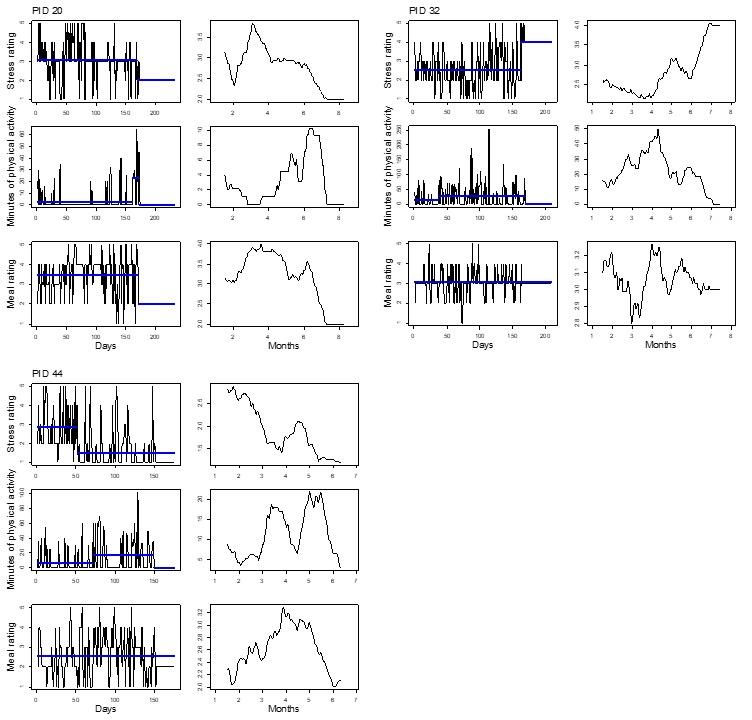
This paper aims to illustrate how individuals' daily reports of stress and health behavior (time series) can be explored using visualization tools.
METHODS
Secondary analysis was conducted on 6 months of daily diary reports of stress and health behavior (physical activity and diet quality) from mostly ethnic minority mothers who pilot-tested a self-monitoring mobile health app. Time series with minimal missing data from 14 of the 44 mothers were analyzed. Correlations between stress and health behavior within each time series were reported as a preliminary step. Stress and health behavior time series patterns were visualized by plotting moving averages and time points where mean shifts in the data occurred (changepoints).
RESULTS
Median correlation was small and negative for associations of stress with physical activity (r=-.14) and diet quality (r=-.08). Moving averages and changepoints for stress and health behavior were aligned for some participants but not for others. A third subset of participants exhibited little variation in stress and health behavior reports.
CONCLUSIONS
Median correlations in this study corroborate prior findings. In addition, time series visualizations highlighted variations in stress and health behavior across individuals and time points, which are difficult to capture through correlations and regression-based summary measures.
背景
通过日常日记数据报告的健康行为模式对于在单病例试验及相关研究设计中理解个体层面的情况并进行干预很重要。人们常常对多种结果之间的关系感兴趣,比如压力与健康行为之间的关系。然而,分析通常使用评估个体总体效应的回归方法,且标准分析针对单一结果。
目的
本文旨在说明如何使用可视化工具探索个体关于压力和健康行为的每日报告(时间序列)。
方法
对主要为少数族裔母亲的压力和健康行为(身体活动和饮食质量)的6个月日常日记报告进行二次分析,这些母亲对一款自我监测移动健康应用程序进行了试点测试。分析了44位母亲中14位缺失数据最少的时间序列。作为初步步骤,报告了每个时间序列中压力与健康行为之间的相关性。通过绘制移动平均值和数据发生均值变化的时间点(变化点)来可视化压力和健康行为的时间序列模式。
结果
压力与身体活动(r = -0.14)和饮食质量(r = -0.08)之间关联的中位数相关性较小且为负。部分参与者的压力和健康行为的移动平均值与变化点是一致的,但其他参与者并非如此。第三组参与者在压力和健康行为报告方面几乎没有变化。
结论
本研究中的中位数相关性证实了先前的研究结果。此外,时间序列可视化突出了个体间以及不同时间点上压力和健康行为的差异,而这些差异难以通过相关性和基于回归的汇总指标来捕捉。



 Zotero 插件