Singh Shivani, Vandana Kharidi Laxman
Department of Periodontics, College of Dental Sciences, Davangere, Karnataka, India.
J Indian Soc Periodontol. 2019 Jan-Feb;23(1):35-41. doi: 10.4103/jisp.jisp_332_18.
In the present era, demand of beauty and esthetics has increased rapidly. Interdental papilla construction, especially in the esthetic zone, is one of the most challenging tasks. Interdental papilla loss might occur due to several reasons as a consequence of periodontal surgery, trauma, and others.
The present study was aimed to prepare economically feasible injectable form of hyaluronic acid (HA) gel in three different concentrations - 1%, 2%, and 5% HA to evaluate its efficacy in the enhancement of deficient interdental papilla (IDP).
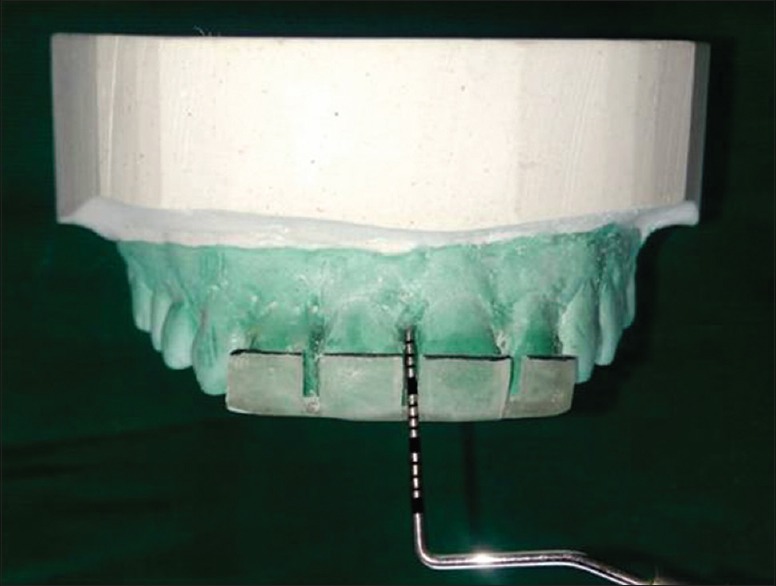
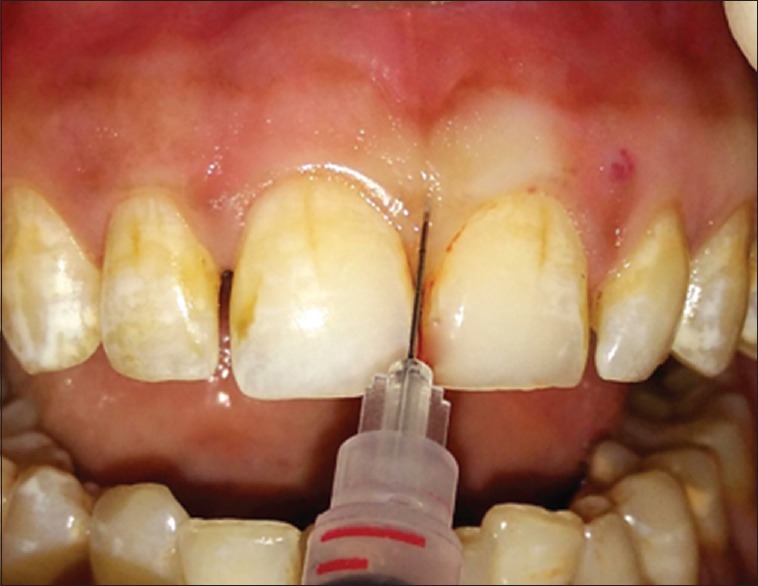
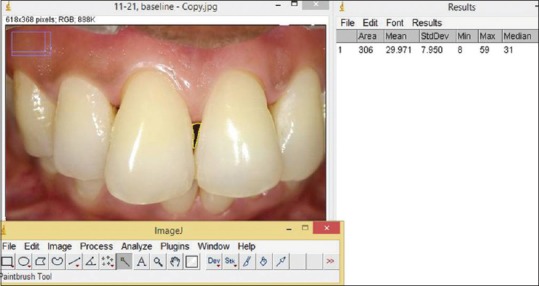
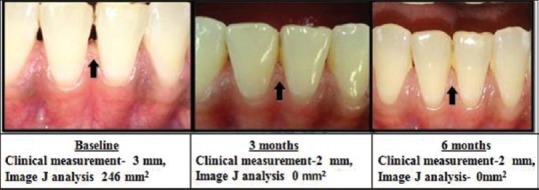
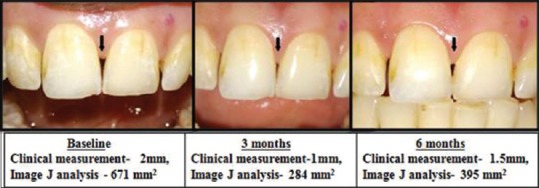
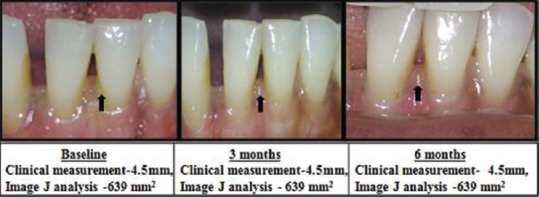
A total of 42 sites (mean age range was 29.6-30.6 years) was categorized into three groups; 1% HA group (16 sites), 2% HA group (14 sites), and 5% HA group (12 sites). Total 35 sites were followed up out of 42 in which 2% HA group included only 7 sites. Both maxillary (17 sites) and mandibular (18 sites) sites were included in this study. HA was injected at 2 mm apical to papillary tip at weekly interval for 3 weeks. The IDP augmentation was measured using UNC-15 probe and modified stent at 1, 3, and 6 months. The photographic analysis was done using Image J software.
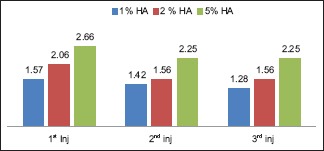
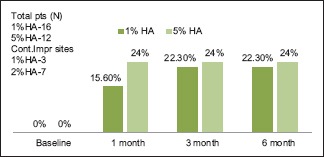
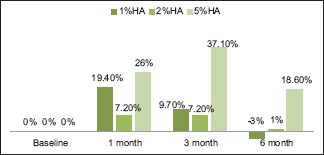
On clinical measurement, 5% of HA showed highly significant enhancement ( = 0.001) of 19.2%, 20.6% 18.2% at 1, 3, and 6 months, respectively. On photographic analysis, 5% of HA showed 41%, 42.9%, and 39.8% at 1, 3, and 6 months, respectively. However, intergroup comparison showed nonsignificant improvement.
This study results suggest that the use of 5% of HA is effective for interdental deficiency treatment with minimal rebound at the end of 6 months. The modified stent for IDP measurement used in this study for the first time in the literature is highly recommended. The photographic analysis using image J Analyzer serves a useful and dependable tool. Further, long-term clinical studies would throw more insight in this regard.
在当今时代,对美丽和美学的需求迅速增长。牙间乳头重建,尤其是在美学区域,是最具挑战性的任务之一。牙间乳头丧失可能由于牙周手术、创伤等多种原因而发生。
本研究旨在制备三种不同浓度(1%、2%和5%)的经济可行的透明质酸(HA)凝胶注射剂,以评估其在增强缺牙间乳头(IDP)方面的疗效。
总共42个部位(平均年龄范围为29.6 - 30.6岁)被分为三组;1% HA组(16个部位)、2% HA组(14个部位)和5% HA组(12个部位)。42个部位中共有35个部位进行了随访,其中2% HA组仅包括7个部位。本研究包括上颌(17个部位)和下颌(18个部位)的部位。HA在牙乳头尖端根尖2mm处每周注射一次,共注射3周。在1、3和6个月时使用UNC - 15探针和改良支架测量IDP增大情况。使用Image J软件进行摄影分析。
临床测量显示,5%的HA在1、3和6个月时分别有19.2%、20.6%、18.2%的高度显著增强(P = 0.001)。摄影分析显示,5%的HA在1、3和6个月时分别为41%、42.9%和39.8%。然而,组间比较显示改善不显著。
本研究结果表明,使用5%的HA对牙间缺损治疗有效,在6个月末反弹最小。强烈推荐本研究首次在文献中使用的用于IDP测量改良支架。使用Image J分析仪进行摄影分析是一种有用且可靠的工具。此外,长期临床研究将在这方面提供更多见解。