Liu Yang, Li Yue, Bai Yun-Peng, Fan Xiao-Xi
Department of Thoracic Surgery, The First Affiliated Hospital of China Medical University, Shenyang, China.
Front Oncol. 2019 Jan 22;9:5. doi: 10.3389/fonc.2019.00005. eCollection 2019.
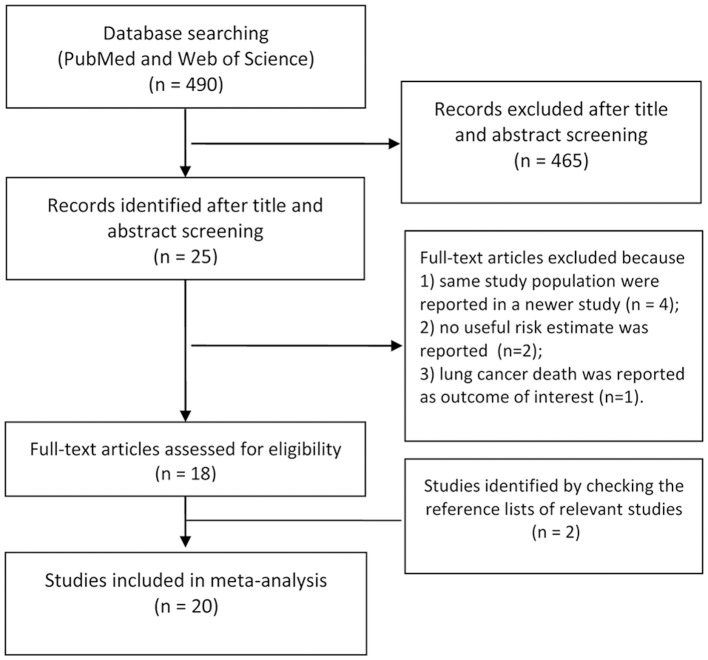
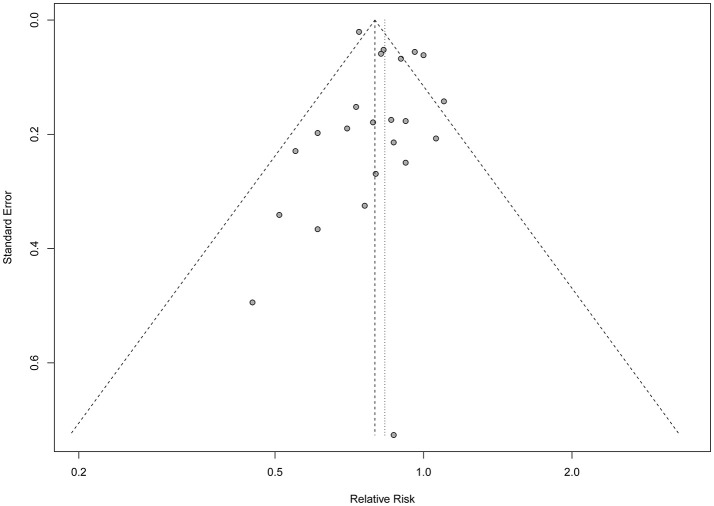
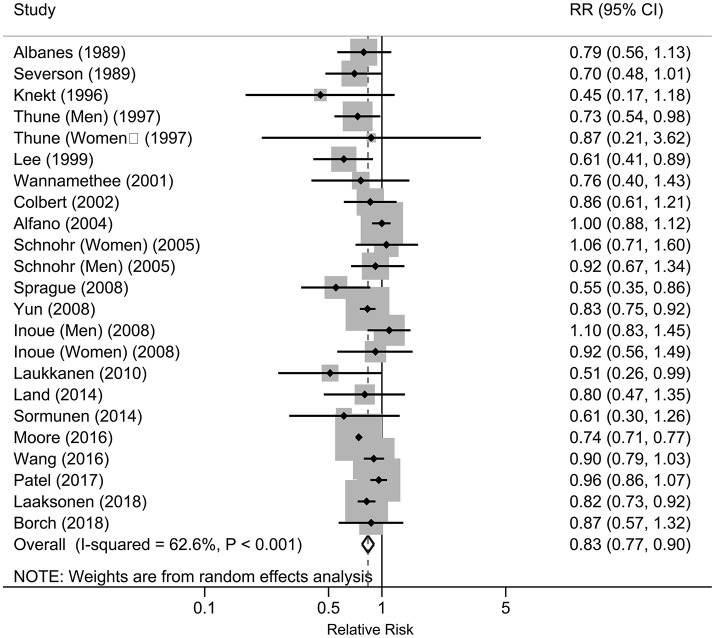
Epidemiological evidences regarding the association between physical activity and the risk of lung cancer are still controversial. We aimed to investigate the relationship between physical activity and risk of lung cancer in men and women, as well as other high-risk populations such as cigarette smokers. We conducted a meta-analysis of cohort studies to evaluate the association between physical activity and risk of lung cancer. Relevant studies were identified by searching PubMed and Web of Knowledge through August 2018. Study-specific relative risk (RR) with 95% confidence interval (CI) were pooled using random effect model when significant heterogeneity was detected. Twenty cohort studies with a total of 2,965,811 participants and 31,807 lung cancer cases were included. There was an inverse association between the physical activity and risk of lung cancer. Compared with the low level of physical activity, the pooled RR was 0.83 (95%CI: 0.77, 0.90), with significant heterogeneity ( = 62.6%, < 0.001). The corresponding pooled RRs were 0.90 (95%CI: 0.82, 0.99) for women and 0.81 (95%CI: 0.73, 0.90) for men. Smokers with a high level of physical activity were associated with a 10% lower risk for lung cancer (RR = 0.90, 95% CI: 0.84, 0.97), while the association was not significant among non-smokers (RR = 0.95, 95% CI: 0.88, 1.03). Subgroups analysis stratified by whether the studies adjusted for smoking intensity and durations yielded the same magnitude of RR. However, the RR for subgroups without adjustment for dietary factors was 0.74 (95%CI: 0.71, 0.77), which was significantly lower than that with dietary factors adjusted (RR = 0.89, 95%CI: 0.84, 0.95). Increased physical activity might be associated with lower risk of lung cancer. Such inverse association was identified among smokers rather than non-smokers. Large interventional studies are expected to further verify these findings.
关于体育活动与肺癌风险之间关联的流行病学证据仍存在争议。我们旨在调查男性、女性以及其他高危人群(如吸烟者)的体育活动与肺癌风险之间的关系。我们对队列研究进行了荟萃分析,以评估体育活动与肺癌风险之间的关联。通过检索截至2018年8月的PubMed和Web of Knowledge来确定相关研究。当检测到显著异质性时,使用随机效应模型汇总研究特异性相对风险(RR)及其95%置信区间(CI)。纳入了20项队列研究,共有2,965,811名参与者和31,807例肺癌病例。体育活动与肺癌风险之间存在负相关。与低体育活动水平相比,汇总RR为0.83(95%CI:0.77, 0.90),存在显著异质性(I² = 62.6%,P < 0.001)。女性相应的汇总RR为0.90(95%CI:0.82, 0.99),男性为0.81(95%CI:0.73, 0.90)。体育活动水平高的吸烟者患肺癌的风险降低10%(RR = 0.90,95%CI:0.84, 0.97),而非吸烟者之间的关联不显著(RR = 0.95,95%CI:0.88, 1.03)。按研究是否调整吸烟强度和持续时间分层的亚组分析得出了相同幅度的RR。然而,未调整饮食因素的亚组的RR为0.74(95%CI:0.71, 0.77),显著低于调整了饮食因素的亚组(RR = 0.89,95%CI:0.84, 0.95)。增加体育活动可能与较低的肺癌风险相关。这种负相关在吸烟者而非非吸烟者中得到证实。大型干预性研究有望进一步验证这些发现。