Environmental Health Division, Seoul Metropolitan Government, Seoul, Korea.
Epidemiol Health. 2018;40:e2018056. doi: 10.4178/epih.e2018056. Epub 2018 Nov 13.
Water-borne diseases caused by Vibrio parahemolyticus are often known to cause gastritis when raw or undercooked seafood is eaten. It is very rare that Vibrio gastritis caused by ingesting non-seafood products occurs on a large scale. On September 19, 2017, a large-scale Vibrio gastritis occurred after the city residents consumed food at a bazaar held in a welfare center in Jungnang-gu, Seoul.
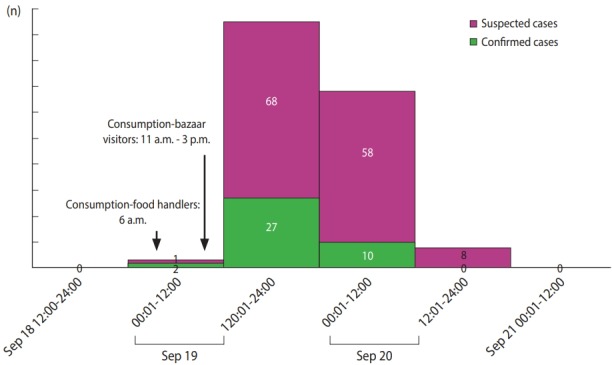
The total number of visitors was approximately 299, and 237 (79.3%) of them showed symptoms. Among those who showed symptoms, 116 (48.9%) consulted the hospital, and 53 (45.6%) were hospitalized. Among the 299 exposed individuals, 174 (58.1%) responded to this survey: 163 (93.6%) with and 11 (6.4%) without symptoms. This study was retrospectively conducted by investigating the exposed individuals. To investigate the spread of infection, medical staff of hospitals in the epidemic area were interviewed, exposed individuals surveyed, microbiological testing conducted, and ingredient handling and cooking processes investigated.
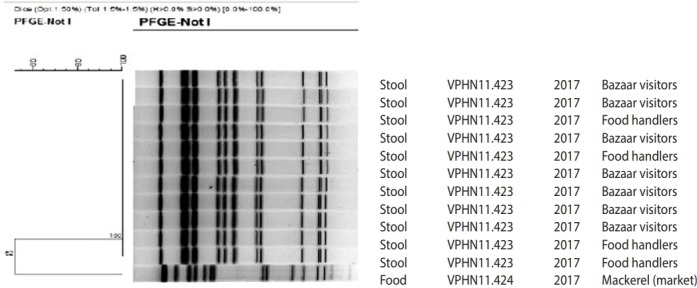
A total of 237 individuals, including 6 food handlers, were affected (prevalence, 79.2%). During the microbiological testing, V. parahemolyticus was found in 34 patients and 4 food handlers. In the consumption analysis, the relative risk of kimbap was 6.79 (confidence interval 1.10 to 41.69). In-depth investigation found that squid, an ingredient of Korean pancake, and egg sheets, an ingredient of kimbap, were prepared using the same cutting board and knife, which were thought to be the cause of cross-contamination that led to a large-scale outbreak of Vibrio gastritis.
A recent large-scale outbreak of Vibrio gastritis occurred due to the cross-contamination with kimbap during the preparation process of squid rather than the actual consumption of seafood. Thus, a more stringent hygiene management is necessary during the processing and management of food to prevent infections associated with V. parahemolyticus.
食用生的或未煮熟的海鲜时,副溶血性弧菌引起的水源性疾病通常会导致胃炎。因摄入非海鲜产品而引起的大规模副溶血性胃炎非常罕见。2017 年 9 月 19 日,首尔江西区福利中心举办的集市上,市民食用食物后,发生了大规模副溶血性胃炎疫情。
共有约 299 名访客,其中 237 名(79.3%)出现症状。出现症状者中有 116 人(48.9%)就医,53 人(45.6%)住院。在 299 名暴露者中,174 人(58.1%)对此次调查做出了回应:163 人(93.6%)有症状,11 人(6.4%)无症状。本研究通过对暴露者进行回顾性调查来开展。为了调查感染的传播情况,对疫区医院的医务人员进行了访谈,对暴露者进行了调查,进行了微生物检测,并对食材处理和烹饪过程进行了调查。
共有 237 人(包括 6 名食品处理人员)受影响(发生率为 79.2%)。在微生物检测中,在 34 名患者和 4 名食品处理人员中发现了副溶血性弧菌。在消费分析中,紫菜包饭的相对风险为 6.79(95%置信区间 1.10 至 41.69)。深入调查发现,韩国煎饼的一种食材鱿鱼和紫菜包饭的一种食材鸡蛋饼是用同一块砧板和刀准备的,这被认为是导致交叉污染的原因,导致了大规模副溶血性胃炎的爆发。
最近一起大规模副溶血性胃炎疫情是由于在准备鱿鱼的过程中与紫菜包饭发生交叉污染,而不是实际食用海鲜所致。因此,在处理和管理食品时,需要更严格的卫生管理,以防止与副溶血性弧菌相关的感染。