Zhu Yun, Cao Xuehong, Zhang Xiaomeng, Chen Quan, Wen Lei, Wang Ping
Department of Otorhinolaryngology, Union Hospital, Tongji Medical College, Huazhong University of Science and Technology, Wuhan, Hubei 430022, China.
Department of Traditional Chinese Medicine, Medical College, Xiamen University, Xiamen, Fujian Province 361102, China.
Cancer Manag Res. 2019 Feb 12;11:1383-1390. doi: 10.2147/CMAR.S188415. eCollection 2019.
To study the prognostic value of KL) and its promoter DNA methylation in head and neck squamous cell carcinoma (HNSCC) and to assess their associations with the autophagy gene LC3 and the RNA transferase gene NSUN2.
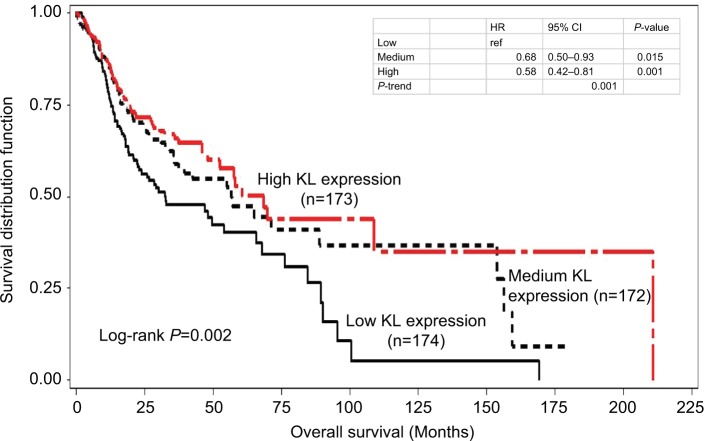
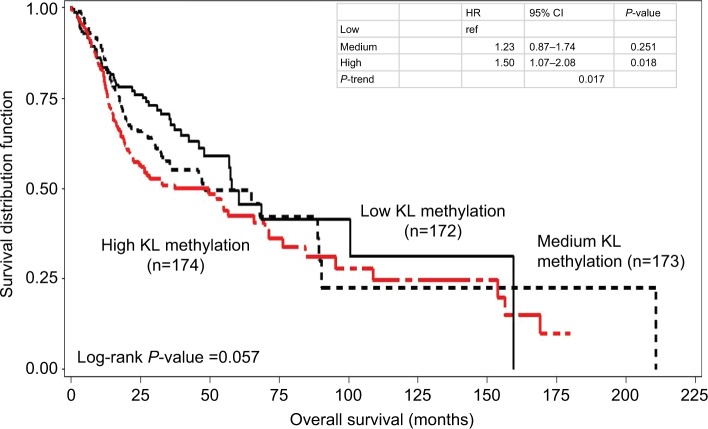
Upper quartile normalized RNA-seq V2 RSEM values of KL mRNA and beta value for KL methylation were retrieved from The Cancer Genome Atlas HNSCC dataset. Kaplan-Meier survival curves were used to assess the associations of KL expression and methylation with patient survival; multivariate Cox proportional hazards regression models were used to estimate the HRs and their 95% CIs.
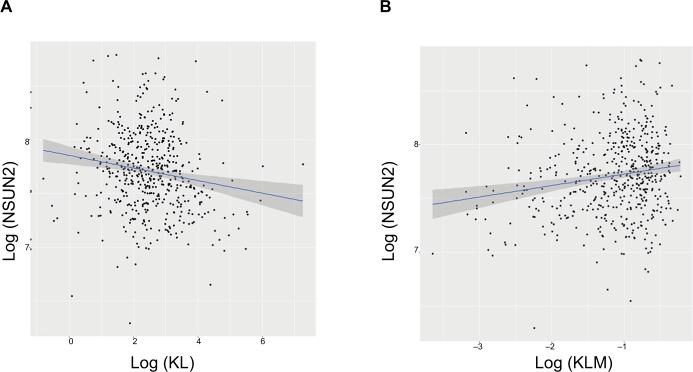
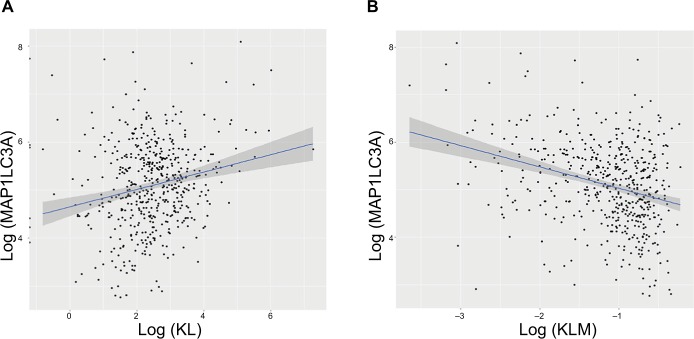
There is a negative relationship between KL gene expression and its promoter DNA methylation in HNSCC. KL gene expression was positively correlated with overall survival, while KL methylation was inversely correlated with the overall survival of HNSCC patients. Furthermore, KL methylation was significantly associated with gender (=0.012), tumor grade (=0.0009) and tumor site (<0.0001). Finally, HNSCC patients with high KL gene expression or low KL DNA methylation had high LC3 but low NSUN2.
KL methylation silenced its gene expression in HNSCC. Low KL expression and high KL methylation can be potential biomarkers for worse prognosis in HNSCC. As the downstream targets, and could be responsible for the KL expression in HNSCC.
研究KL及其启动子DNA甲基化在头颈部鳞状细胞癌(HNSCC)中的预后价值,并评估它们与自噬基因LC3和RNA转移酶基因NSUN2的相关性。
从癌症基因组图谱HNSCC数据集中检索KL mRNA的上四分位数标准化RNA测序V2 RSEM值和KL甲基化的β值。采用Kaplan-Meier生存曲线评估KL表达和甲基化与患者生存的相关性;使用多变量Cox比例风险回归模型估计风险比(HRs)及其95%置信区间(CIs)。
在HNSCC中,KL基因表达与其启动子DNA甲基化之间存在负相关关系。KL基因表达与总生存期呈正相关,而KL甲基化与HNSCC患者的总生存期呈负相关。此外,KL甲基化与性别(P = 0.012)、肿瘤分级(P = 0.0009)和肿瘤部位(P < 0.0001)显著相关。最后,KL基因高表达或KL DNA低甲基化的HNSCC患者具有高LC3但低NSUN2。
在HNSCC中,KL甲基化使其基因表达沉默。低KL表达和高KL甲基化可能是HNSCC预后较差的潜在生物标志物。作为下游靶点,LC3和NSUN2可能与HNSCC中KL的表达有关。