Department of Clinical Chemistry and Informatics, Graduate School of Pharmaceutical Sciences, Kumamoto University, 5-1 Oe-honmachi, Chuo-ku, Kumamoto, Japan.
Kagoshima Pharmaceutical Association, 2-8-15 Yojiro, Kagoshima, Japan.
PLoS One. 2019 Mar 20;14(3):e0213763. doi: 10.1371/journal.pone.0213763. eCollection 2019.
Patients with chronic kidney disease (CKD) depend on advice from healthcare professionals to avoid using unsuitable over-the-counter (OTC) drugs. Recently, qualified, registered nonpharmacist salespersons became licensed to sell OTC drugs in Japan. However, registered salespersons' knowledge and awareness of precautions regarding unsuitable OTC drugs for use in patients with CKD are unclear.
This study aimed to clarify the awareness, knowledge, and implementation of precautions by registered salespersons regarding OTC drugs used by patients with CKD. Additionally, we evaluated the change of registered salespersons' knowledge and awareness of this topic generated by a pharmacist intervention.
A questionnaire survey and pharmacist intervention were applied to 175 registered salespersons. The intervention comprised a 50-minute lecture imparted by a pharmacist who was trained in nephrology. The knowledge, awareness, and implementation of precautions by participants with respect to nonsteroidal anti-inflammatory drugs (NSAIDs) and antacids were evaluated before and after the intervention.
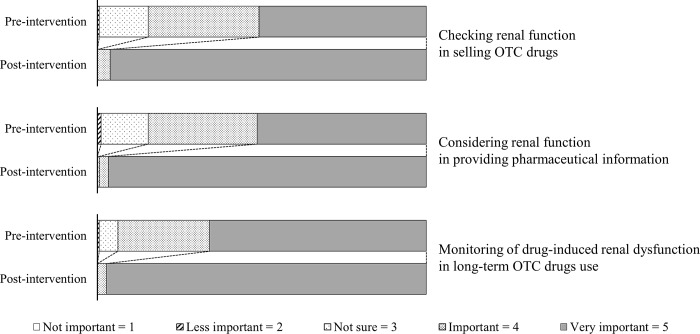
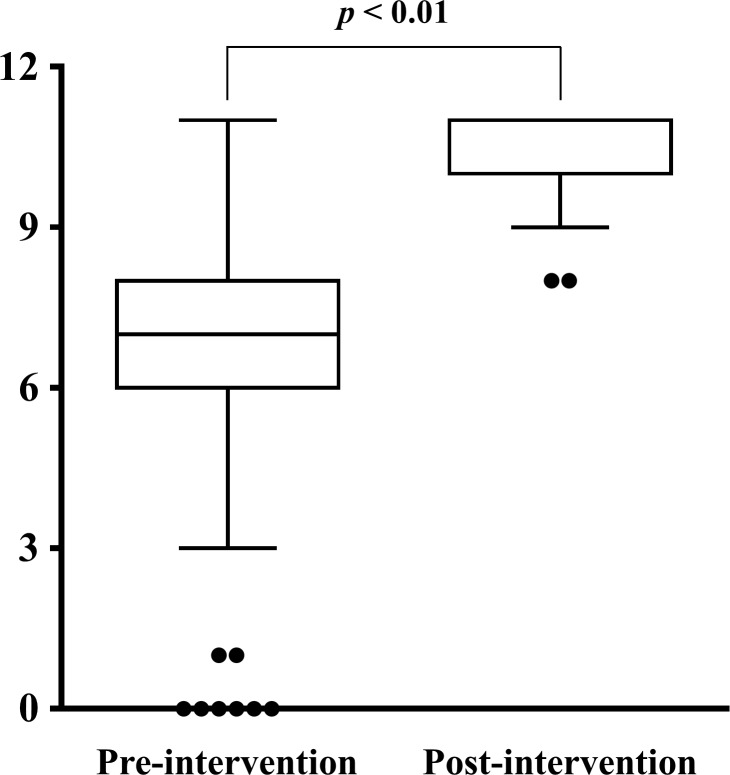
Approximately half of the registered salespersons reported previous experience with selling OTC drugs that were inappropriate for patients with CKD (NSAIDs, 48.0%; antacids, 39.7%). Few participants recognized the need to check renal function when selling those drugs to such patients (NSAIDs, 25.7%; antacids, 47.5%). The registered salespersons' awareness and knowledge were significantly higher after the intervention than before it.
The results indicate that before the intervention, the registered salespersons had low levels of awareness and knowledge regarding OTC drug use in patients with CKD despite having prior experience selling unsuitable OTC drugs. However, the pharmacist intervention improved the registered salespersons' awareness and knowledge. The educational program for registered salespersons might be necessary to prevent inappropriate OTC drug use by patients with CKD.
患有慢性肾脏病(CKD)的患者依赖于医护人员的建议,以避免使用不合适的非处方(OTC)药物。最近,合格的、注册的非药师销售人员获得了在日本销售 OTC 药物的许可。然而,注册销售人员对 CKD 患者使用不合适的 OTC 药物的注意事项的了解和认识尚不清楚。
本研究旨在阐明注册销售人员对 CKD 患者使用的 OTC 药物的认识、知识和注意事项的执行情况。此外,我们评估了药剂师干预对注册销售人员对这一主题的知识和认识的变化。
对 175 名注册销售人员进行了问卷调查和药剂师干预。干预措施包括由接受过肾脏病培训的药剂师进行的 50 分钟讲座。在干预前后,评估了参与者对非甾体抗炎药(NSAIDs)和抗酸剂的知识、认识和注意事项。
约一半的注册销售人员报告有销售不适合 CKD 患者的 OTC 药物的经验(NSAIDs,48.0%;抗酸剂,39.7%)。很少有参与者认识到在向这些患者销售这些药物时需要检查肾功能(NSAIDs,25.7%;抗酸剂,47.5%)。与干预前相比,干预后注册销售人员的意识和知识显著提高。
结果表明,在干预前,尽管有销售不合适的 OTC 药物的经验,但注册销售人员对 CKD 患者使用 OTC 药物的认识和知识水平较低。然而,药剂师干预提高了注册销售人员的意识和知识。对注册销售人员进行教育计划可能是预防 CKD 患者不适当使用 OTC 药物的必要措施。