Department of Earth Sciences, Carleton University, Ottawa, ON, Canada.
Department of Biology, University of Toronto at Mississauga, Mississauga, ON, Canada.
PLoS One. 2019 Mar 22;14(3):e0213694. doi: 10.1371/journal.pone.0213694. eCollection 2019.
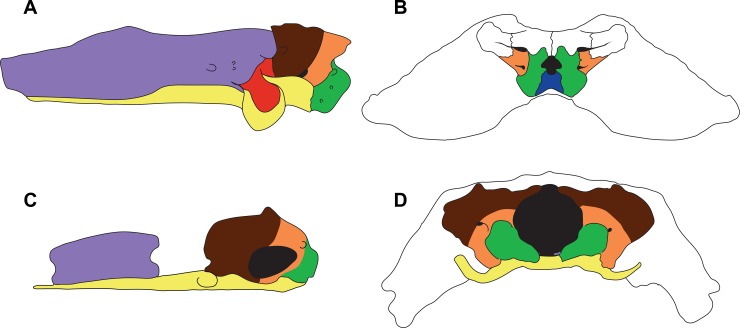
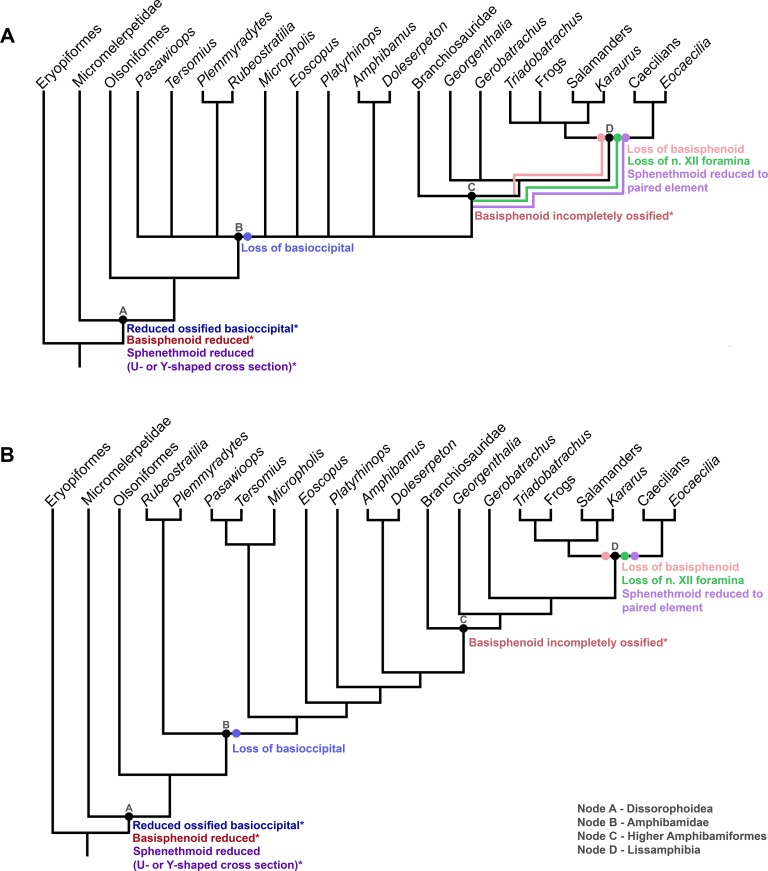
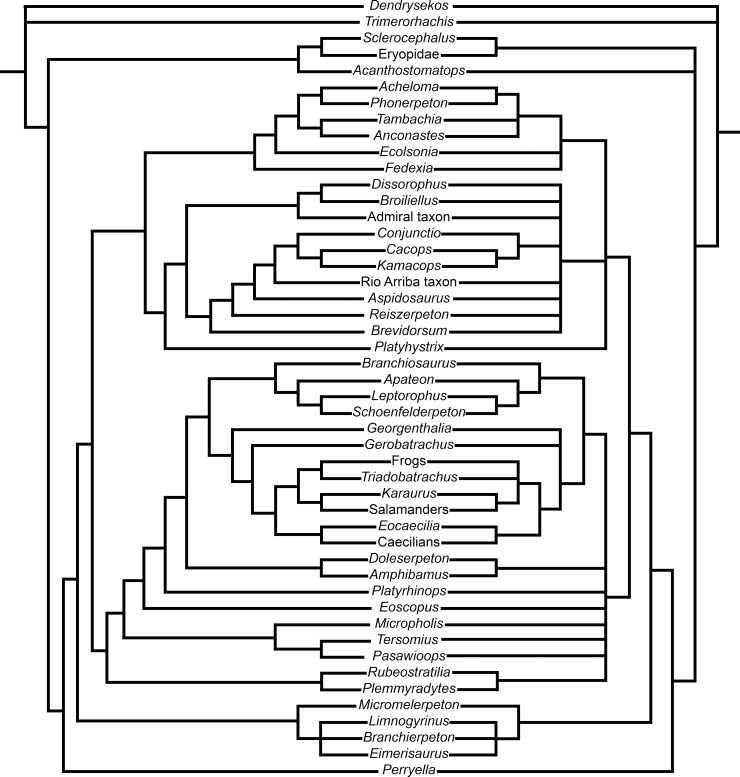
Dissorophoidea, a group of temnospondyl tetrapods that first appear in the Late Carboniferous, is made up of two clades ⎼ Olsoniformes and Amphibamiformes (Branchiosauridae and Amphibamidae) ⎼ the latter of which is widely thought to have given rise to living amphibians (i.e., Lissamphibia). The lissamphibian braincase has a highly derived morphology with several secondarily lost elements; however, these losses have never been incorporated into phylogenetic analyses and thus the timing and nature of these evolutionary events remain unknown. Hindering research into this problem has been the lack of phylogenetic analyses of Dissorophoidea that includes both taxonomically dense sampling and specific characters to document changes in the braincase in the lineage leading to Lissamphibia. Here we build on a recent, broadly sampled dissorophoid phylogenetic analysis to visualize key events in the evolution of the lissamphibian braincase. Our ancestral character state reconstructions show a clear, step-wise trend towards reduction of braincase ossification leading to lissamphibians, including reduction of the sphenethmoid, loss of the basioccipital at the Amphibamiformes node, and further loss of both the basisphenoid and the hypoglossal nerve foramina at the Lissamphibia node. Our analysis confirms that the highly derived condition of the lissamphibian braincase is characterized by overall simplification in terms of the number and extent of chondrocranial ossifications.
Dissorophoidea 是一类出现于晚石炭世的合弓类四足动物,由两个演化支组成——Olsoniformes 和 Amphibamiformes(包含 Branhiosauridae 和 Amphibamidae)——后者被广泛认为是现代两栖动物(即有尾目)的祖先。有尾目动物的脑颅具有高度衍生的形态,有几个元素是次生丢失的;然而,这些缺失从未被纳入系统发育分析中,因此这些进化事件的时间和性质仍然未知。阻碍对这一问题研究的是,缺乏包括分类密集采样和特定特征在内的 Dissorophoidea 系统发育分析,这些特征可以记录在通向有尾目动物的谱系中脑颅的变化。在这里,我们在最近的广泛采样的 dissorophoid 系统发育分析的基础上,可视化了有尾目动物脑颅进化中的关键事件。我们的祖先特征状态重建显示,朝着导致有尾目动物的脑颅骨化程度降低的方向有一个清晰的、逐步的趋势,包括 sphenethmoid 的减少、在 Amphibamiformes 节点处的 basioccipital 的丢失,以及在 Lissamphibia 节点处进一步丢失 basisphenoid 和 hypoglossal nerve foramina。我们的分析证实,有尾目动物脑颅的高度衍生状态的特征是在软骨颅骨骨化的数量和程度上总体简化。