
厄瓜多尔中部蛋鸡养殖场分离出的[具体内容缺失]的存在与多样性。
Presence and diversity of isolated from layer farms in central Ecuador.
作者信息
Salazar Gabriela A, Guerrero-López Ricardo, Lalaleo Liliana, Avilés-Esquivel Diana, Vinueza-Burgos Christian, Calero-Cáceres William
机构信息
UTA RAM OneHealth Group, Faculty of Agricultural Sciences, Universidad Técnica de Ambato, Cevallos, Ecuador.
Facultad de Medicina Veterinaria y Zootecnia, Universidad Central del Ecuador, Quito, Ecuador.
出版信息
F1000Res. 2019 Feb 28;8:235. doi: 10.12688/f1000research.18233.2. eCollection 2019.
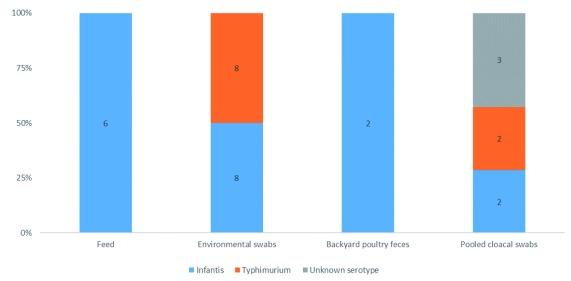
Given the considerable role played by in the incidence of food contamination, around the world, surveillance of this infection is prioritized by both food producers and health care authorities. Data remains insufficient concerning the prevalence of in poultry systems in Ecuador and in Latin America in general. In this study, we evaluated the presence and diversity of serovars in samples taken from 21 layer farms and backyard layers in central Ecuador during August-November 2017. was isolated following standardized methods (ISO 6579) and the serovar determination was carried out by PCR. A significant presence of was detected in the 21 farms evaluated, with a frequency of 76% (95% confidence interval (CI): 53-92) in environmental surfaces, 33% (95%CI: 15-57) in pooled cloacal swabs from layer hens, 33% (95% CI: 13-59) on feed samples, and 10% (95%CI: 1-30) in backyard layer feces from traditional local markets. The dominant serovars detected were Infantis and Typhimurium. This study forms a basis for further surveillance of serovars in layer farms in central Ecuador.
鉴于[病原体名称]在食物污染发生率中所起的重要作用,在全球范围内,食品生产商和卫生保健当局都将对这种感染的监测列为优先事项。关于厄瓜多尔以及整个拉丁美洲家禽养殖系统中[病原体名称]的流行情况,数据仍然不足。在本研究中,我们评估了2017年8月至11月期间从厄瓜多尔中部21个蛋鸡养殖场和庭院蛋鸡采集的样本中[病原体名称]血清型的存在情况和多样性。按照标准化方法(ISO 6579)分离[病原体名称],并通过PCR进行血清型测定。在所评估的21个养殖场中检测到大量[病原体名称],在环境表面的检出频率为76%(95%置信区间(CI):53 - 92),蛋鸡泄殖腔混合拭子中的检出频率为33%(95%CI:15 - 57),饲料样本中的检出频率为33%(95%CI:13 - 59),传统当地市场庭院蛋鸡粪便中的检出频率为10%(95%CI:1 - 30)。检测到的主要血清型为婴儿沙门氏菌和鼠伤寒沙门氏菌。本研究为进一步监测厄瓜多尔中部蛋鸡养殖场中的[病原体名称]血清型奠定了基础。
 Zotero 插件