
慢性肾脏病中医疗警报配件的使用:一项试点研究。
Use of a Medical-Alert Accessory in CKD: A Pilot Study.
作者信息
Farhy Eli, Diamantidis Clarissa Jonas, Doerfler Rebecca M, Fink Wanda J, Zhan Min, Fink Jeffrey C
机构信息
Departments of Medicine and.
Divisions of General Internal Medicine and.
出版信息
Clin J Am Soc Nephrol. 2019 Jul 5;14(7):994-1001. doi: 10.2215/CJN.13531118. Epub 2019 Jun 6.
BACKGROUND AND OBJECTIVES
Poor disease recognition may jeopardize the safety of CKD care. We examined safety events and outcomes in patients with CKD piloting a medical-alert accessory intended to improve disease recognition and an observational subcohort from the same population.
DESIGN, SETTING, PARTICIPANTS, & MEASUREMENTS: We recruited 350 patients with stage 2-5 predialysis CKD. The first (pilot) 108 participants were given a medical-alert accessory (bracelet or necklace) indicating the diagnosis of CKD and displaying a website with safe CKD practices. The subsequent (observation) subcohort (=242) received usual care. All participants underwent annual visits with ascertainment of patient-reported events (class 1) and actionable safety findings (class 2). Secondary outcomes included 50% GFR reduction, ESKD, and death. Cox proportional hazards assessed the association of the medical-alert accessory with outcomes.
RESULTS
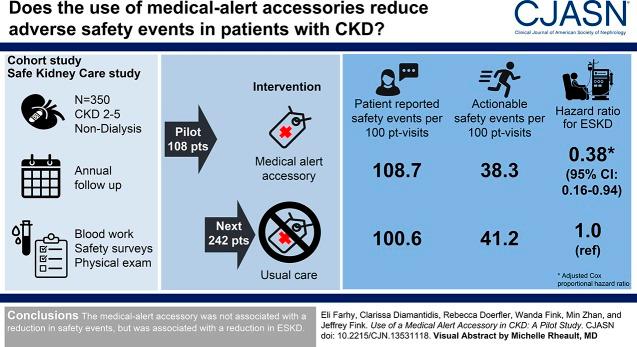
Median follow-up of pilot and observation subcohorts were 52 (interquartile range, 44-63) and 37 (interquartile range, 27-47) months, respectively. The frequency of class 1 and class 2 safety events reported at annual visits was not different in the pilot versus observation group, with 108.7 and 100.6 events per 100 patient-visits (=0.13), and 38.3 events and 41.2 events per 100 patient visits (=0.23), respectively. The medical-alert accessory was associated with lower crude and adjusted rate of ESKD versus the observation group (hazard ratio, 0.42; 95% confidence interval, 0.20 to 0.89; and hazard ratio, 0.38; 95% confidence interval, 0.16 to 0.94, respectively). The association of the medical-alert accessory with the composite endpoint of ESKD or 50% reduction GFR was variable over time but appeared to have an early benefit (up to 23 months) with its use. There was no significant difference in incidence of hospitalization, death, or a composite of all outcomes between medical-alert accessory users and the observational group.
CONCLUSIONS
The medical-alert accessory was not associated with incidence of safety events but was associated with a lower rate of ESKD relative to usual care.
背景与目的
对疾病认识不足可能会危及慢性肾脏病(CKD)护理的安全性。我们对使用旨在提高疾病认知度的医疗警示配件的CKD患者以及来自同一人群的观察性子队列的安全事件和结局进行了研究。
设计、地点、参与者及测量方法:我们招募了350例2 - 5期透析前CKD患者。前108名(试点)参与者获得了一个医疗警示配件(手镯或项链),该配件标明CKD诊断并展示一个包含CKD安全措施的网站。随后的(观察)子队列(n = 242)接受常规护理。所有参与者每年接受一次随访,确定患者报告的事件(1类)和可采取行动的安全发现(2类)。次要结局包括肾小球滤过率(GFR)降低50%、终末期肾病(ESKD)和死亡。Cox比例风险模型评估医疗警示配件与结局之间的关联。
结果
试点子队列和观察性子队列的中位随访时间分别为52个月(四分位间距,44 - 63个月)和37个月(四分位间距,27 - 47个月)。在年度随访中报告的1类和2类安全事件的发生率在试点组和观察组之间没有差异,每100次患者就诊分别为108.7次和100.6次事件(P = 0.13),以及每100次患者就诊分别为38.3次和41.2次事件(P = 0.23)。与观察组相比,医疗警示配件与ESKD的粗发生率和调整后发生率较低相关(风险比,0.42;95%置信区间,0.20至0.89;以及风险比,0.38;95%置信区间,0.16至0.94)。医疗警示配件与ESKD或GFR降低50%的复合终点之间的关联随时间变化,但使用该配件似乎有早期益处(长达23个月)。医疗警示配件使用者与观察组在住院率、死亡率或所有结局的综合发生率方面没有显著差异。
结论
医疗警示配件与安全事件的发生率无关,但与相对于常规护理较低的ESKD发生率相关。
 Zotero 插件