
巢的特征决定了巢内的小气候,并影响到一种南极海鸟——威尔逊氏暴风鹱的繁殖产量。
Nest characteristics determine nest microclimate and affect breeding output in an Antarctic seabird, the Wilson's storm-petrel.
机构信息
Institute for Biodiversity and Ecosystem Dynamics, University of Amsterdam, Amsterdam, The Netherlands.
Department of Vertebrate Ecology and Zoology, University of Gdańsk, Gdańsk, Poland.
出版信息
PLoS One. 2019 Jun 13;14(6):e0217708. doi: 10.1371/journal.pone.0217708. eCollection 2019.
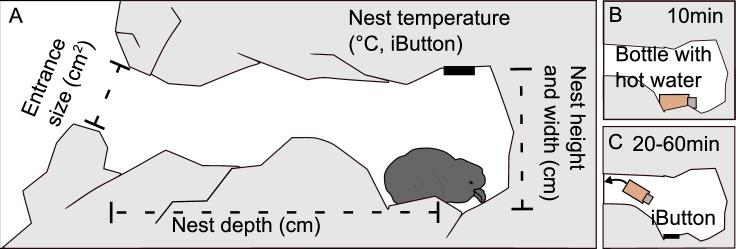
The importance of nest characteristics for birds breeding in the extreme climate conditions of polar regions, has been greatly understudied. Nest parameters, like nest orientation, exposure and insulation, could strongly influence microclimate and protection against precipitation of the nest, thereby affecting breeding success. A burrow nesting seabird, the Wilson's storm-petrel (Oceanites oceanicus) is an excellent model species to investigate the importance of nest characteristics, as it is the smallest endotherm breeding in the Antarctic. Here, we investigated the effects of nest parameters such as internal nest dimensions, nest micro-topography and thermal properties of the nest burrow and the influence of weather conditions on breeding output, measured as hatching success, chick survival, and chick growth. We collected data during the austral summers of 2017 and 2018, on King George Island, maritime Antarctica. Our results showed that the thermal microclimate of the nest burrow was significantly improved by a small entrance size, a low nest height, and insulation and tended to be enhanced by a low wind exposition index and an eastern nest site orientation. In addition, an eastern nest site orientation significantly reduced the chance of snow blocking. However, the relationships between nest characteristics and breeding output were complex and might be affected by other parameters like food availability and parental quality. The relation between chick growth and nest air temperature remained especially indistinct. Nevertheless, our results indicate that nest characteristics that enhance the thermal microclimate and reduce the risk of snow blocking favoured both hatching success and chick survival. Due to climate change in the Antarctic, snowfall is expected to increase in the future, which will likely enhance the importance of nest characteristics that determine snow blocking. Additionally, despite global warming, thermally favourable nest burrows will likely still be advantageous in the highly variable and challenging Antarctic climate.
在极地极端气候条件下繁殖的鸟类,其巢特征的重要性尚未得到充分研究。巢参数,如巢的方位、暴露程度和绝缘,可能会强烈影响巢内的小气候和对巢的保护,从而影响繁殖成功率。穴居海鸟威尔逊管鼻鹱(Oceanites oceanicus)是研究巢特征重要性的极佳模式物种,因为它是南极地区最小的恒温动物繁殖者。在这里,我们研究了巢参数(如内部巢尺寸、巢微地形和巢洞穴的热特性)的影响,以及天气条件对繁殖产出的影响,以孵化成功率、雏鸟存活率和雏鸟生长来衡量。我们于 2017 年和 2018 年的南极夏季在乔治王岛(King George Island)收集数据,南极洲的一个海岛。我们的结果表明,小的入口尺寸、低的巢高度、绝缘等可显著改善巢洞穴的热微气候,并趋向于通过低的风暴露指数和东部巢址方位来增强。此外,东部巢址方位显著降低了积雪堵塞的可能性。然而,巢特征与繁殖产出之间的关系是复杂的,可能受到其他参数的影响,如食物供应和亲鸟质量。雏鸟生长与巢内空气温度之间的关系尤其不明显。尽管如此,我们的研究结果表明,改善热微气候和降低积雪堵塞风险的巢特征有利于孵化成功率和雏鸟存活率。由于南极气候变化,预计未来降雪量将会增加,这可能会增加决定积雪堵塞的巢特征的重要性。此外,尽管全球变暖,但在南极高度变化和极具挑战性的气候条件下,热舒适的巢洞穴可能仍然具有优势。



 Zotero 插件