Hawash Yousry, Ismail Khadiga, Alsharif Khalaf, Alsanie Walaa
Clinical Laboratories Sciences Department, College of Applied Medical Science, Taif University, Taif, Saudi Arabia.
Parasitology Department, National Liver Institute, Menoufia University, Menoufia, Egypt.
Korean J Parasitol. 2019 Jun;57(3):233-242. doi: 10.3347/kjp.2019.57.3.233. Epub 2019 Jun 30.
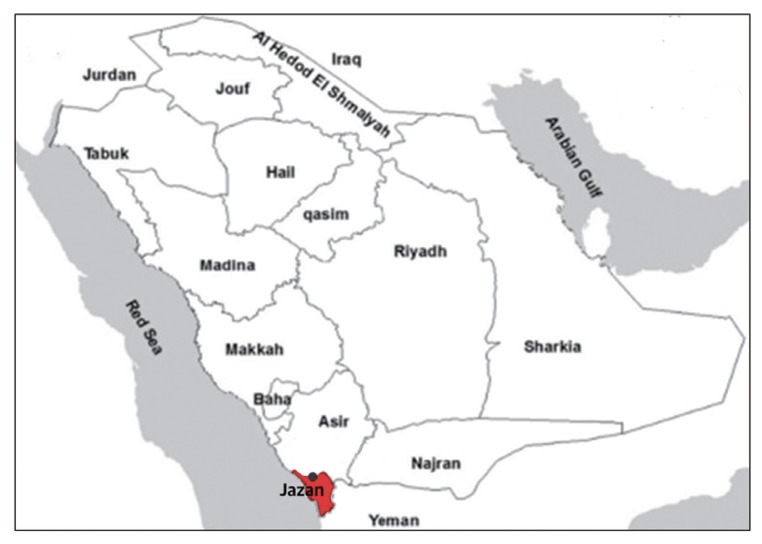
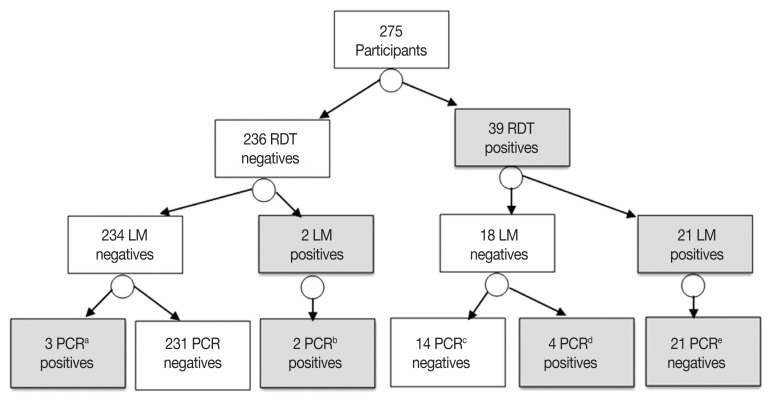
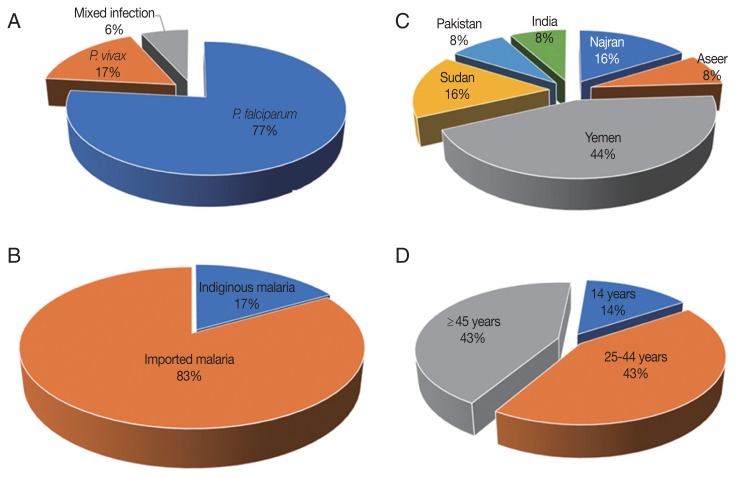
Detailed description of malaria in low transmission areas is crucial for elimination. The current study aimed to provide a comprehensive description for malaria transmission in Jazan, a low transmission district, southwestern Saudi Arabia. Patients at a tertiary care hospital were recruited in our study between August 2016 and September 2018. Malaria diagnosis was performed through a species-specific nested polymerase chain reaction (nested PCR), microscopy and Paramax-3TM rapid detection test (RDT). Malaria was detected in 30 patients by the PCR, with point prevalence of 10.9%. Of these malaria infections, 80% was imported, 26.6% was asymptomatic and 23.3% was sub-microscopic. Malaria was reported throughout the year, with February/March and September/October peaks. Infection was significantly more in males than in females (P=0.01). Likewise, infections were detected more in febrile than in non-febrile patients (P=0.01). Adult aged 15-24 years, fever and travel were identified as high-risk factors. Malaria was primarily attributed to Plasmodium falciparum mono-infections, followed by P. vivax mono-infections and lastly to falciparum/vivax mixed infections accounting 76.6%, 16.6%, and 6.6% of PCR-confirmed malaria cases, respectively. The nested PCR was superior to the smear microscopy (sensitivity 76.6%; specificity 100%) and the RDT (sensitivity 83.3%, specificity 94.2%). The overall percent agreement between microscopy and the RDT was 92.7% (kappa=0.63). High proportion of imported malaria including sub-microscopic and sub-patent cases were described. We suggest that incorporation of molecular tool into the conventional malaria diagnosis is beneficial in Jazan district.
详细描述低传播地区的疟疾情况对疟疾消除至关重要。本研究旨在全面描述沙特阿拉伯西南部低传播地区吉赞的疟疾传播情况。2016年8月至2018年9月期间,我们在一家三级护理医院招募了患者。通过种特异性巢式聚合酶链反应(巢式PCR)、显微镜检查和Paramax-3TM快速检测试验(RDT)进行疟疾诊断。通过PCR在30名患者中检测到疟疾,点患病率为10.9%。在这些疟疾感染中,80%为输入性,26.6%为无症状感染,23.3%为亚显微感染。全年均有疟疾报告,2月/3月和9月/10月出现高峰。男性感染明显多于女性(P=0.01)。同样,发热患者中的感染检出率高于非发热患者(P=0.01)。15-24岁的成年人、发热和旅行被确定为高危因素。疟疾主要归因于恶性疟原虫单一感染,其次是间日疟原虫单一感染,最后是恶性疟原虫/间日疟原虫混合感染,分别占PCR确诊疟疾病例的76.6%、16.6%和6.6%。巢式PCR优于涂片显微镜检查(敏感性76.6%;特异性100%)和RDT(敏感性83.3%,特异性94.2%)。显微镜检查和RDT之间的总体一致性百分比为92.7%(kappa=0.63)。描述了包括亚显微和亚临床病例在内的高比例输入性疟疾。我们建议在吉赞地区将分子工具纳入常规疟疾诊断是有益的。