Department of Ophthalmology, Queen's Medical Centre, Nottingham, NG7 2UH, UK.
Trials. 2019 Jul 16;20(1):437. doi: 10.1186/s13063-019-3523-0.
Amblyopia (lazy eye) affects the vision of approximately 2% of all children. Traditional treatment consists of wearing a patch over their 'good' eye for a number of hours daily, over several months. This treatment is unpopular and compliance is often low. Therefore, results can be poor. I-BiT is a system, based on stereo technology using shutter glasses, designed to treat amblyopia using dichoptic stimulation. This trial uses a redesigned system for home use and includes eye-tracking capability.
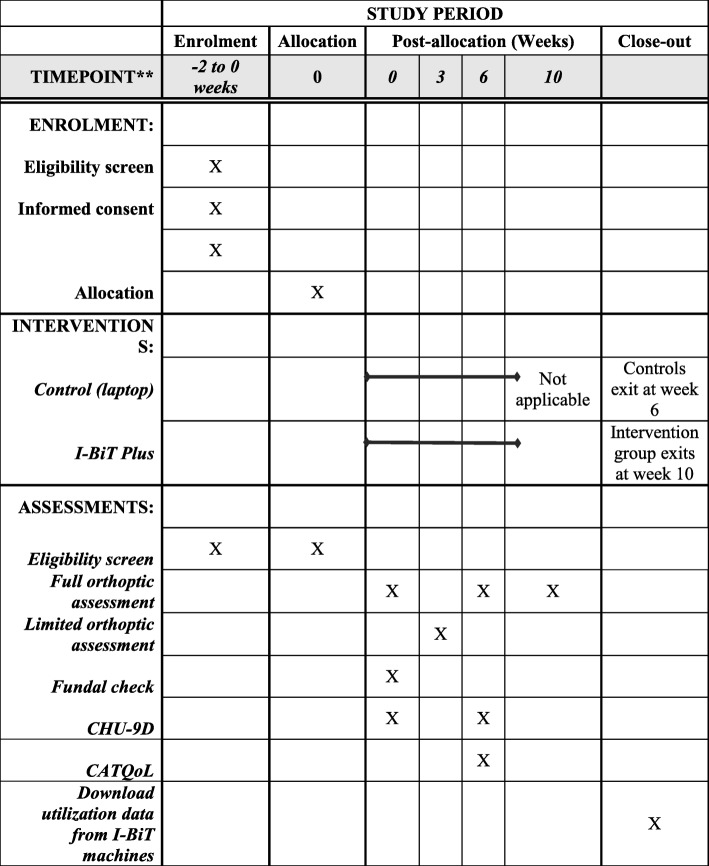
METHODS/DESIGN: This is a randomised controlled trial involving three groups of 40 patients each, aged between 3.5 and 12 years, with a diagnosis of (1) anisometropic amblyopia, (2) mixed or strabismic amblyopia prior to strabismic surgery and (3) mixed or strabismic amblyopia who have just undergone strabismus surgery. They will be randomised in a 1:1 ratio between I-BiT and control and will receive treatment, at home over a 6-week period. Their visual acuity will be assessed independently at baseline, mid-treatment (week 3), at the end of treatment (week 6) and, for those receiving the active I-BiT treatment, 4 weeks after completing treatment (week 10). The primary endpoint will be the change in visual acuity from baseline to the end of treatment. Secondary endpoints will be additional visual acuity measures, patient acceptability, compliance and the incidence of adverse events.
This is a randomised controlled trial using the redesigned I-BiT™ system to determine if this is a feasible treatment strategy for the management of anisometropic, strabismic and mixed amblyopia.
ISRCTN Number/Clinical trials.gov, ID: NCT02810847 . Registered on 23 June 2016.
弱视(懒眼)影响了大约 2%的所有儿童的视力。传统的治疗方法包括每天戴眼罩几个小时,持续几个月。这种治疗方法不受欢迎,依从性往往很低。因此,结果可能很差。I-BiT 是一种基于立体技术使用快门眼镜的系统,旨在通过双眼刺激治疗弱视。本试验使用重新设计的家庭使用系统,并包括眼球追踪功能。
方法/设计:这是一项随机对照试验,涉及三组各 40 名年龄在 3.5 至 12 岁之间的患者,诊断为(1)屈光不正性弱视、(2)斜视手术前的混合或斜视性弱视、(3)刚刚接受斜视手术的混合或斜视性弱视。他们将以 1:1 的比例随机分为 I-BiT 和对照组,并在家中接受为期 6 周的治疗。他们的视力将在基线、治疗中期(第 3 周)、治疗结束时(第 6 周)进行独立评估,对于接受主动 I-BiT 治疗的患者,在治疗结束后 4 周(第 10 周)进行评估。主要终点是从基线到治疗结束时视力的变化。次要终点是额外的视力测量、患者可接受性、依从性和不良事件的发生率。
这是一项使用重新设计的 I-BiT™系统的随机对照试验,以确定这是否是管理屈光不正性、斜视性和混合性弱视的一种可行的治疗策略。
ISRCTN 号码/临床试验.gov,编号:NCT02810847。于 2016 年 6 月 23 日注册。