Carvalho Genival Barbosa de, Giraldo Lina Restrepo, Lira Renan Bezerra, Macambira Isabela Bergh Martins, Tapia Marcel Adalid, Kohler Hugo Fontan, Novoa Joel Arévalo, Kowalski Luiz Paulo
MD, MSc. Attending Physician of Head and Neck Surgery, Department of Otorhinolaryngology, A.C. Camargo Cancer Center, and Head and Neck Surgery Sector, Department of Otorhinolaryngology, A.C. Camargo Cancer Center, São Paulo (SP), Brazil.
MD. Master's Student of Head and Neck Surgery, Department of Otorhinolaryngology, A.C. Camargo Cancer Center, São Paulo (SP), Brazil.
Sao Paulo Med J. 2019 Jul 22;137(3):241-247. doi: 10.1590/1516-3180.2018.0336140319.
The relationship between preoperative vitamin D deficiency and postoperative hypocalcemia in cases of total thyroidectomy (TT) is a matter of controversy and may vary according to geographical scenarios and populations.
The objective here was to evaluate whether preoperative vitamin D deficiency was associated with postoperative symptomatic hypocalcemia in a population in South America.
Retrospective cohort study on data from all patients undergoing total thyroidectomy, with or without central compartment lymph node dissection, from January 2014 to December 2017, at the A. C. Camargo Cancer Center.
Patients with benign thyroid disease (Graves' disease, multinodular goiter or hyperthyroidism) or thyroid cancer who underwent primary total thyroidectomy with or without central compartment lymph node dissection were included. The exclusion criteria were simultaneous parathyroidectomy and conditions that could affect serum calcium levels. The data collected included patient demographics, thyroid pathology, extent of the surgical procedure and complications. Information on preoperative and postoperative calcium, parathyroid hormone (PTH) and vitamin D levels were retrieved from the medical records.
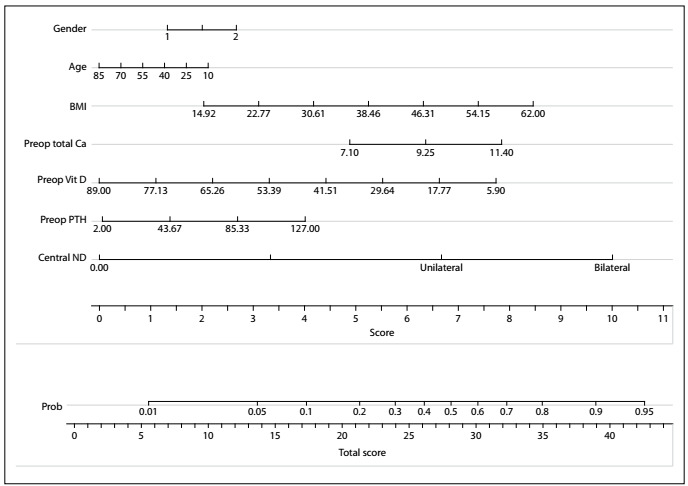
1,347 patients were assessed and postoperative hypocalcemia was diagnosed in 284 patients (21%). The vitamin D levels were considered deficient in 243 patients (18%). Postoperative hypocalcemia was diagnosed in 357 patients (31.5%). Multivariate analysis showed that central compartment dissection and preoperative total calcium and deficient vitamin D levels were significant risk factors for postoperative hypocalcemia.
Deficient preoperative vitamin D levels were a significant risk factor for postoperative hypocalcemia. Preoperative oral supplementation should be considered, to minimize this risk.
在全甲状腺切除术(TT)病例中,术前维生素D缺乏与术后低钙血症之间的关系存在争议,并且可能因地理环境和人群的不同而有所差异。
本研究旨在评估在南美洲人群中,术前维生素D缺乏是否与术后症状性低钙血症相关。
对2014年1月至2017年12月期间在A.C.卡马戈癌症中心接受全甲状腺切除术(无论是否进行中央区淋巴结清扫)的所有患者的数据进行回顾性队列研究。
纳入患有良性甲状腺疾病(格雷夫斯病、多结节性甲状腺肿或甲状腺功能亢进症)或甲状腺癌且接受了初次全甲状腺切除术(无论是否进行中央区淋巴结清扫)的患者。排除标准为同时进行甲状旁腺切除术以及可能影响血清钙水平的疾病。收集的数据包括患者人口统计学信息、甲状腺病理、手术范围和并发症。从病历中获取术前和术后钙、甲状旁腺激素(PTH)和维生素D水平的信息。
共评估了1347例患者,其中284例(21%)被诊断为术后低钙血症。243例患者(18%)的维生素D水平被认为缺乏。357例患者(31.5%)被诊断为术后低钙血症。多因素分析显示,中央区清扫、术前总钙水平和维生素D缺乏是术后低钙血症显著的危险因素。
术前维生素D水平缺乏是术后低钙血症的显著危险因素。应考虑术前口服补充维生素D,以将这种风险降至最低。