Key Laboratory of Breast Cancer, Department of Breast Surgery, Fudan University Shanghai Cancer Center, Shanghai Medical College, Fudan University, Shanghai, China.
Department of Oncology, Fudan University Shanghai Cancer Center, Shanghai Medical College, Fudan University, Shanghai, China.
Cancer Med. 2019 Oct;8(14):6212-6220. doi: 10.1002/cam4.2453. Epub 2019 Aug 2.
Endocrine therapy is the preferred treatment for patients with hormone receptor -positive metastatic breast cancer (MBC). While visceral metastasis is a negative prognostic factor, few studies have distinguished between the prognoses of patients with metastases at different visceral sites.
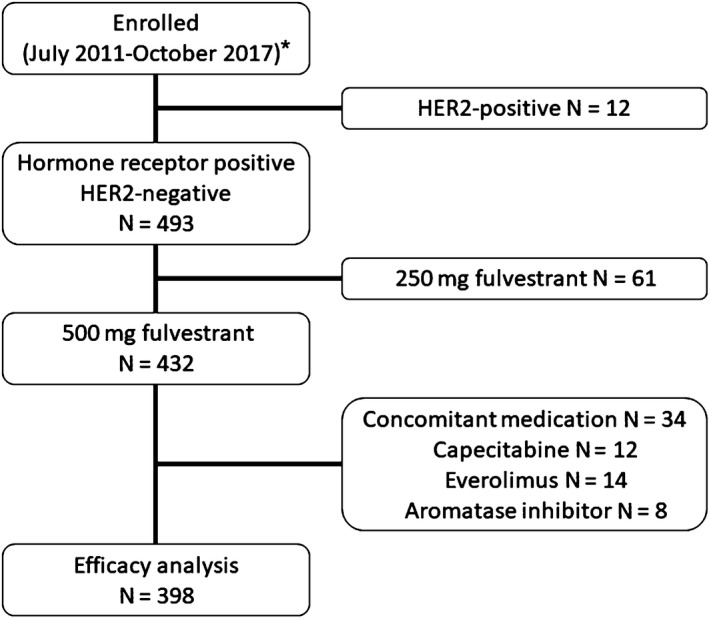
In total, 398 patients receiving fulvestrant 500 mg at a single center over a 6-year period were analyzed. Logistic regression models were used to identify the prognostic factors associated with progression-free survival (PFS). Kaplan-Meier analysis was used to compare the PFS of patients with lung and liver metastases.
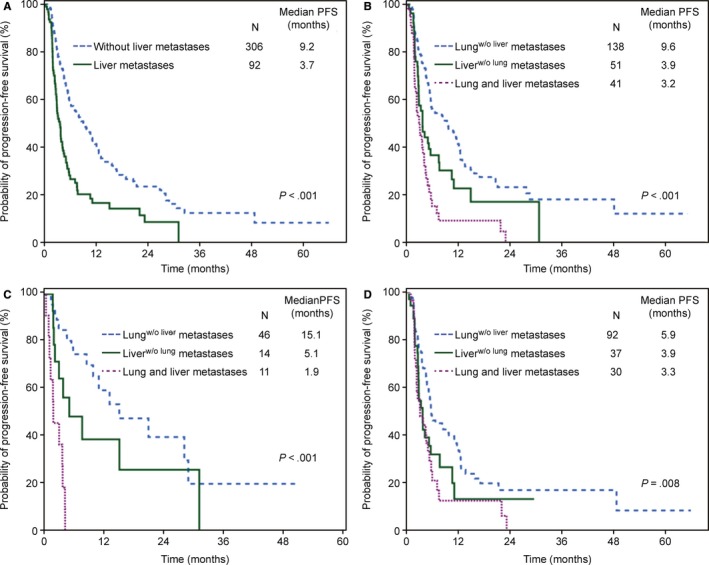
Baseline visceral metastases were present in 233 patients, including 138 with lung metastases (lung metastases without liver involvement), 51 with liver metastases (liver metastases without lung involvement) and 41 with lung and liver metastases. The median PFS was 6.8 months (5.6 and 9.2 months for visceral and nonvisceral metastases, respectively, P = .028). PFS was longer in patients with lung metastases than in those with liver metastases or lung and liver metastases (9.6, 3.7 and 3.2 months, respectively, P < .001; liver vs. lung hazard ratio (HR) 1.70; lung and liver vs. lung HR 2.85). Patients with liver metastases experienced significantly worse PFS than those without liver involvement (3.7 vs. 9.2 months, P < .001). PFS benefits were observed in patients with longer disease-free intervals, no liver metastases, and no previous chemotherapy.
Fulvestrant treatment benefited patients with lung or nonvisceral metastases. When treating hormone receptor-positive/HER2-negative MBC patients with endocrine therapy, it is important to differentiate patients with lung metastases from those with liver metastases.
内分泌治疗是激素受体阳性转移性乳腺癌(MBC)患者的首选治疗方法。虽然内脏转移是一个预后不良的因素,但很少有研究区分不同内脏部位转移患者的预后。
在一个中心,对 398 例在 6 年内接受氟维司群 500mg 治疗的患者进行了分析。采用逻辑回归模型确定与无进展生存期(PFS)相关的预后因素。Kaplan-Meier 分析用于比较肺转移和肝转移患者的 PFS。
基线时存在内脏转移的患者有 233 例,其中 138 例为肺转移(无肝累及的肺转移),51 例为肝转移(无肺累及的肝转移),41 例为肺和肝转移。中位 PFS 为 6.8 个月(内脏和非内脏转移分别为 5.6 和 9.2 个月,P=0.028)。肺转移患者的 PFS 长于肝转移或肺和肝转移患者(分别为 9.6、3.7 和 3.2 个月,P<0.001;肝转移与肺转移的风险比(HR)为 1.70;肺和肝转移与肺转移的 HR 为 2.85)。有肝转移的患者的 PFS 明显短于无肝转移的患者(3.7 与 9.2 个月,P<0.001)。无肝转移和无既往化疗的患者 PFS 获益更明显。
氟维司群治疗有益于有肺或非内脏转移的患者。在对激素受体阳性/HER2 阴性 MBC 患者进行内分泌治疗时,区分肺转移患者和肝转移患者非常重要。