Division of Hematology-Oncology, Department of Medicine, Samsung Medical Center, Sungkyunkwan University School of Medicine, Seoul, Korea.
Department of Oncology, Asan Medical Center, University of Ulsan College of Medicine, Seoul, Korea.
Cancer Res Treat. 2020 Apr;52(2):374-387. doi: 10.4143/crt.2019.198. Epub 2019 Aug 13.
The treatment outcome of brentuximab vedotin (BV) has not been related with CD30 expression in previous studies enrolling patients with a wide range of CD30 expression level. Thus, this study explored the efficacy of BV in high-CD30-expressing non-Hodgkin lymphoma (NHL) patients most likely to benefit.
This phase II study (Clinicaltrials.gov: NCT02280785) enrolled relapsed or refractory high-CD30-expressing NHL, with BV administered intravenously at 1.8 mg/kg every 3 weeks. The primary endpoint was > 40% disease control rate, consisting of complete response (CR), partial response (PR), or stable disease. We defined high CD30 expression as ≥ 30% tumor cells positive for CD30 by immunohistochemistry.
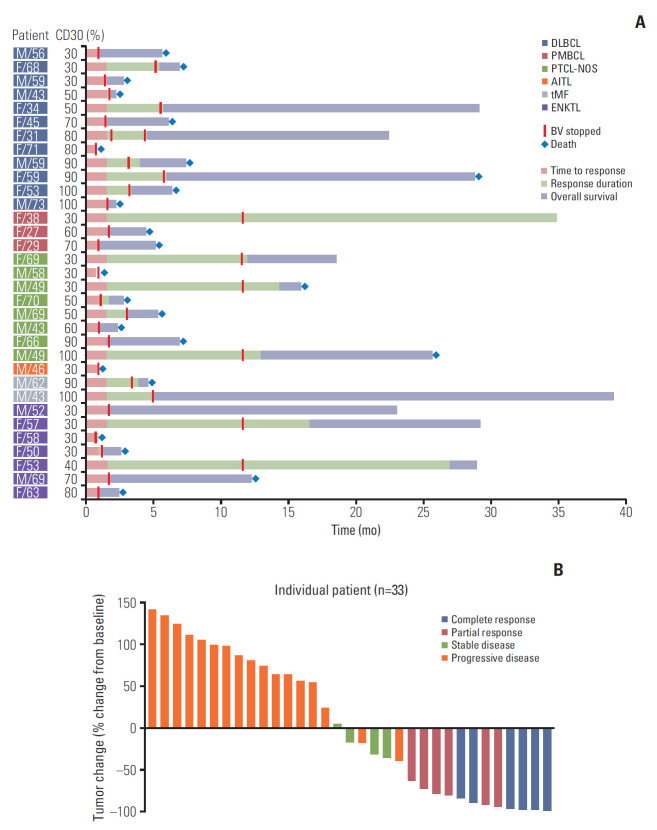
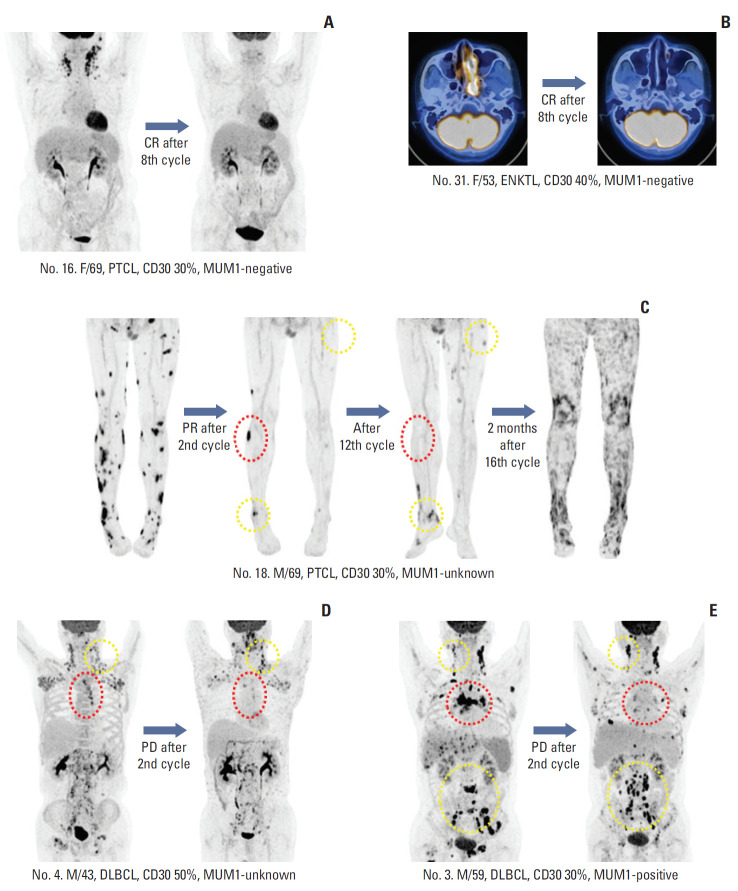
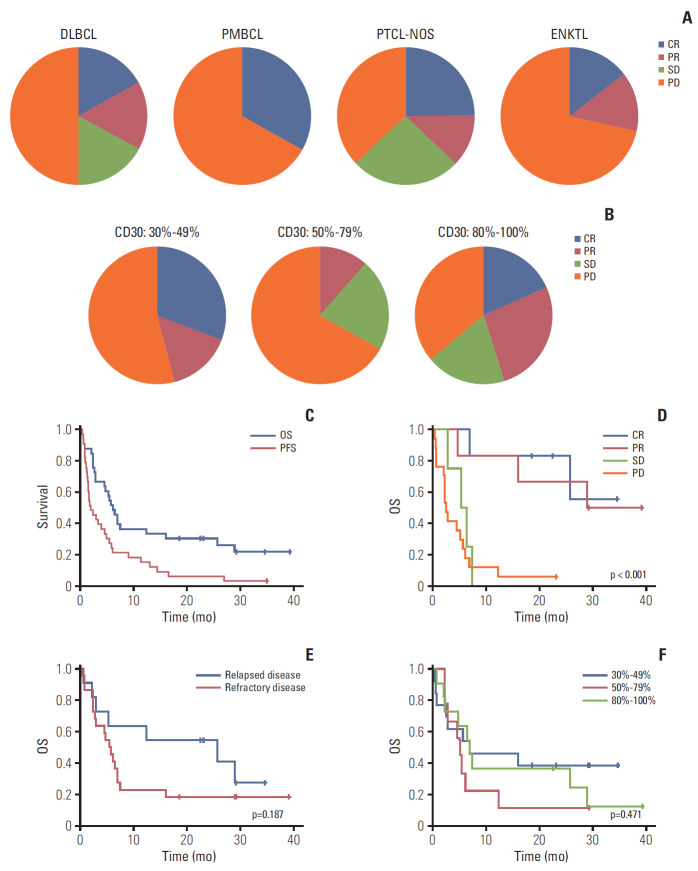
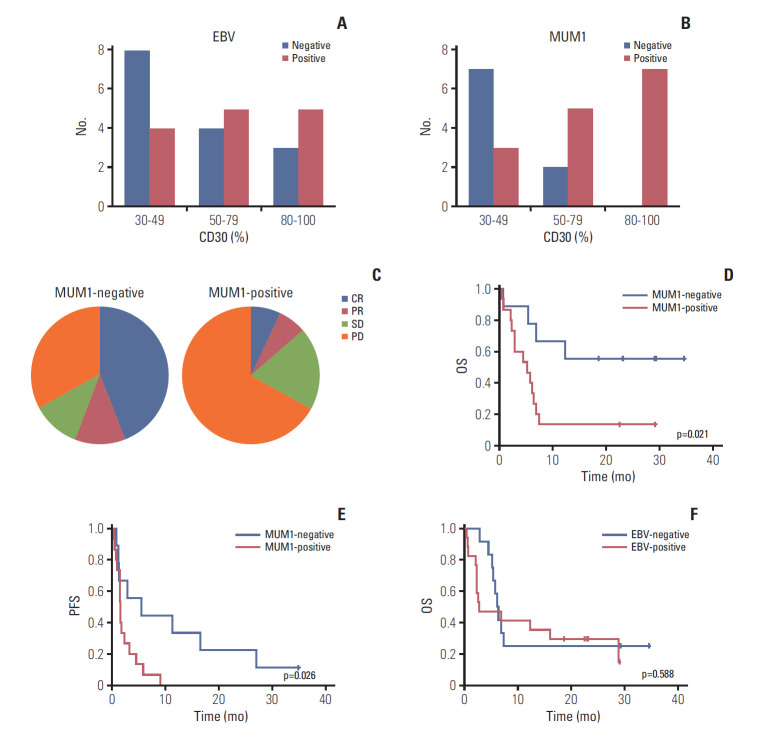
High-CD30-expressing NHL patients (n=33) were enrolled except anaplastic large cell lymphoma. The disease control rate was 48.5% (16/33) including six CR and six PR; six patients (4CR, 2PR) maintained their response over 16 completed cycles. Response to BV and survival were not associated with CD30 expression levels. Over a median of 29.2 months of follow-up, the median progression-free and overall survival rates were 1.9 months and 6.1 months, respectively. The most common adverse events were fever (39%), neutropenia (30%), fatigue (24%), and peripheral sensory neuropathy (27%). In a post-hoc analysis for the association of multiple myeloma oncogene 1 (MUM1) on treatment outcome, MUM1- negative patients showed a higher response (55.6%, 5/9) than MUM1-positive patients (13.3%, 2/15).
BV performance as a single agent was acceptable in terms of disease control rates and toxicity profiles, especially MUM1-negative patients.
在之前纳入 CD30 表达水平广泛的患者的研究中,本研究旨在探索在最有可能受益的高 CD30 表达非霍奇金淋巴瘤(NHL)患者中,贝林妥欧单抗(BV)的治疗效果是否与 CD30 表达相关。
本 II 期研究(Clinicaltrials.gov:NCT02280785)纳入了复发或难治性高 CD30 表达 NHL 患者,BV 静脉滴注,剂量为 1.8mg/kg,每 3 周一次。主要终点为>40%的疾病控制率,包括完全缓解(CR)、部分缓解(PR)或疾病稳定。我们将高 CD30 表达定义为免疫组化检测到≥30%的肿瘤细胞 CD30 阳性。
共纳入 33 例高 CD30 表达 NHL 患者(除外间变大细胞淋巴瘤)。疾病控制率为 48.5%(16/33),包括 6 例 CR 和 6 例 PR;6 例患者(4 例 CR,2 例 PR)在完成 16 个周期的治疗后仍保持缓解。BV 治疗效果和生存与 CD30 表达水平无关。中位随访 29.2 个月时,中位无进展生存期和总生存期分别为 1.9 个月和 6.1 个月。最常见的不良反应是发热(39%)、中性粒细胞减少(30%)、乏力(24%)和周围感觉神经病(27%)。在一项针对多发性骨髓瘤癌基因 1(MUM1)与治疗效果关系的事后分析中,MUM1 阴性患者的缓解率(55.6%,5/9)明显高于 MUM1 阳性患者(13.3%,2/15)。
BV 单药治疗的疾病控制率和毒性谱可接受,尤其是 MUM1 阴性患者。