
黄芪甲苷 IV 的作用及核受体 RXRα 在高糖腹透液中人腹膜间皮细胞中的作用。
Effect of astragaloside IV and the role of nuclear receptor RXRα in human peritoneal mesothelial cells in high glucose‑based peritoneal dialysis fluids.
机构信息
Department of Nephrology, Jiangsu Province Hospital of Chinese Medicine, Affiliated Hospital of Nanjing University of Chinese Medicine, Nanjing, Jiangsu 210029, P.R. China.
Department of Urology, Jiangsu Province Hospital of Chinese Medicine, Affiliated Hospital of Nanjing University of Chinese Medicine, Nanjing, Jiangsu 210029, P.R. China.
出版信息
Mol Med Rep. 2019 Oct;20(4):3829-3839. doi: 10.3892/mmr.2019.10604. Epub 2019 Aug 22.
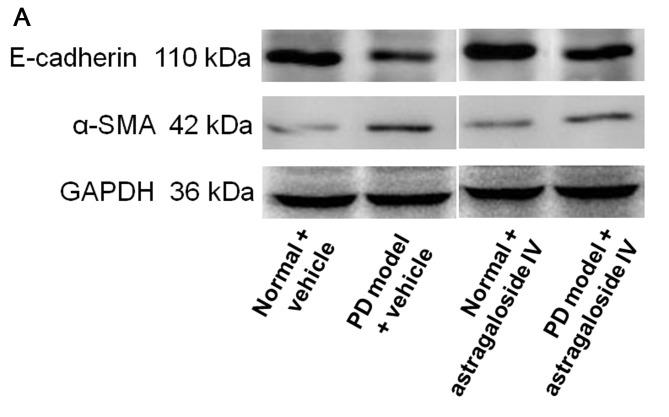
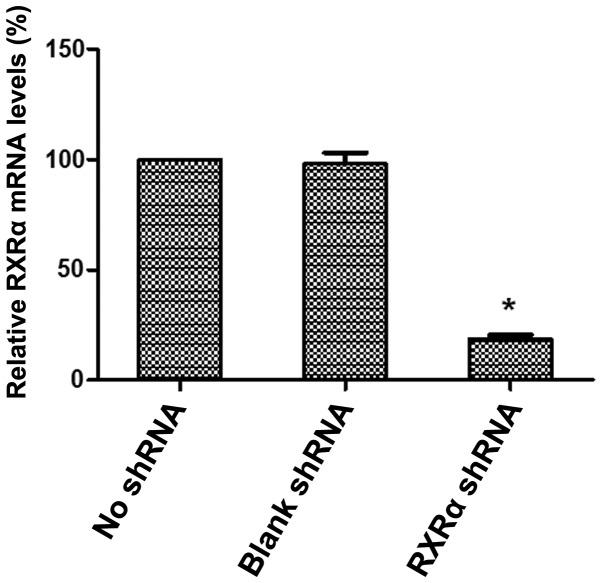
Peritoneal fibrosis is a serious complication that can occur during peritoneal dialysis (PD), which is primarily caused by damage to peritoneal mesothelial cells (PMCs). The onset of peritoneal fibrosis is delayed or inhibited by promoting PMC survival and inhibiting PMC epithelial‑to‑mesenchymal transition (EMT). In the present study, the effect of astragaloside IV and the role of the nuclear receptor retinoid X receptor‑α (RXRα) in PMCs in high glucose‑based PD fluids was investigated. Human PMC HMrSV5 cells were transfected with RXRα short hairpin RNA (shRNA), or an empty vector, and then treated with PD fluids and astragaloside IV. Cell viability, apoptosis and EMT were examined using the Cell Counting Kit‑8 assay and flow cytometry, and by determining the levels of caspase‑3, E‑cadherin and α‑smooth muscle actin (α‑SMA) via western blot analysis. Cell viability and apoptosis were increased, as were the levels of E‑cadherin in HMrSV5 cells following treatment with PD fluid. The protein levels of α‑SMA and caspase‑3 were increased by treatment with PD fluid. Exposure to astragaloside IV inhibited these changes; however, astragaloside IV did not change cell viability, apoptosis, E‑cadherin or α‑SMA levels in HMrSV5 cells under normal conditions. Transfection of HMrSV5 cells with RXRα shRNA resulted in decreased viability and E‑cadherin expression, and increased apoptosis and α‑SMA levels, in HMrSV5 cells treated with PD fluids and co‑treated with astragaloside IV or vehicle. These results suggested that astragaloside IV increased cell viability, and inhibited apoptosis and EMT in PMCs in PD fluids, but did not affect these properties of PMCs under normal condition. Thus, the present study suggested that RXRα is involved in maintaining viability, inhibiting apoptosis and reducing EMT of PMCs in PD fluid.
腹膜纤维化是腹膜透析(PD)过程中可能出现的一种严重并发症,主要由腹膜间皮细胞(PMCs)损伤引起。促进 PMC 存活和抑制 PMC 上皮-间充质转化(EMT)可延迟或抑制腹膜纤维化的发生。本研究探讨了黄芪甲苷 IV 在高糖 PD 液中对 PMCs 的作用及其核受体视黄醇 X 受体-α(RXRα)的作用。用人 PMC HMrSV5 细胞转染 RXRα 短发夹 RNA(shRNA)或空载体,然后用 PD 液和黄芪甲苷 IV 处理。通过细胞计数试剂盒-8 检测和流式细胞术检测细胞活力、细胞凋亡和 EMT,通过 Western blot 分析测定 caspase-3、E-钙黏蛋白和α-平滑肌肌动蛋白(α-SMA)的水平。用 PD 液处理后,HMrSV5 细胞的细胞活力和细胞凋亡增加,E-钙黏蛋白水平升高。PD 液处理后,α-SMA 和 caspase-3 的蛋白水平升高。黄芪甲苷 IV 抑制了这些变化;然而,在正常条件下,黄芪甲苷 IV 并未改变 HMrSV5 细胞的细胞活力、细胞凋亡、E-钙黏蛋白或α-SMA 水平。在 HMrSV5 细胞中转染 RXRα shRNA 后,用 PD 液处理并用黄芪甲苷 IV 或载体共处理的 HMrSV5 细胞的活力和 E-钙黏蛋白表达降低,细胞凋亡和α-SMA 水平升高。这些结果表明,黄芪甲苷 IV 增加了 PD 液中 PMCs 的细胞活力,抑制了细胞凋亡和 EMT,但对正常条件下 PMCs 的这些特性没有影响。因此,本研究表明 RXRα 参与维持 PD 液中 PMCs 的活力,抑制细胞凋亡和减少 EMT。




 Zotero 插件