Department of Internal Medicine, Seoul National University Bundang Hospital, Seongnam, Korea.
Department of Internal Medicine and Liver Research Institute, Seoul National University, Seongnam, Korea.
Gut Liver. 2020 Jul 15;14(4):439-449. doi: 10.5009/gnl19091.
BACKGROUND/AIMS: The utility of serum pepsinogen (sPG) I and the sPGI/II ratio as biomarkers for screening individuals with gastric cancer (GC) has not been established in Korea. The aim of this study was to define the role of sPG, especially sPGII, in GC screening.
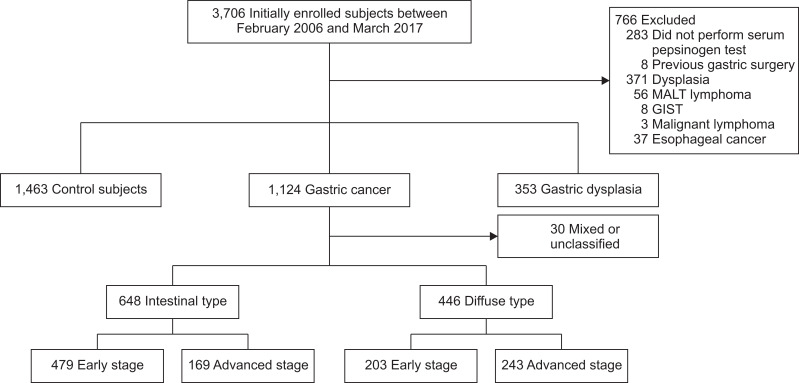
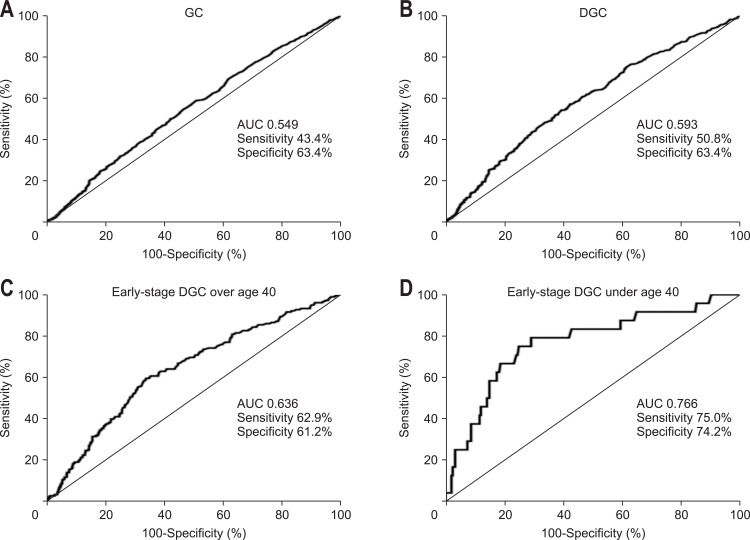
This study enrolled 2,940 subjects, including patients with GC (n=1,124) or gastric dysplasia (n=353) and controls (n=1,463). Tests to determine sPG levels and (HP) infection status were performed. Area under the curve and receiver operating characteristic curve were calculated to identify the optimal cutoff values for sPG. The usefulness of sPG levels for the detection of GC and gastric dysplasia was validated by multivariate logistic regression.
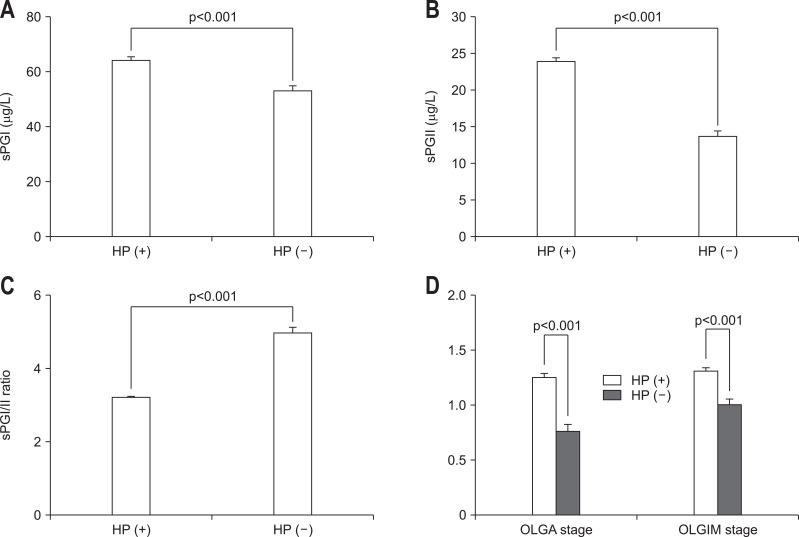
The sPGI/II ratio was associated with the risk of gastric dysplasia and advanced-stage intestinal-type GC (IGC). In contrast, sPGII was associated with the risk of early-stage diffuse-type GC (DGC). Significantly higher risk was indicated by an sPGI/II ratio <3 for gastric dysplasia and advanced-stage IGC and by sPGII levels ≥20 µg/L for early-stage DGC. Positive HP status showed a stronger association with DGC than with IGC. When sPGII level and HP status were combined, the prevalence of DGC was higher in the ≥20 µg/L sPGII and HP-positive group. Age younger than 40 years was strongly related to early-stage DGC, especially in females (odds ratio, 21.00; p=0.006).
sPGII ≥20 ng/mL and positive HP status suggest a risk of early-stage DGC, particularly in young adult females in South Korea.
背景/目的:血清胃蛋白酶原(sPG)I 和 sPGI/II 比值作为胃癌(GC)筛查个体的生物标志物在韩国尚未得到证实。本研究旨在定义 sPG,特别是 sPGII,在 GC 筛查中的作用。
本研究纳入了 2940 名受试者,包括 GC(n=1124)或胃黏膜异型增生(n=353)患者和对照组(n=1463)。检测 sPG 水平和幽门螺杆菌(HP)感染状态。计算曲线下面积和接受者操作特征曲线以确定 sPG 的最佳截断值。通过多变量逻辑回归验证 sPG 水平对 GC 和胃黏膜异型增生检测的有用性。
sPGI/II 比值与胃黏膜异型增生和晚期肠型 GC(IGC)的风险相关。相反,sPGII 与早期弥漫型 GC(DGC)的风险相关。sPGI/II 比值<3 与胃黏膜异型增生和晚期 IGC 相关,sPGII 水平≥20 µg/L 与早期 DGC 相关,表明风险显著增加。阳性 HP 状态与 DGC 的相关性强于 IGC。当 sPGII 水平和 HP 状态结合时,≥20 µg/L sPGII 和 HP 阳性组的 DGC 患病率较高。年龄小于 40 岁与早期 DGC 密切相关,尤其是女性(比值比,21.00;p=0.006)。
sPGII≥20 ng/mL 和阳性 HP 状态提示韩国年轻成年女性存在早期 DGC 的风险。