
CRISPR-Cas12a核酸酶可结合无RNA/DNA互补性的柔性DNA双链体。
CRISPR-Cas12a Nucleases Bind Flexible DNA Duplexes without RNA/DNA Complementarity.
作者信息
Jiang Wei, Singh Jaideep, Allen Aleique, Li Yue, Kathiresan Venkatesan, Qureshi Omair, Tangprasertchai Narin, Zhang Xiaojun, Parameshwaran Hari Priya, Rajan Rakhi, Qin Peter Z
机构信息
Department of Chemistry andDepartment of Biological Sciences, University of Southern California, Los Angeles, California 90089, United States.
Department of Chemistry and Biochemistry, Price Family Foundation Institute of Structural Biology, Stephenson Life Sciences Research Center, University of Oklahoma, Norman, Oklahoma 73019, United States.
出版信息
ACS Omega. 2019 Oct 9;4(17):17140-17147. doi: 10.1021/acsomega.9b01469. eCollection 2019 Oct 22.
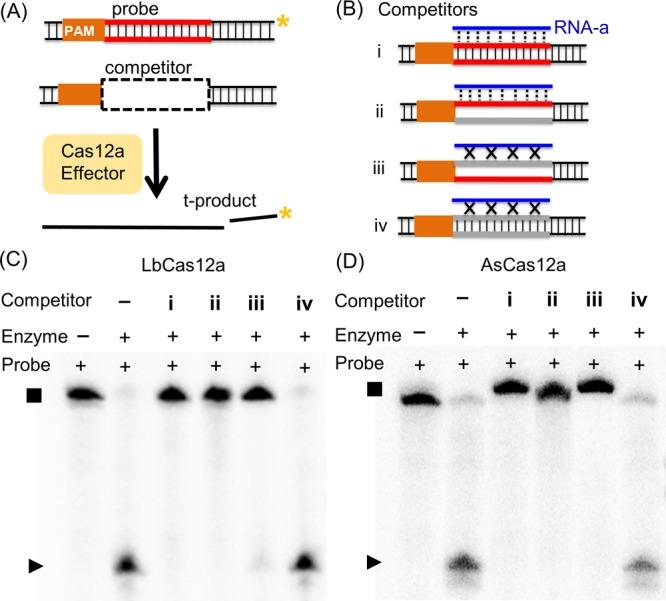
Cas12a (also known as "Cpf1") is a class 2 type V-A CRISPR-associated nuclease that can cleave double-stranded DNA at specific sites. The Cas12a effector enzyme comprises a single protein and a CRISPR-encoded small RNA (crRNA) and has been used for genome editing and manipulation. Work reported here examined in vitro interactions between the Cas12a effector enzyme and DNA duplexes with varying states of base-pairing between the two strands. The data revealed that in the absence of complementarity between the crRNA guide and the DNA target-strand, Cas12a binds duplexes with unpaired segments. These off-target duplexes were bound at the Cas12a site responsible for RNA-guided double-stranded DNA binding but were not cleaved due to the lack of RNA/DNA hybrid formation. Such promiscuous binding was attributed to increased DNA flexibility induced by the unpaired segment present next to the protospacer-adjacent-motif. The results suggest that target discrimination of Cas12a can be influenced by flexibility of the DNA. As such, in addition to the linear sequence, flexibility and other physical properties of the DNA should be considered in Cas12a-based genome engineering applications.
Cas12a(也称为“Cpf1”)是一种2类V-A型CRISPR相关核酸酶,可在特定位点切割双链DNA。Cas12a效应酶由单一蛋白质和CRISPR编码的小RNA(crRNA)组成,已被用于基因组编辑和操作。本文报道的研究检测了Cas12a效应酶与双链DNA之间的体外相互作用,双链DNA的两条链之间具有不同的碱基配对状态。数据显示,在crRNA引导序列与DNA靶链之间不存在互补性的情况下,Cas12a会结合具有未配对片段的双链体。这些脱靶双链体在负责RNA引导的双链DNA结合的Cas12a位点处结合,但由于缺乏RNA/DNA杂交体的形成而未被切割。这种杂乱的结合归因于原间隔序列相邻基序旁边存在的未配对片段诱导的DNA灵活性增加。结果表明,Cas12a的靶标识别可能受DNA灵活性的影响。因此,在基于Cas12a的基因组工程应用中,除了线性序列外,还应考虑DNA的灵活性和其他物理特性。



 Zotero 插件