• 文献检索
  • 文档翻译
  • 深度研究
  • 学术资讯
  • Suppr Zotero 插件Zotero 插件
  • 邀请有礼
  • 套餐&价格
  • 历史记录
应用&插件
Suppr Zotero 插件Zotero 插件浏览器插件Mac 客户端Windows 客户端微信小程序
定价
高级版会员购买积分包购买API积分包
服务
文献检索文档翻译深度研究API 文档MCP 服务
关于我们
关于 Suppr公司介绍联系我们用户协议隐私条款
关注我们

Suppr 超能文献

核心技术专利:CN118964589B侵权必究
粤ICP备2023148730 号-1Suppr @ 2026

文献检索

告别复杂PubMed语法,用中文像聊天一样搜索,搜遍4000万医学文献。AI智能推荐,让科研检索更轻松。

立即免费搜索

文件翻译

保留排版,准确专业,支持PDF/Word/PPT等文件格式,支持 12+语言互译。

免费翻译文档

深度研究

AI帮你快速写综述,25分钟生成高质量综述,智能提取关键信息,辅助科研写作。

立即免费体验

克罗恩病肠切除术后复发的危险因素。

Risk factors for recurrence after bowel resection for Crohn's disease.

作者信息

Chen Ze-Xian, Chen Yong-Le, Huang Xiao-Ming, Lin Xu-Tao, He Xiao-Wen, Lan Ping

机构信息

Department of Colorectal Surgery, the Sixth Affiliated Hospital, Sun Yat-Sen University, Guangzhou 510655, Guangdong Province, China.

Department of Hepatobiliary Surgery, the Sixth Affiliated Hospital, Sun Yat-Sen University, Guangzhou 510655, Guangdong Province, China.

出版信息

World J Gastrointest Pharmacol Ther. 2019 Oct 15;10(4):67-74. doi: 10.4292/wjgpt.v10.i4.67.

DOI:10.4292/wjgpt.v10.i4.67
PMID:31692953
原文链接:https://pmc.ncbi.nlm.nih.gov/articles/PMC6829093/
Abstract

BACKGROUND

Complications of Crohn's disease such as intestinal obstruction, fistula or perforation often need surgical treatment. Nearly 70%-80% patients with Crohn's disease would receive surgical treatment during the lifetime. However, surgical treatment is incurable for Crohn's disease. The challenge of recurrence postoperatively troubles both doctors and patients. Over 50% patients would suffer recurrence postoperatively. Some certain risk factors are associated with recurrence of Crohn's disease.

AIM

To evaluate the risk factors for endoscopic recurrence and clinical recurrence after bowel resection in Crohn's disease.

METHODS

Patients diagnosed Crohn's disease and received intestinal resection between April 2007 and December 2013 were included in this study. Data on the general demographic information, preoperative clinical characteristics, surgical information, postoperative clinical characteristics were collected. Continuous data are expressed as median (inter quartile range), and categorical data as frequencies and percentages. Kaplan-Meier method was applied to estimate the impact of the clinical variables above on the cumulative rate of postoperative endoscopic recurrence and clinical recurrence, then log-rank test was applied to test the homogeneity of those clinical variables. Multivariate Cox proportional hazard regression analysis was performed to identify the risk factors of postoperative endoscopic recurrence and clinical recurrence.

RESULTS

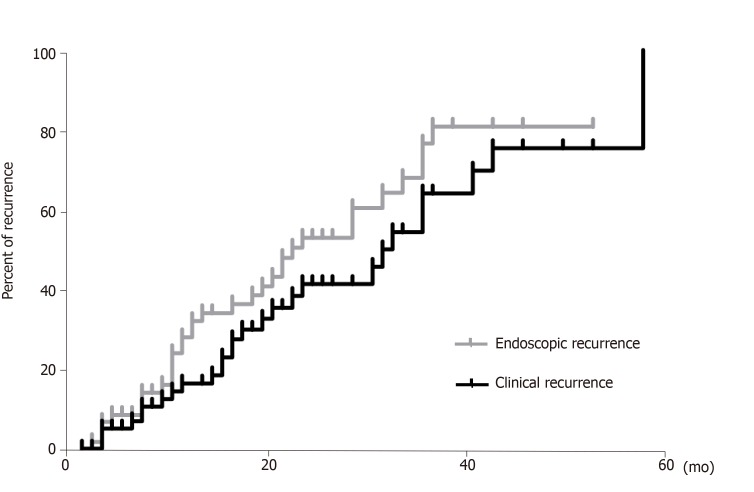
A total of 64 patients were included in this study. The median follow-up time for the patients was 17 (9.25-25.75) mo. In this period, 41 patients (64.1%) had endoscopic recurrence or clinical recurrence. Endoscopic recurrence occurred in 34 (59.6%) patients while clinical recurrence occurred in 28 (43.8%) patients, with the interval between the operation and recurrence of 13.0 (8.0-24.5) months and 17.0 (8.0-27.8) mo, respectively. In univariate analysis, diagnosis at younger age ( < 0.001), disease behavior of penetrating ( = 0.044) and preoperative use of anti-tumor necrosis factor (TNF) ( = 0.020) were significantly correlated with endoscopic recurrence, while complication with perianal lesions ( = 0.032) and preoperative use of immunomodulatory ( = 0.031) were significantly correlated with clinical recurrence. As to multivariate analysis, diagnostic age ( = 0.004), disease behavior ( = 0.041) and preoperative use of anti-TNF ( = 0.010) were independent prognostic factors for endoscopic recurrence, while complication with perianal lesions ( = 0.023) was an independent prognostic factor for clinical recurrence.

CONCLUSION

Diagnostic age, disease behavior, preoperative use of anti-TNF and complication with perianal lesions were independent risk factors for postoperative recurrence in Crohn's disease.
https://cdn.ncbi.nlm.nih.gov/pmc/blobs/d954/6829093/e7a57ec43829/WJGPT-10-67-g001.jpg
摘要

背景

克罗恩病的并发症如肠梗阻、瘘管或穿孔常需手术治疗。近70%-80%的克罗恩病患者在其一生中会接受手术治疗。然而,手术治疗无法治愈克罗恩病。术后复发的难题困扰着医生和患者双方。超过50%的患者术后会复发。某些特定的风险因素与克罗恩病的复发相关。

目的

评估克罗恩病肠切除术后内镜复发和临床复发的风险因素。

方法

本研究纳入了2007年4月至2013年12月期间诊断为克罗恩病并接受肠切除的患者。收集了一般人口统计学信息、术前临床特征、手术信息、术后临床特征的数据。连续数据以中位数(四分位间距)表示,分类数据以频率和百分比表示。采用Kaplan-Meier法评估上述临床变量对术后内镜复发和临床复发累积率的影响,然后应用对数秩检验来检验这些临床变量的同质性。进行多变量Cox比例风险回归分析以确定术后内镜复发和临床复发的风险因素。

结果

本研究共纳入64例患者。患者的中位随访时间为17(9.25 - 25.75)个月。在此期间,41例患者(64.1%)发生了内镜复发或临床复发。34例(59.6%)患者发生了内镜复发,28例(43.8%)患者发生了临床复发,手术与复发的间隔分别为13.0(8.0 - 24.5)个月和17.0(8.0 - 27.8)个月。单因素分析中,诊断时年龄较小(<0.001)、穿透性疾病行为(=0.044)和术前使用抗肿瘤坏死因子(TNF)(=0.020)与内镜复发显著相关,而肛周病变并发症(=0.032)和术前使用免疫调节剂(=0.031)与临床复发显著相关。多因素分析中,诊断年龄(=0.004)、疾病行为(=0.041)和术前使用抗TNF(=0.010)是内镜复发的独立预后因素,而肛周病变并发症(=0.023)是临床复发的独立预后因素。

结论

诊断年龄、疾病行为、术前使用抗TNF和肛周病变并发症是克罗恩病术后复发的独立风险因素。

相似文献

1
Risk factors for recurrence after bowel resection for Crohn's disease.克罗恩病肠切除术后复发的危险因素。
World J Gastrointest Pharmacol Ther. 2019 Oct 15;10(4):67-74. doi: 10.4292/wjgpt.v10.i4.67.
2
Risk factors for symptomatic anastomotic postoperative recurrence following ileo-colic resection in Crohn's disease.克罗恩病患者行回肠结肠切除术后吻合口术后复发的症状性危险因素。
Colorectal Dis. 2021 May;23(5):1184-1192. doi: 10.1111/codi.15530. Epub 2021 Feb 3.
3
Factors affecting the incidence of early endoscopic recurrence after ileocolonic resection for Crohn's disease: a multicentre observational study.克罗恩病回结肠切除术后早期内镜复发发生率的影响因素:一项多中心观察性研究
Colorectal Dis. 2017 Jan;19(1):O39-O45. doi: 10.1111/codi.13581.
4
Quantitative analysis of adipose tissue for predicting Crohn's disease postoperative endoscopic recurrence and anastomotic ulcer.定量分析脂肪组织预测克罗恩病术后内镜复发和吻合口溃疡。
Int J Colorectal Dis. 2023 Jun 16;38(1):170. doi: 10.1007/s00384-023-04456-z.
5
Risk factors for postoperative recurrence after primary bowel resection in patients with Crohn's disease.克罗恩病患者初次肠道切除术后复发的风险因素。
World J Gastroenterol. 2017 Oct 14;23(38):7016-7024. doi: 10.3748/wjg.v23.i38.7016.
6
Postoperative Crohn's Disease Recurrence Risk and Optimal Biologic Timing After Temporary Diversion Following Ileocolic Resection.回结肠切除术后临时造口术后克罗恩病复发风险及最佳生物制剂使用时机
Inflamm Bowel Dis. 2025 Mar 3;31(3):686-695. doi: 10.1093/ibd/izae117.
7
Predictors of postoperative recurrence in a cohort of Tunisian patients with Crohn's disease.一组突尼斯克罗恩病患者术后复发的预测因素
Ther Adv Gastrointest Endosc. 2022 Mar 19;15:26317745211060689. doi: 10.1177/26317745211060689. eCollection 2022 Jan-Dec.
8
Profile of Consecutive Fecal Calprotectin Levels in the Perioperative Period and Its Predictive Capacity for Early Endoscopic Recurrence in Crohn's Disease.围手术期连续粪便钙卫蛋白水平特征及其对克罗恩病早期内镜复发的预测能力。
Dis Colon Rectum. 2019 Mar;62(3):318-326. doi: 10.1097/DCR.0000000000001263.
9
Immediate prophylactic vs endoscopic or symptomatic-driven azathioprine treatment to prevent surgical recurrence after intestinal resection for Crohn's disease.克罗恩病肠切除术后即刻预防与内镜或症状驱动的硫唑嘌呤治疗预防手术复发。
Colorectal Dis. 2018 Sep;20(9):O267-O276. doi: 10.1111/codi.14352. Epub 2018 Aug 20.
10
Myenteric plexitis is a risk factor for endoscopic and clinical postoperative recurrence after ileocolonic resection in Crohn's disease.肌间神经丛炎是克罗恩病患者回结肠切除术后内镜及临床复发的一个危险因素。
Dig Liver Dis. 2016 Jul;48(7):753-8. doi: 10.1016/j.dld.2016.02.023. Epub 2016 Mar 3.

引用本文的文献

1
Anti-TNF Agents and New Biological Agents (Vedolizumab and Ustekinumab) in the Prevention and Treatment of Postoperative Recurrence After Surgery in Crohn's Disease.抗 TNF 制剂和新型生物制剂(维得利珠单抗和乌司奴单抗)在克罗恩病术后预防和治疗复发中的作用。
Drugs. 2023 Sep;83(13):1179-1205. doi: 10.1007/s40265-023-01916-2. Epub 2023 Jul 28.
2
Perforating and nonperforating indications in repeated surgeries for Crohn's disease.克罗恩病再次手术中的穿孔性和非穿孔性指征
World J Clin Cases. 2022 Mar 26;10(9):2733-2742. doi: 10.12998/wjcc.v10.i9.2733.

本文引用的文献

1
Risk factors for postoperative recurrence of Crohn's disease with emphasis on surgical predictors.克罗恩病术后复发的危险因素,重点关注手术预测因素。
Ann Gastroenterol. 2017;30(6):598-612. doi: 10.20524/aog.2017.0195. Epub 2017 Sep 26.
2
Risk factors for postoperative recurrence after primary bowel resection in patients with Crohn's disease.克罗恩病患者初次肠道切除术后复发的风险因素。
World J Gastroenterol. 2017 Oct 14;23(38):7016-7024. doi: 10.3748/wjg.v23.i38.7016.
3
Rates and Predictors of Endoscopic and Clinical Recurrence After Primary Ileocolic Resection for Crohn's Disease.
克罗恩病初次回结肠切除术后内镜及临床复发的发生率和预测因素
Dig Dis Sci. 2017 Jan;62(1):188-196. doi: 10.1007/s10620-016-4351-7. Epub 2016 Oct 24.
4
Patients with perianal Crohn's disease have poor disease outcomes after primary bowel resection.肛周克罗恩病患者在初次肠道切除术后疾病预后较差。
J Gastroenterol Hepatol. 2016 Aug;31(8):1436-42. doi: 10.1111/jgh.13310.
5
Strategies for the prevention of postoperative recurrence of Crohn's disease.预防克罗恩病术后复发的策略。
Colorectal Dis. 2013 Dec;15(12):1471-80. doi: 10.1111/codi.12326.
6
Time trend and risk factors for reoperation in Crohn's disease in Japan.日本克罗恩病再次手术的时间趋势及危险因素
Hepatogastroenterology. 2012 Jun;59(116):1081-6. doi: 10.5754/hge10822.
7
Review article: the natural history of postoperative Crohn's disease recurrence.综述文章:术后克罗恩病复发的自然史。
Aliment Pharmacol Ther. 2012 Mar;35(6):625-33. doi: 10.1111/j.1365-2036.2012.05002.x. Epub 2012 Feb 7.
8
Has there been a change in the natural history of Crohn's disease? Surgical rates and medical management in a population-based inception cohort from Western Hungary between 1977-2009.克罗恩病的自然病程是否发生了变化?1977-2009 年匈牙利西部基于人群的发病队列中的手术率和医学治疗。
Am J Gastroenterol. 2012 Apr;107(4):579-88. doi: 10.1038/ajg.2011.448. Epub 2012 Jan 10.
9
Scheduled infliximab monotherapy to prevent recurrence of Crohn's disease following ileocolic or ileal resection: a 3-year prospective randomized open trial.经预定安排的英夫利昔单抗单药疗法用于预防回肠结肠切除术或回肠切除术治疗后的克罗恩病复发:一项 3 年前瞻性随机开放试验。
Inflamm Bowel Dis. 2012 Sep;18(9):1617-23. doi: 10.1002/ibd.21928. Epub 2011 Nov 13.
10
Epidemiology and natural history of inflammatory bowel diseases.炎症性肠病的流行病学和自然史。
Gastroenterology. 2011 May;140(6):1785-94. doi: 10.1053/j.gastro.2011.01.055.