Gale Sara L, Trinh Huong, Mathew Nitya, Jahreis Angelika, Lin Celia J F, Sarsour Khaled
, Genentech, South San Francisco, CA, USA.
Rheumatol Ther. 2020 Mar;7(1):89-99. doi: 10.1007/s40744-019-00181-8. Epub 2019 Nov 16.
Real-world use of immunomodulating therapy (IMT) in patients with systemic sclerosis (SSc) was investigated for the first time in a descriptive, retrospective cohort analysis of claims made in a healthcare insurance database to characterize treatment patterns and their alignment with SSc disease manifestations.
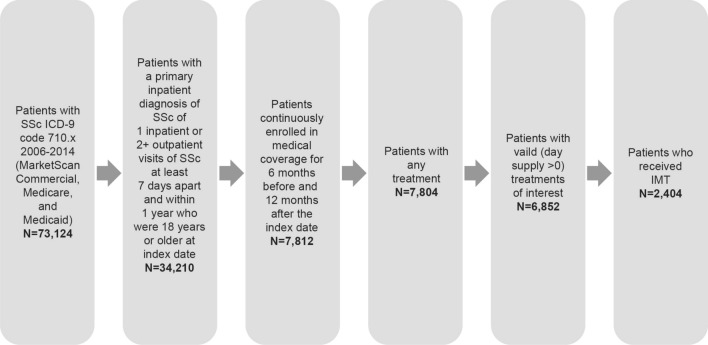
Treatment patterns and disease manifestations, symptoms, complications, and comorbidities were assessed in patients with SSc enrolled in a US healthcare claims database who received treatment between January 2006 and December 2013 and for whom data were available 6 months before and 12 months after SSc diagnosis.
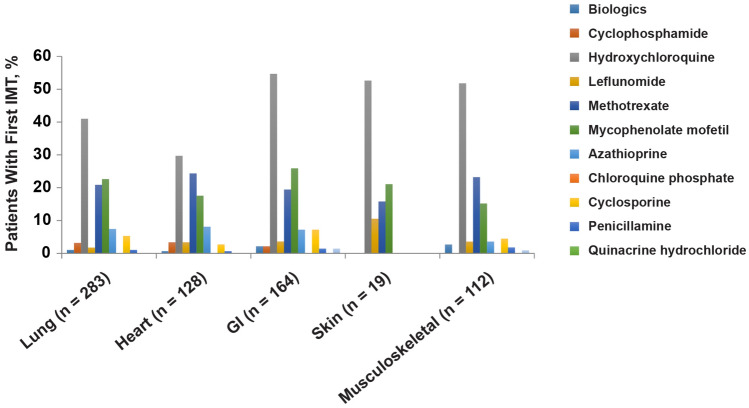
Among 7812 eligible patients, 6852 received treatments of interest for SSc and 2404 (30.8%) received IMT during the first year after SSc diagnosis. In the first year after diagnosis, the most common claims were for antibiotics (61.7%), opioids (50.6%), glucocorticoids (46.5%), and proton pump inhibitors (35.4%); the most common organs involved with complications among patients with SSc were lung (30.5%), heart (17.4%), and gastrointestinal tract (22.4%); the most common signs or symptoms were musculoskeletal (16.1%) and fatigue (10.5%); 1035 patients (15.1%) had infections and 14 (0.2%) had malignancies. Among patients who received IMT, 43.8% received at least hydroxychloroquine and 21.1% received at least methotrexate; 460 patients switched to a second IMT, 23.0% to at least methotrexate and 22.8% to at least mycophenolate mofetil. The most common comorbidities reported with first IMT were in lung (11.8%), overlap syndrome (8.4%), heart (5.3%), and gastrointestinal (6.8%) categories.
One-third of patients with SSc in the healthcare claims population received IMTs during the first year after diagnosis. However, patients who received IMTs had disease manifestations similar to those of the overall SSc healthcare claims population.
在一项对医疗保险数据库中的理赔申请进行的描述性回顾性队列分析中,首次对系统性硬化症(SSc)患者免疫调节治疗(IMT)的实际应用情况进行了调查,以描述治疗模式及其与SSc疾病表现的一致性。
对纳入美国医疗理赔数据库的SSc患者的治疗模式、疾病表现、症状、并发症和合并症进行评估,这些患者在2006年1月至2013年12月期间接受了治疗,且在SSc诊断前6个月和诊断后12个月有可用数据。
在7812名符合条件的患者中,6852名接受了针对SSc的相关治疗,2404名(30.8%)在SSc诊断后的第一年接受了IMT。在诊断后的第一年,最常见的理赔项目是抗生素(61.7%)、阿片类药物(50.6%)、糖皮质激素(46.5%)和质子泵抑制剂(35.4%);SSc患者中出现并发症的最常见受累器官是肺(30.5%)、心脏(17.4%)和胃肠道(22.4%);最常见的体征或症状是肌肉骨骼方面的(16.1%)和疲劳(10.5%);1035名患者(15.1%)发生感染,14名患者(0.2%)发生恶性肿瘤。在接受IMT的患者中,43.8%至少接受了羟氯喹,21.1%至少接受了甲氨蝶呤;460名患者换用了第二种IMT,23.0%至少换用了甲氨蝶呤,22.8%至少换用了霉酚酸酯。首次接受IMT时报告的最常见合并症在肺部(11.8%)、重叠综合征(8.4%)、心脏(5.3%)和胃肠道(6.8%)类别中。
在医疗理赔人群中,三分之一的SSc患者在诊断后的第一年接受了IMT。然而,接受IMT的患者的疾病表现与整个SSc医疗理赔人群的相似。