UMR BIPAR, Animal Health Laboratory, INRA, ANSES, Ecole Nationale Vétérinaire d'Alfort, Université Paris-Est, Maisons-Alfort, France.
Laboratory for Animal Health, Epidemiology Unit, ANSES, University Paris Est, Maisons-Alfort, France.
Parasit Vectors. 2019 Nov 21;12(1):551. doi: 10.1186/s13071-019-3799-7.
Ixodes ricinus is the predominant tick species in Europe and the primary pathogen vector for both humans and animals. These ticks are frequently involved in the transmission of Borrelia burgdorferi (sensu lato), the causative agents of Lyme borreliosis. While much more is known about I. ricinus tick-borne pathogen composition, information about temporal tick-borne pathogen patterns remain scarce. These data are crucial for predicting seasonal/annual patterns which could improve understanding and prevent tick-borne diseases.
We examined tick-borne pathogen (TBP) dynamics in I. ricinus collected monthly in a peri-urban forest over three consecutive years. In total, 998 nymphs were screened for 31 pathogenic species using high-throughput microfluidic real-time PCR.
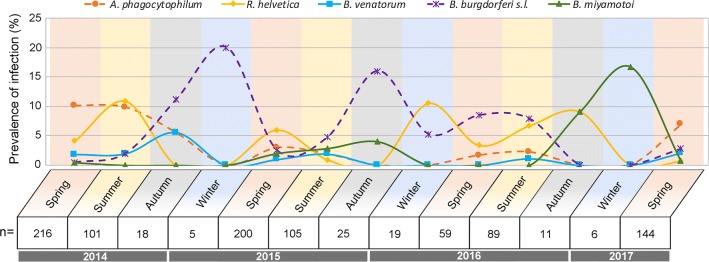
We detected DNA from Anaplasma phagocytophilum (5.3%), Rickettsia helvetica (4.5%), Borrelia burgdorferi (s.l.) (3.7%), Borrelia miyamotoi (1.2%), Babesia venatorum (1.5%) and Rickettsia felis (0.1%). Among all analysed ticks, 15.9% were infected by at least one of these microorganisms, and 1.3% were co-infected. Co-infections with B. afzeli/B. garinii and B. garinii/B. spielmanii were significantly over-represented. Moreover, significant variations in seasonal and/or inter-annual prevalence were observed for several pathogens (R. helvetica, B. burgdorferi (s.l.), B. miyamotoi and A. phagocytophilum).
Analysing TBP prevalence in monthly sampled tick over three years allowed us to assess seasonal and inter-annual fluctuations of the prevalence of TBPs known to circulate in the sampled area, but also to detect less common species. All these data emphasize that sporadic tick samplings are not sufficient to determine TBP prevalence and that regular monitoring is necessary.
蓖子硬蜱是欧洲主要的蜱种,也是人和动物的主要病原体载体。这些蜱经常参与传播伯氏疏螺旋体(广义),即莱姆病的病原体。虽然人们对蓖子硬蜱蜱传病原体的组成有了更多的了解,但关于蜱传病原体的时间模式的信息仍然很少。这些数据对于预测季节性/年度模式至关重要,这可以提高对蜱传疾病的理解和预防。
我们在三年内每月对一个城市周边森林中的蓖子硬蜱进行了蜱传病原体(TBP)动态检测。总共对 998 只若虫进行了 31 种致病物种的高通量微流控实时 PCR 筛查。
我们在 5.3%的 Anaplasma phagocytophilum、4.5%的 Rickettsia helvetica、3.7%的 Borrelia burgdorferi(s.l.)、1.2%的 Borrelia miyamotoi、1.5%的 Babesia venatorum 和 0.1%的 Rickettsia felis 中检测到 DNA。在所有分析的蜱中,至少有一种微生物感染的比例为 15.9%,1.3%的蜱发生了混合感染。B. afzeli/B. garinii 和 B. garinii/B. spielmanii 的混合感染明显更为常见。此外,几种病原体(R. helvetica、B. burgdorferi(s.l.)、B. miyamotoi 和 A. phagocytophilum)的季节性和/或年度间流行率存在显著差异。
对三年内每月采集的蜱进行 TBP 流行率分析,使我们能够评估在采样区域内循环的已知 TBP 的季节性和年度间波动,但也能检测到较不常见的物种。所有这些数据都强调,偶尔的蜱采样不足以确定 TBP 的流行率,需要进行定期监测。