School of Immunology and Microbial Sciences, King's College London, London, UK
National Institute for Health Research Biomedical Research Centre at Guy's and St Thomas' NHS Foundation Trust and King's College London, London, UK.
Gut. 2020 Mar;69(3):578-590. doi: 10.1136/gutjnl-2019-318483. Epub 2019 Dec 2.
The functional role of interleukin-22 (IL22) in chronic inflammation is controversial, and mechanistic insights into how it regulates target tissue are lacking. In this study, we evaluated the functional role of IL22 in chronic colitis and probed mechanisms of IL22-mediated regulation of colonic epithelial cells.
To investigate the functional role of IL22 in chronic colitis and how it regulates colonic epithelial cells, we employed a three-dimentional mini-gut epithelial organoid system, in vivo disease models and transcriptomic datasets in human IBD.
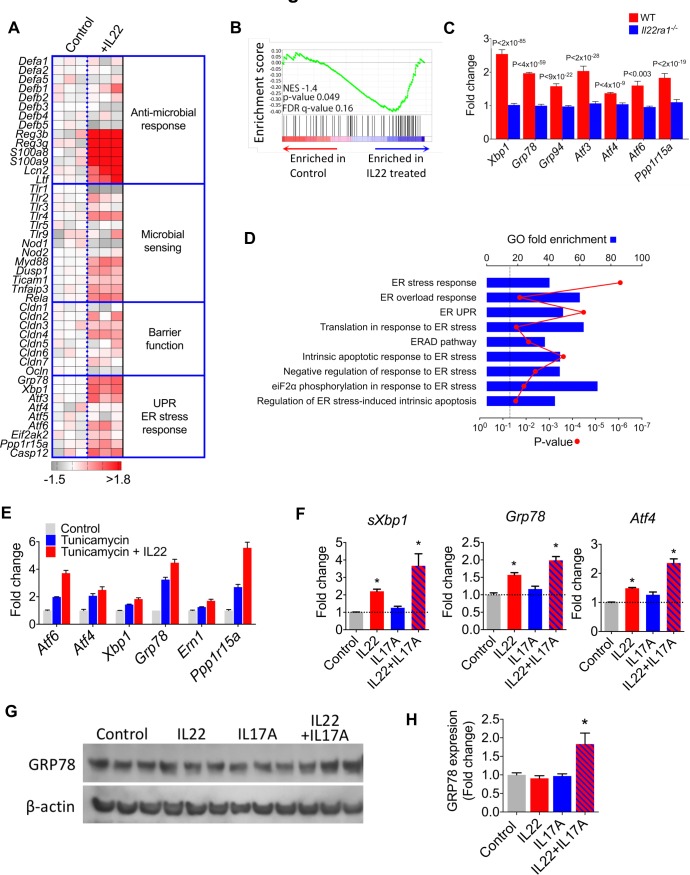
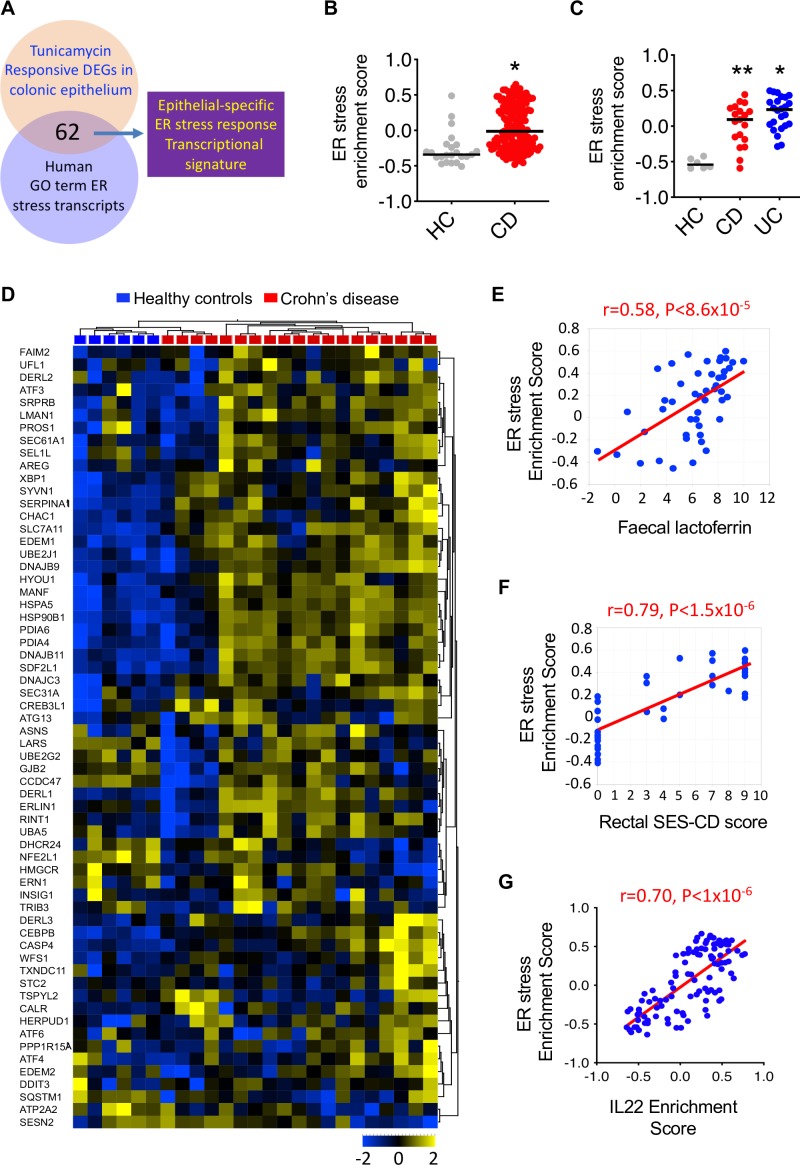
As well as inducing transcriptional modules implicated in antimicrobial responses, IL22 also coordinated an endoplasmic reticulum (ER) stress response transcriptional programme in colonic epithelial cells. In the colon of patients with active colonic Crohn's disease (CD), there was enrichment of IL22-responsive transcriptional modules and ER stress response modules. Strikingly, in an IL22-dependent model of chronic colitis, targeting IL22 alleviated colonic epithelial ER stress and attenuated colitis. Pharmacological modulation of the ER stress response similarly impacted the severity of colitis. In patients with colonic CD, antibody blockade of IL12p40, which simultaneously blocks IL12 and IL23, the key upstream regulator of IL22 production, alleviated the colonic epithelial ER stress response.
Our data challenge perceptions of IL22 as a predominantly beneficial cytokine in IBD and provide novel insights into the molecular mechanisms of IL22-mediated pathogenicity in chronic colitis. Targeting IL22-regulated pathways and alleviating colonic epithelial ER stress may represent promising therapeutic strategies in patients with colitis.
NCT02749630.
白细胞介素-22(IL-22)在慢性炎症中的功能作用存在争议,其调节靶组织的机制尚不清楚。在这项研究中,我们评估了 IL-22 在慢性结肠炎中的功能作用,并探讨了 IL-22 调节结肠上皮细胞的机制。
为了研究 IL-22 在慢性结肠炎中的功能作用及其对结肠上皮细胞的调节作用,我们采用了三维迷你肠道上皮类器官系统、体内疾病模型和人类 IBD 的转录组数据集。
除了诱导与抗菌反应相关的转录模块外,IL-22 还协调了结肠上皮细胞中的内质网(ER)应激反应转录程序。在活动性结肠克罗恩病(CD)患者的结肠中,IL-22 反应转录模块和 ER 应激反应模块富集。引人注目的是,在 IL-22 依赖性慢性结肠炎模型中,靶向 IL-22 可减轻结肠上皮 ER 应激并减轻结肠炎。ER 应激反应的药物调节也同样影响结肠炎的严重程度。在患有结肠 CD 的患者中,IL12p40 的抗体阻断(同时阻断 IL12 和 IL23,IL22 产生的关键上游调节剂)减轻了结肠上皮的 ER 应激反应。
我们的数据挑战了将 IL-22 视为 IBD 中主要有益细胞因子的观点,并为 IL-22 介导的慢性结肠炎发病机制中的分子机制提供了新的见解。靶向 IL-22 调节的途径和减轻结肠上皮 ER 应激可能是结肠炎患者有前途的治疗策略。
NCT02749630。