
交联聚乙烯变形过程中的变形不稳定性与片晶破碎
Deformation Instabilities and Lamellae Fragmentation during Deformation of Cross-linked Polyethylene.
作者信息
Bartczak Zbigniew, Vozniak Alina
机构信息
Centre of Molecular and Macromolecular Studies, Polish Academy of Sciences, Sienkiewicza 112, 90-363 Łódź, Poland.
出版信息
Polymers (Basel). 2019 Nov 28;11(12):1954. doi: 10.3390/polym11121954.
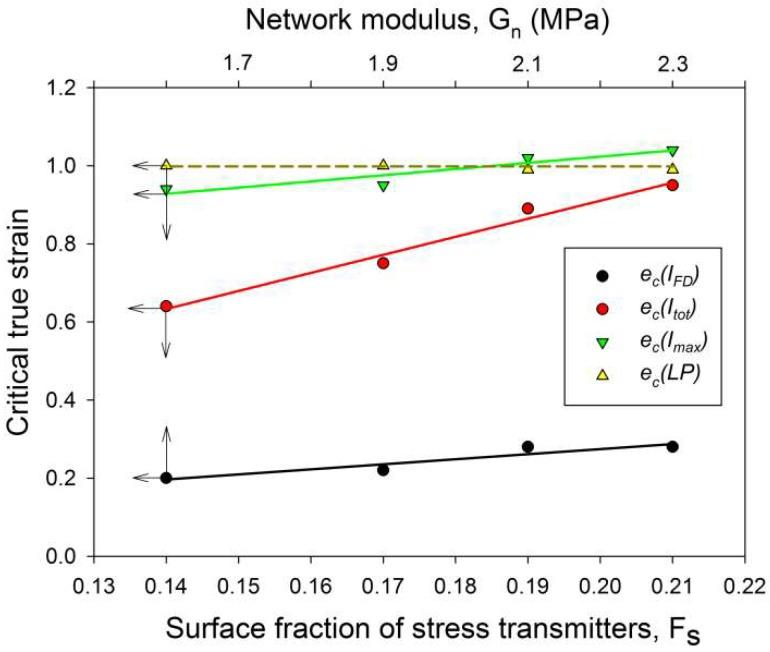
The effect of the topology of the amorphous phase and phase interconnectivity on the stability of the deformation of semicrystalline polyethylene was investigated. The chain topology was modified by crosslinking the samples with electron beam irradiation. The samples were deformed by plane-strain compression, while the accompanying structural changes were monitored with X-ray and differential scanning calorimetry (DSC). At the true strain around of e = 0.3, the lamellar stacks parallel to the loading direction experienced microbuckling instability, which shortly led to the cooperative kinking of lamellae. Macroscopically, this showed up as the 'second yield.' Buckling is driven by the different stiffness levels of the hard and soft layers and their strong connectivity-for given layer thickness, the critical strain for buckling appeared proportional to the stiffness of the amorphous phase. Above e = 1.0, lamellae fragmentation was observed. This resulted from the localization of crystallographic slip, which was triggered by stress concentrations generated at lamellae faces by taut 'stress transmitter' (ST) chains. Accordingly, the fragmentation was found to be dependent on the surface fraction of STs at the amorphous-crystal interface: a low concentration of STs resulted in fewer but stronger stress concentrations, which led to earlier slip localization, followed quickly by lamellae fragmentation. The observed instabilities, either lamellae kinking or fragmentation, profoundly influenced the deformation process as well as the resultant structure. Both phenomena relieved much of the structural constraints imposed on deforming lamellae and make further strain accommodation easier.
研究了非晶相拓扑结构和相互连性对半结晶聚乙烯变形稳定性的影响。通过电子束辐照交联样品来改变链拓扑结构。样品通过平面应变压缩进行变形,同时用X射线和差示扫描量热法(DSC)监测伴随的结构变化。在真应变约为e = 0.3时,平行于加载方向的片晶堆叠经历了微屈曲失稳,这很快导致片晶的协同扭结。宏观上,这表现为“二次屈服”。屈曲是由硬层和软层不同的刚度水平及其强互连性驱动的——对于给定的层厚度,屈曲的临界应变似乎与非晶相的刚度成正比。在e = 1.0以上,观察到片晶破碎。这是由晶体滑移的局部化导致的,晶体滑移是由拉紧的“应力传递体”(ST)链在片晶表面产生的应力集中引发的。因此,发现破碎取决于非晶-晶体界面处ST的表面分数:低浓度的ST导致较少但更强的应力集中,这导致更早的滑移局部化,随后很快发生片晶破碎。观察到的失稳,无论是片晶扭结还是破碎,都深刻地影响了变形过程以及最终的结构。这两种现象都减轻了施加在变形片晶上的许多结构约束,并使进一步的应变适应更容易。


 Zotero 插件