Tomašechová Jana, Hančinský Richard, Predajňa Lukáš, Kraic Ján, Mihálik Daniel, Šoltys Katarína, Vávrová Silvia, Böhmer Miroslav, Sabanadzovic Sead, Glasa Miroslav
Biomedical Research Center of the Slovak Academy of Sciences, Institute of Virology, Dúbravská cesta 9, 84505 Bratislava, Slovak Republic.
Faculty of Natural Sciences, University of Ss. Cyril and Methodius, Nám. J. Herdu 2, 91701 Trnava, Slovak Republic.
Plants (Basel). 2019 Dec 26;9(1):41. doi: 10.3390/plants9010041.
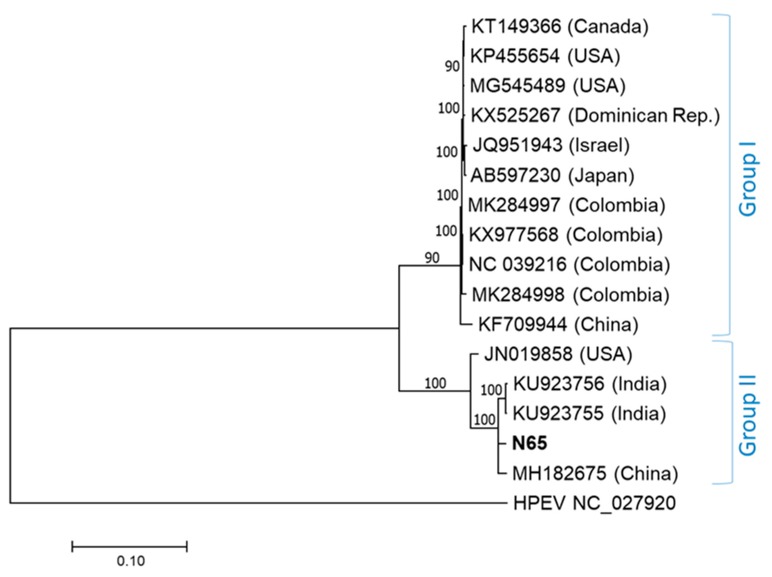
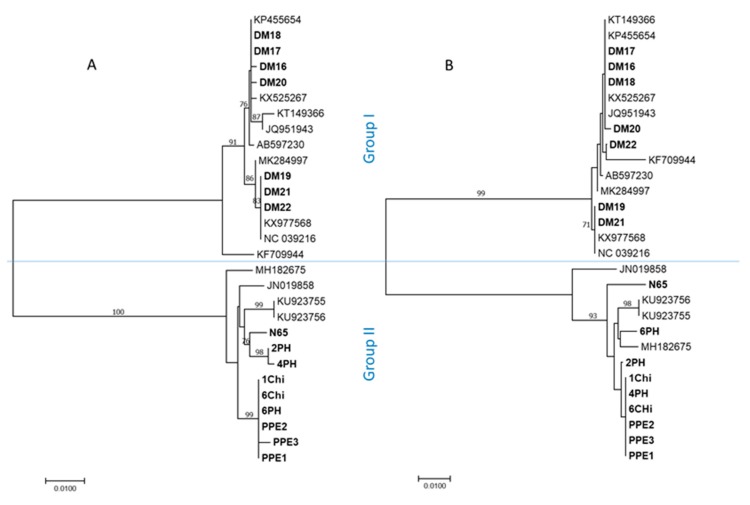
Ribosomal RNA-depleted total RNAs from a sweet pepper plant (, labelled as N65) grown in western Slovakia and showing severe virus-like symptoms (chlorosis, mottling and deformation of leaf lamina) were subjected to high-throughput sequencing (HTS) on an Illumina MiSeq platform. The de novo assembly of ca. 5.5 million reads, followed by mapping to the reference sequences, revealed the coinfection of pepper by several viruses; i.e., cucumber mosaic virus (CMV), watermelon mosaic virus (WMV), pepper cryptic virus 2 (PCV2) and bell pepper endornavirus (BPEV). A complete polyprotein-coding genomic sequence (14.6 kb) of BPEV isolate N65 was determined. A comparison of BPEV-N65 sequences with BPEV genomes available in GenBank showed 86.1% to 98.6% identity at the nucleotide level. The close phylogenetic relationship with isolates from India and China resulted in their distinct grouping compared to the other BPEV isolates. Further analysis has revealed the presence of BPEV in sweet or chili peppers obtained from various sources and locations in Slovakia (plants grown in gardens, greenhouse or retail shop). Additionally, the partial sequencing of two genomic portions from 15 BPEV isolates revealed that the Slovak isolates segregated into two molecular clusters, indicating a genetically distinct population (mean inter-group nucleotide divergence reaching 12.7% and 14.5%, respectively, based on the genomic region targeted). Due to the mix infections of BPEV-positive peppers by potato virus Y (PVY) and/or CMV, the potential role of individual viruses in the observed symptomatology could not be determined. This is the first evidence and characterization of BPEV from the central European region.
从斯洛伐克西部种植的一株甜椒植株(标记为N65)中提取的核糖体RNA耗尽的总RNA,该植株表现出严重的病毒样症状(叶片黄化、斑驳和变形),在Illumina MiSeq平台上进行了高通量测序(HTS)。对约550万个读段进行从头组装,随后与参考序列进行比对,结果显示该甜椒被多种病毒共同感染,即黄瓜花叶病毒(CMV)、西瓜花叶病毒(WMV)、辣椒隐性病毒2(PCV2)和甜椒内病毒(BPEV)。确定了BPEV分离株N65的完整多蛋白编码基因组序列(14.6 kb)。将BPEV-N65序列与GenBank中可用的BPEV基因组进行比较,在核苷酸水平上显示出86.1%至98.6%的同一性。与来自印度和中国的分离株的密切系统发育关系导致它们与其他BPEV分离株形成明显的分组。进一步分析发现,在斯洛伐克不同来源和地点获得的甜椒或辣椒中存在BPEV(花园、温室或零售店种植的植株)。此外,对15个BPEV分离株的两个基因组部分进行的部分测序表明,斯洛伐克分离株分为两个分子簇,表明存在一个遗传上不同的群体(基于靶向的基因组区域,组间平均核苷酸差异分别达到12.7%和14.5%)。由于BPEV阳性甜椒被马铃薯Y病毒(PVY)和/或CMV混合感染,无法确定单个病毒在观察到的症状学中的潜在作用。这是来自中欧地区BPEV的首个证据和特征描述。