Caceres Billy A, Hickey Kathleen T, Bakken Suzanne B, Biviano Angelo B, Garan Hasan, Goldenthal Isaac L, Koleck Theresa A, Masterson-Creber Ruth, Turchioe Meghan Reading, Jia Haomiao
J Cardiovasc Nurs. 2020 Jul/Aug;35(4):327-336. doi: 10.1097/JCN.0000000000000646.
Atrial fibrillation (AF) is associated with high recurrence rates and poor health-related quality of life (HRQOL) but few effective interventions to improve HRQOL exist.
The aim of this study was to examine the impact of the "iPhone Helping Evaluate Atrial Fibrillation Rhythm through Technology" (iHEART) intervention on HRQOL in patients with AF.
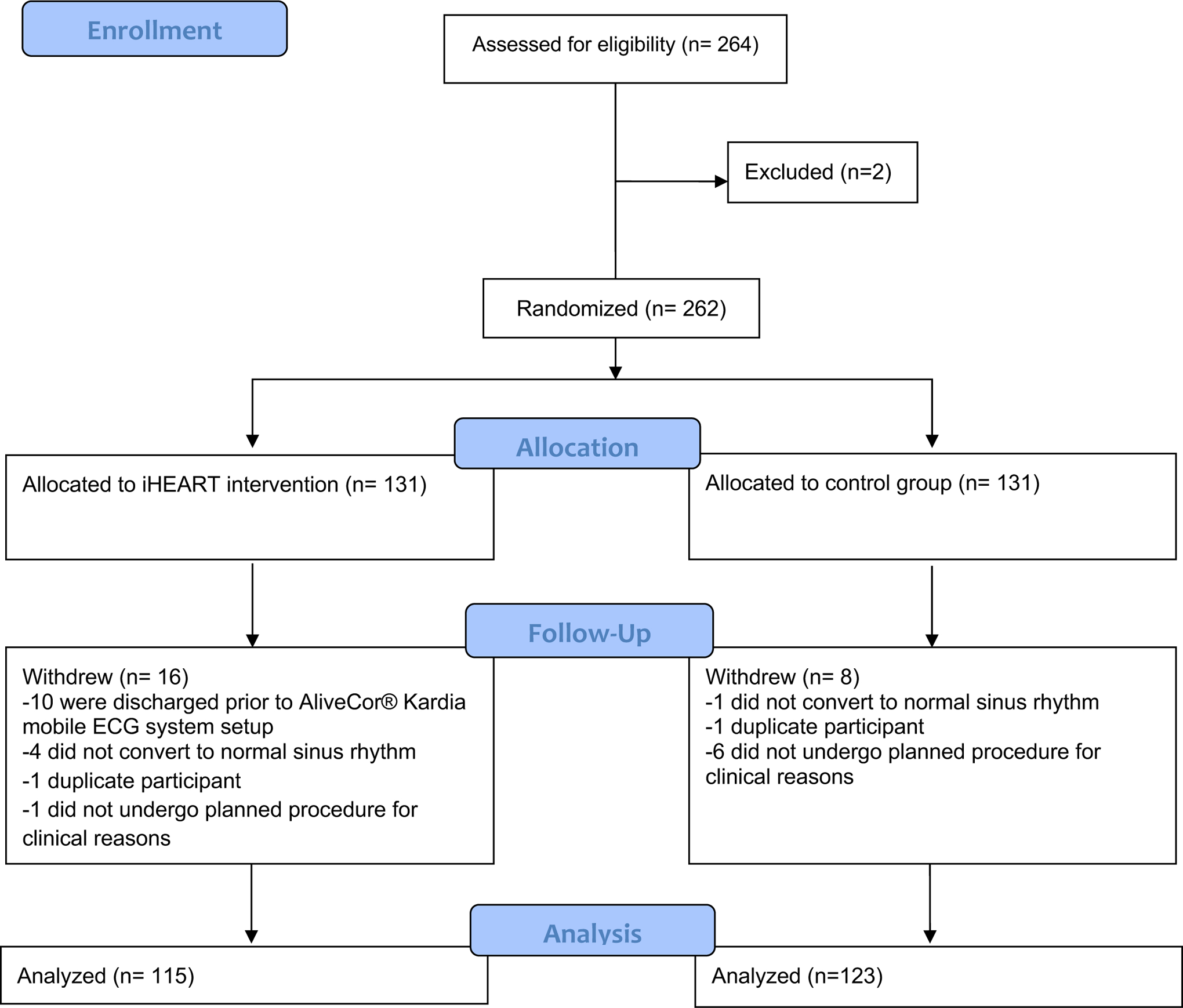
We randomized English- and Spanish-speaking adult patients with AF to receive either the iHEART intervention or usual care for 6 months. The iHEART intervention used smartphone-based electrocardiogram monitoring and motivational text messages. Three instruments were used to measure HRQOL: the Atrial Fibrillation Effect on Quality of Life (AFEQT), the 36-item Short-Form Health survey, and the EuroQol-5D. We used linear mixed models to compare the effect of the iHEART intervention on HRQOL, quality-adjusted life-years, and AF symptom severity.
A total of 238 participants were randomized to the iHEART intervention (n = 115) or usual care (n = 123). Of the participants, 77% were men and 76% were white. More than half (55%) had an AF recurrence. Both arms had improved scores from baseline to follow-up for AFEQT and AF symptom severity scores. The global AFEQT score improved 18.5 and 11.2 points in the intervention and control arms, respectively (P < .05). There were no statistically significant differences in HRQOL, quality-adjusted life-years, or AF symptom severity between groups.
We found clinically meaningful improvements in AF-specific HRQOL and AF symptom severity for both groups. Additional research with longer follow-up should examine the influence of smartphone-based interventions for AF management on HRQOL and address the unique needs of patients diagnosed with different subtypes of AF.
心房颤动(AF)与高复发率及较差的健康相关生活质量(HRQOL)相关,但改善HRQOL的有效干预措施很少。
本研究旨在探讨“通过技术帮助评估心房颤动心律的iPhone”(iHEART)干预措施对AF患者HRQOL的影响。
我们将讲英语和西班牙语的成年AF患者随机分为两组,分别接受iHEART干预或常规护理,为期6个月。iHEART干预使用基于智能手机的心电图监测和激励性短信。使用三种工具测量HRQOL:心房颤动对生活质量的影响(AFEQT)、36项简短健康调查问卷和欧洲五维健康量表。我们使用线性混合模型比较iHEART干预对HRQOL、质量调整生命年和AF症状严重程度的影响。
共有238名参与者被随机分配到iHEART干预组(n = 115)或常规护理组(n = 123)。参与者中,77%为男性,76%为白人。超过一半(55%)的患者出现AF复发。两组从基线到随访时,AFEQT和AF症状严重程度评分均有所改善。干预组和对照组的全球AFEQT评分分别提高了18.5分和11.2分(P < .05)。两组之间在HRQOL、质量调整生命年或AF症状严重程度方面无统计学显著差异。
我们发现两组在AF特异性HRQOL和AF症状严重程度方面均有临床意义的改善。进一步的长期随访研究应考察基于智能手机的AF管理干预措施对HRQOL的影响,并满足不同亚型AF患者的独特需求。