Division of Infectious Disease, Department of Pediatrics, Children's Hospital of Philadelphia, Philadelphia, PA; Center for Pediatric Clinical Effectiveness, Children's Hospital of Philadelphia, Research Institute, Philadelphia, PA; Department of Pediatrics, Perelman School of Medicine of the University of Pennsylvania, Philadelphia, PA.
Center for Pediatric Clinical Effectiveness, Children's Hospital of Philadelphia, Research Institute, Philadelphia, PA.
J Pediatr. 2020 Apr;219:126-132.e2. doi: 10.1016/j.jpeds.2019.12.056. Epub 2020 Feb 6.
To describe the epidemiology of and risk factors associated with acute kidney injury (AKI) during acyclovir treatment in neonates and infants.
We conducted a multicenter (n = 4), retrospective cohort study of all hospitalized infants age <60 days treated with intravenous acyclovir (≥1 dose) for suspected or confirmed neonatal herpes simplex virus disease from January 2011 to December 2015. Infants with serum creatinine measured both before acyclovir (baseline) and during treatment were included. We classified AKI based on changes in creatinine according to published neonatal AKI criteria and performed Cox regression analysis to evaluate risk factors for AKI during acyclovir treatment.
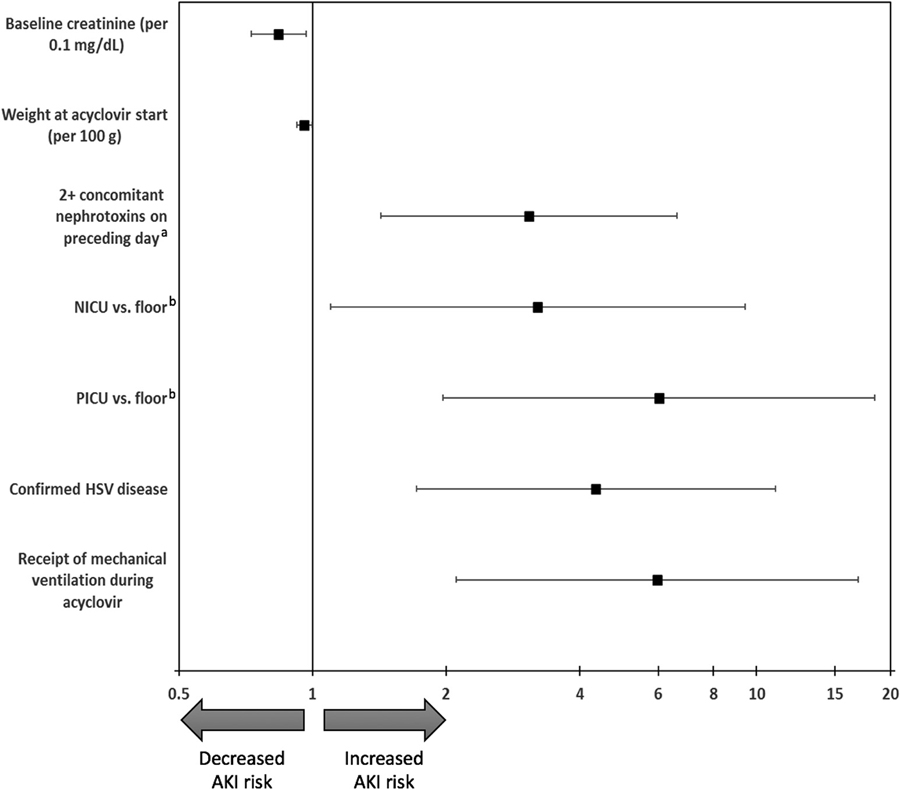
We included 1017 infants. The majority received short courses of acyclovir (median, 5 doses). Fifty-seven infants (5.6%) developed AKI during acyclovir treatment, with an incidence rate of AKI at 11.6 per 1000 acyclovir days. Cox regression analysis identified having confirmed herpes simplex virus disease (OR, 4.35; P = .002), receipt of ≥2 concomitant nephrotoxic medications (OR, 3.07; P = .004), receipt of mechanical ventilation (OR, 5.97; P = .001), and admission to an intensive care unit (OR, 6.02; P = .006) as risk factors for AKI during acyclovir treatment.
Among our cohort of infants exposed to acyclovir, the rate of AKI was low. Sicker infants and those exposed to additional nephrotoxic medications seem to be at greater risk for acyclovir-induced toxicity and warrant closer monitoring.
描述阿昔洛韦治疗新生儿和婴儿单纯疱疹病毒感染时急性肾损伤(AKI)的流行病学和相关危险因素。
我们对 2011 年 1 月至 2015 年 12 月期间因疑似或确诊新生儿单纯疱疹病毒病接受静脉用阿昔洛韦(≥1 剂)治疗的所有住院 <60 天的婴儿进行了一项多中心(n=4)回顾性队列研究。纳入了在阿昔洛韦治疗前(基线)和治疗期间均有血清肌酐测量值的婴儿。我们根据已发表的新生儿 AKI 标准中肌酐的变化对 AKI 进行分类,并进行 Cox 回归分析以评估阿昔洛韦治疗期间 AKI 的危险因素。
我们纳入了 1017 名婴儿。大多数婴儿接受了短期阿昔洛韦治疗(中位数 5 剂)。57 名婴儿(5.6%)在阿昔洛韦治疗期间发生 AKI,AKI 的发生率为每 1000 阿昔洛韦天 11.6 例。Cox 回归分析确定确诊单纯疱疹病毒病(OR,4.35;P=0.002)、同时使用≥2 种肾毒性药物(OR,3.07;P=0.004)、使用机械通气(OR,5.97;P=0.001)和入住重症监护病房(OR,6.02;P=0.006)是阿昔洛韦治疗期间 AKI 的危险因素。
在我们接受阿昔洛韦暴露的婴儿队列中,AKI 的发生率较低。病情较重的婴儿和同时使用其他肾毒性药物的婴儿似乎面临更高的阿昔洛韦毒性风险,需要更密切的监测。