Tongde Hospital of Zhejiang Province, affiliated with Zhejiang Chinese Medicine University, Hangzhou, 310012, People's Republic of China.
Zhejiang Chinese Medicine University, Hangzhou, 310053, People's Republic of China.
Stem Cell Res Ther. 2020 Feb 26;11(1):83. doi: 10.1186/s13287-020-01595-w.
Autologous peripheral blood stem cell (auto-PBSC) transplantation is an effective therapeutic for the osteonecrosis of the femoral head (ONFH) but without prognosis estimation. This study mainly aimed to (1) determine whether auto-PBSC transplantation is a promising option, (2) assess the risk of hip-preservation failure, (3) achieve a predictive model of femoral head survival after the intervention, and (4) eventually identify clinical indications for auto-PBSC transplantation in future.
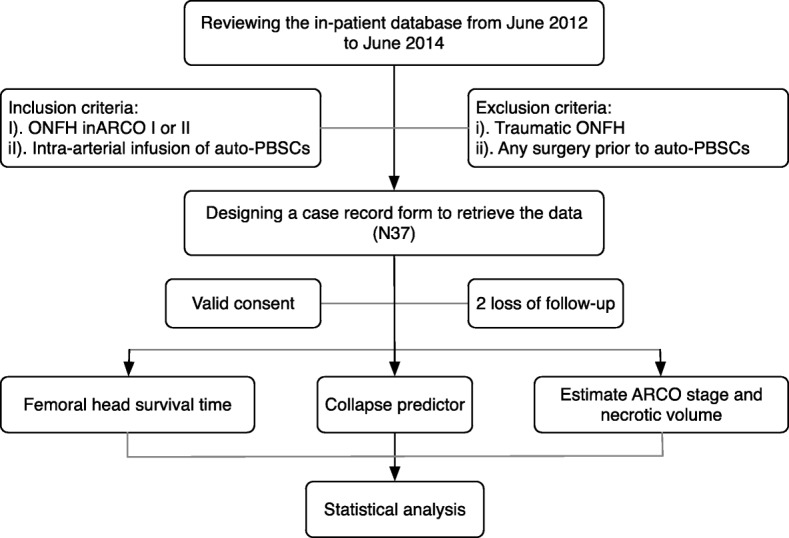
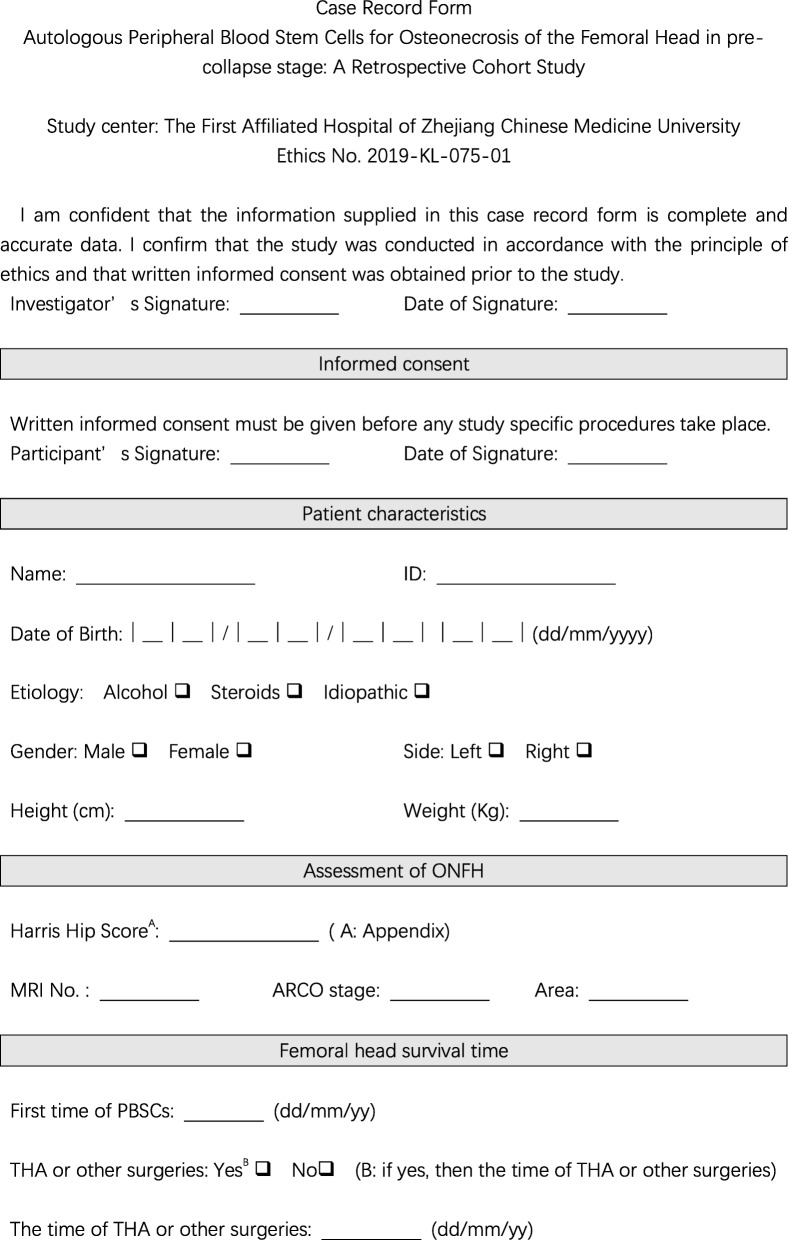
After reviewing the in-patient database of the First Affiliated Hospital of Zhejiang Chinese Medicine University from June 2012 to June 2014, 37 eligible patients with Association Research Circulation Osseous stage I or II ONFH who were receiving intra-arterial infusion of auto-PBSCs were recruited. A case form was designed to retrieve relevant data. Hip-preservation failure was defined as the endpoint. All participants were stratified by the categorical risk of collapse, which was statistically tested through log-rank analysis. All significant factors were evaluated using Cox proportional hazards regression model, and a predictive nomogram plot was generated.
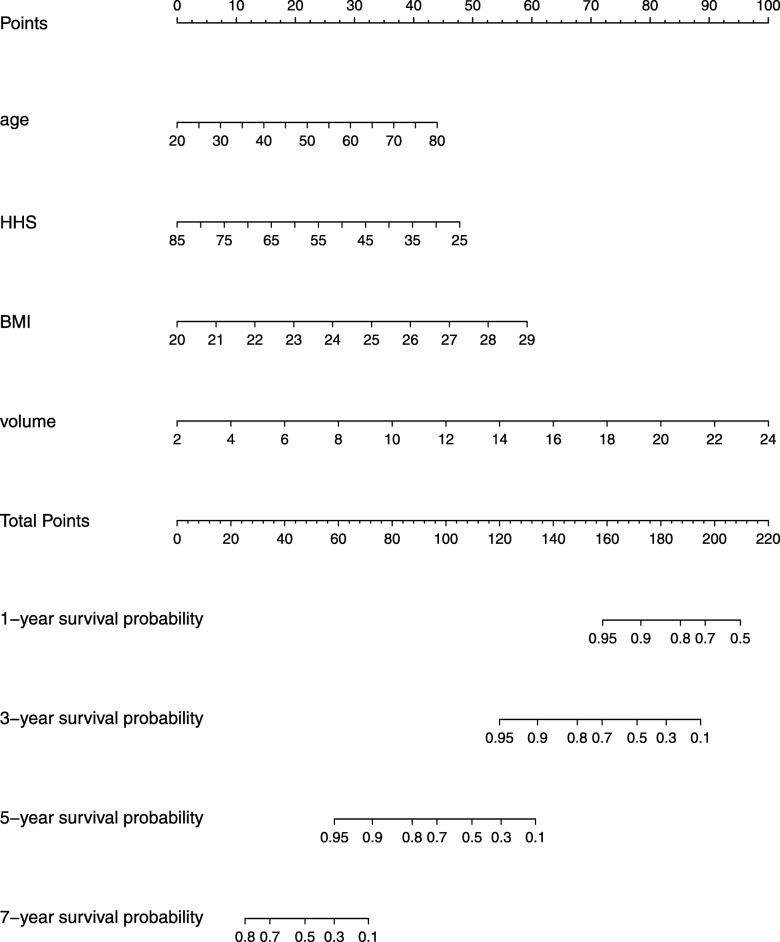
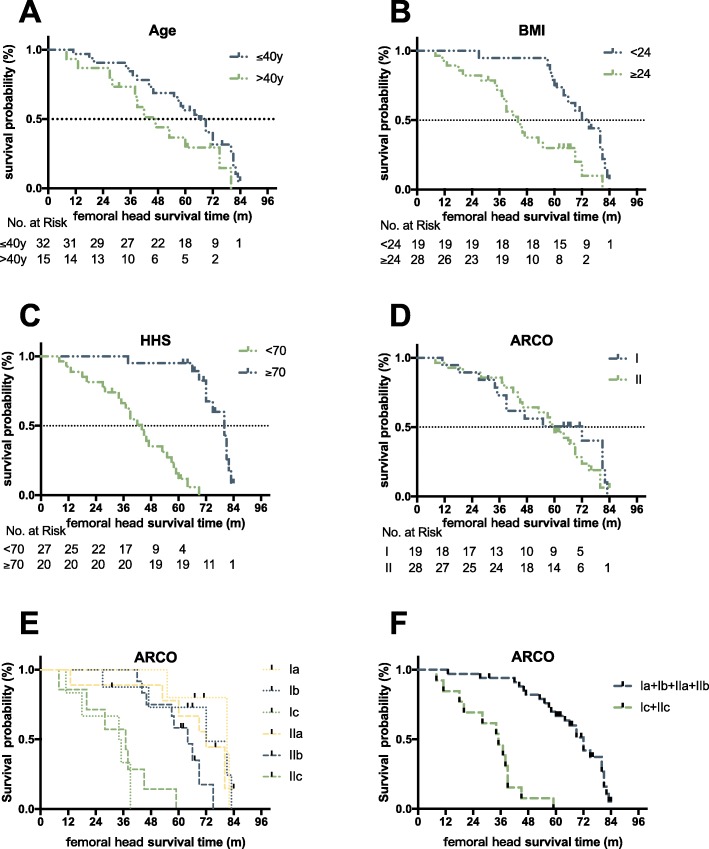
In total, 47 hips were followed up for 53.96 ± 21.09 months; the median survival time was 60.18 months. Among the predictors, body mass index (BMI; P = 0.0015) and Harris hip score (HHS; P < 0.0001) independently affected femoral head survival. Patients with BMI ≥ 24 kg/m exhibited a 2.58 times higher risk of hip-preservation failure [95% confidence interval (CI), 1.32-5.45] than those with BMI < 24 kg/m, whereas those with HHS ≥ 70 exhibited a 0.19 times lower risk (95% CI, 0.09-0.38) than those with HHS < 70. Hazard ratios associated with age (P = 0.042), BMI (P = 0.012), HHS (P = 0.022), and necrotic volume (P = 0.000) were 1.038 (95% CI, 1.001-1.075), 1.379 (95% CI, 1.072-1.773), 0.961 (95% CI, 0.928-0.994), and 1.258 (95% CI, 1.120-1.412), respectively. A nomogram plot (score test P = 0.000; C-index = 0.8863) was available for the orthopedic doctor to predict hip survival probability.
The results suggest that intra-arterial infusion of auto-PBSCs prolongs femoral head survival. Age, BMI, HHS, and necrotic volume can influence the efficacy of this intervention. This study was approved by ethics committee of the trial center, number 2019-KL-075-01.
自体外周血干细胞(auto-PBSC)移植是治疗股骨头坏死(ONFH)的有效方法,但缺乏预后评估。本研究主要旨在:(1)确定自体 PBSC 移植是否是一种有前途的选择;(2)评估髋关节保存失败的风险;(3)实现干预后股骨头存活的预测模型;(4)最终确定自体 PBSC 移植的临床适应证。
回顾 2012 年 6 月至 2014 年 6 月浙江中医药大学第一附属医院住院患者数据库,纳入 37 例接受自体 PBSC 动脉内输注的 Association Research Circulation Osseous 分期 I 或 II 期 ONFH 患者。设计病例表格以检索相关数据。髋关节保存失败定义为终点。通过对数秩检验对分类塌陷风险进行统计学检验。使用 Cox 比例风险回归模型评估所有显著因素,并生成预测列线图。
共随访 47 髋,随访时间为 53.96±21.09 个月,中位生存时间为 60.18 个月。在预测因素中,体重指数(BMI;P=0.0015)和 Harris 髋关节评分(HHS;P<0.0001)独立影响股骨头存活。BMI≥24kg/m2 的患者髋关节保存失败的风险是 BMI<24kg/m2 的患者的 2.58 倍[95%置信区间(CI),1.32-5.45],而 HHS≥70 的患者髋关节保存失败的风险是 HHS<70 的患者的 0.19 倍(95%CI,0.09-0.38)。与年龄(P=0.042)、BMI(P=0.012)、HHS(P=0.022)和坏死体积(P=0.000)相关的危险比分别为 1.038(95%CI,1.001-1.075)、1.379(95%CI,1.072-1.773)、0.961(95%CI,0.928-0.994)和 1.258(95%CI,1.120-1.412)。为骨科医生提供了一个列线图(评分检验 P=0.000;C 指数=0.8863),以预测髋关节存活概率。
结果表明,动脉内输注自体 PBSC 可延长股骨头的存活时间。年龄、BMI、HHS 和坏死体积会影响该干预措施的疗效。本研究经试验中心伦理委员会批准,编号为 2019-KL-075-01。