
频谱高效光正交频分复用
Spectrally efficient optical orthogonal frequency division multiplexing.
作者信息
Lowery Arthur James
机构信息
Department of Electrical and Computer Systems Engineering, Monash University, Clayton, Victoria 3800, Australia.
出版信息
Philos Trans A Math Phys Eng Sci. 2020 Apr 17;378(2169):20190180. doi: 10.1098/rsta.2019.0180. Epub 2020 Mar 2.
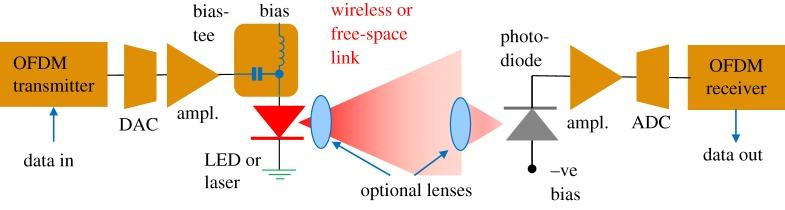
This paper charts the development of spectrally efficient forms of optical orthogonal frequency division multiplexing (OFDM) that are suited for intensity-modulated direct detection systems, such as wireless optical communications. The journey begins with systems using a DC-bias to ensure that no parts of the signal that modulates the optical source are negative in value, as negative optical intensity is unphysical. As the DC-part of the optical signal carries no information, it is wasteful in energy; thus asymmetrically clipped optical OFDM was developed, removing any negative-going peaks below the mean. Unfortunately, the clipping causes second-order distortion and intermodulation, so some subcarriers appear to be unusable, halving spectral efficiency; this is similar for unipolar and flipped optical OFDM. Thus, a considerable effort has been made to regain spectral efficiency, using layered techniques where the clipping distortion is mostly cancelled at the receiver, from a knowledge of one unpolluted layer, enabling one or more extra 'layers/paths/depths' to be received on the previously unusable subcarriers. Importantly, for a given optical power and high-order modulation, layered methods offer the best spectral efficiencies and need the lowest signal-to-noise ratios, especially if diversity combining is used. Thus, they could be important for high-bandwidth optical fibre systems. Efficient methods of generating all layers simultaneously, using fast Fourier transforms with their partial calculations extracted, are discussed, as are experimental demonstrations in both wireless and short-haul communications links. A musical analogy is also provided, which may point to how orchestral and rock music is deciphered in the brain. This article is part of the theme issue 'Optical wireless communication'.
本文阐述了适用于强度调制直接检测系统(如无线光通信)的频谱高效光正交频分复用(OFDM)形式的发展历程。旅程始于使用直流偏置的系统,以确保调制光源的信号部分在值上不为负,因为负光强度是不符合物理规律的。由于光信号的直流部分不携带信息,在能量方面是一种浪费;因此开发了非对称限幅光OFDM,去除均值以下的任何负向峰值。不幸的是,限幅会导致二阶失真和互调,所以一些子载波似乎无法使用,频谱效率减半;单极性和翻转光OFDM也是如此。因此,人们付出了相当大的努力来恢复频谱效率,采用分层技术,在接收机处根据一层未受污染的信息,大部分消除限幅失真,从而在先前无法使用的子载波上接收一个或多个额外的“层/路径/深度”。重要的是,对于给定的光功率和高阶调制,分层方法提供了最佳的频谱效率,并且需要最低的信噪比,特别是如果使用分集合并的话。因此,它们对于高带宽光纤系统可能很重要。文中讨论了使用快速傅里叶变换并提取其部分计算结果来同时生成所有层的高效方法,以及在无线和短距离通信链路中的实验演示。还提供了一个音乐类比,这可能指向大脑如何解读管弦乐和摇滚乐。本文是主题为“光无线通信”的一部分。



 Zotero 插件