Pan Xiafei, Xu Kai, Wang Xin, Chen Guofu, Cheng Huanhuan, Liu Alice Jia, Hou Laurence Tang, Zhong Lin, Chen Jie, Liang Yuanbo
1Department of Ophthalmology, Guangdong Provincial Key Laboratory of Malignant Tumor Epigenetics and Gene Regulation, Sun Yat-sen Memorial Hospital, Sun Yat-sen University, Guangzhou, China.
2School of Ophthalmology and Optometry, Eye Hospital, Wenzhou Medical University, No. 270, Xue Yuan Xi Road, Wenzhou, 3250027 Zhejiang China.
Eye Vis (Lond). 2020 Mar 1;7:12. doi: 10.1186/s40662-020-0175-9. eCollection 2020.
Exercise is widely known to lower intraocular pressure and increase ocular blood flow, which may be beneficial for glaucoma management. However, there are few studies that have reported on the relationship between exercise and glaucoma progression. The aim of our study was to investigate the exercise habits of those with primary open angle glaucoma (POAG) and its association with the progression of visual field (VF) loss.
Daily physical activity (PA) was monitored by an accelerometer (ActiGraph wGT3x-BT) which patients wore for more than 10 h of being awake on their right wrists for 1 week.
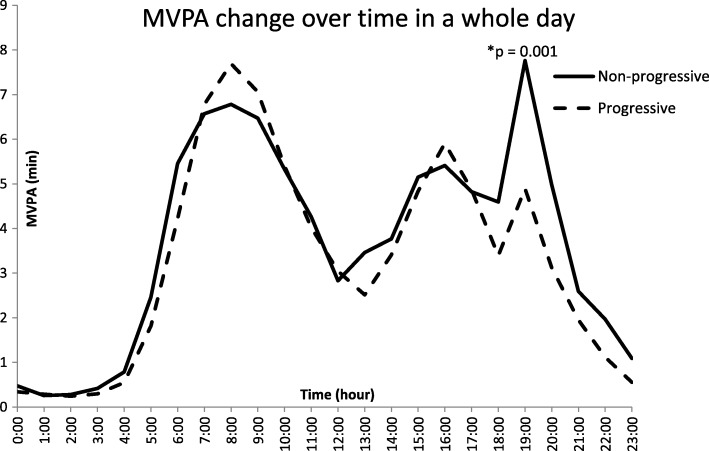
Seventy-one non-progressive and 27 progressive patients were enrolled in the study. 24-h moderate to vigorous physical activity (MVPA) exercise showed that POAG patients had similar variation trends consisting of 3 wave peaks and 2 wave hollows. Minutes spent in MVPA was 19.89 ± 15.81 and 21.62 ± 15.10 during 07:00-09:00 h ( = 0.204), 15.40 ± 14.49 and 15.67 ± 12.43 during 15:00-17:00 h ( = 0.822) and 17.26 ± 21.11 and 11.42 ± 11.58 during 18:00-20:00 h ( = 0.001) in the non-progressive and progressive group, respectively. Univariate analysis indicated that 10 min of MVPA (18:00-20:00 h) [odds ratio, OR (95% CI) = 0.82 (0.73, 0.92)], average mean arterial pressure [OR (95% CI) = 0.96 (0.94, 0.98)], age [OR (95% CI) = 1.06 (1.03, 1.08)], male [OR (95% CI) = 0.67 (0.48, 0.96)], spherical equivalent [OR (95% CI) = 1.14 (1.07, 1.22)] and IOP-lowering medications [OR (95% CI) = 1.54 (1.16, 2.05)] were significantly correlated with having progressive VF damage. Multivariable analysis showed that 10 min of MVPA (18:00-20:00 h) [OR (95% CI) = 0.85 (0.75, 0.97)] was associated with progressive VF loss even after adjusting for other risk factors.
Evening exercise may lower the odds of VF progression, suggesting that exercise habits possibly play an important role in glaucoma progression.
众所周知,运动可降低眼压并增加眼部血流量,这可能对青光眼的治疗有益。然而,很少有研究报道运动与青光眼进展之间的关系。我们研究的目的是调查原发性开角型青光眼(POAG)患者的运动习惯及其与视野(VF)损失进展的关联。
通过加速度计(ActiGraph wGT3x - BT)监测日常身体活动(PA),患者将其佩戴在右手腕上,在清醒状态下佩戴超过10小时,持续1周。
71例病情无进展患者和27例病情进展患者纳入本研究。24小时中度至剧烈身体活动(MVPA)锻炼显示,POAG患者有相似的变化趋势,包括3个波峰和2个波谷。无进展组和进展组在07:00 - 09:00时MVPA的时长分别为19.89±15.81分钟和21.62±15.10分钟(P = 0.204),15:00 - 17:00时分别为15.40±14.49分钟和15.67±12.43分钟(P = 0.822),18:00 - 20:00时分别为17.26±21.11分钟和11.42±11.58分钟(P = 0.001)。单因素分析表明,10分钟的MVPA(18:00 - 20:00时)[比值比,OR(95%可信区间)= 0.82(0.73,0.92)]、平均动脉压[OR(95%可信区间)= 0.96(0.94,0.98)]、年龄[OR(95%可信区间)= 1.06(1.03,1.08)]、男性[OR(95%可信区间)= 0.67(0.48,0.96)]、等效球镜度[OR(95%可信区间)= 1.14(1.07,1.22)]以及降眼压药物[OR(95%可信区间)= 1.54(1.16,2.05)]与VF损害进展显著相关。多变量分析显示,即使在调整其他危险因素后,10分钟的MVPA(18:00 - 20:00时)[OR(95%可信区间)= 0.85(0.75,0.97)]仍与VF损失进展相关。
傍晚运动可能降低VF进展的几率,这表明运动习惯可能在青光眼进展中起重要作用。