Batalik Ladislav, Dosbaba Filip, Hartman Martin, Batalikova Katerina, Spinar Jindrich
Department of Rehabilitation.
Department of Cardiology and Internal Medicine, University Hospital Brno.
Medicine (Baltimore). 2020 Mar;99(11):e19556. doi: 10.1097/MD.0000000000019556.
Telerehabilitation in cardiology has the potential to become the alternative to regular outpatient cardiac rehabilitation. Our study focuses on the wrist heart rate monitor as a telerehabilitation device, defines detected limitations, and compares results between home-based and regular outpatient rehabilitation methods, related to physical fitness, quality of life, and training adherence. The study design was a randomized controlled trial.
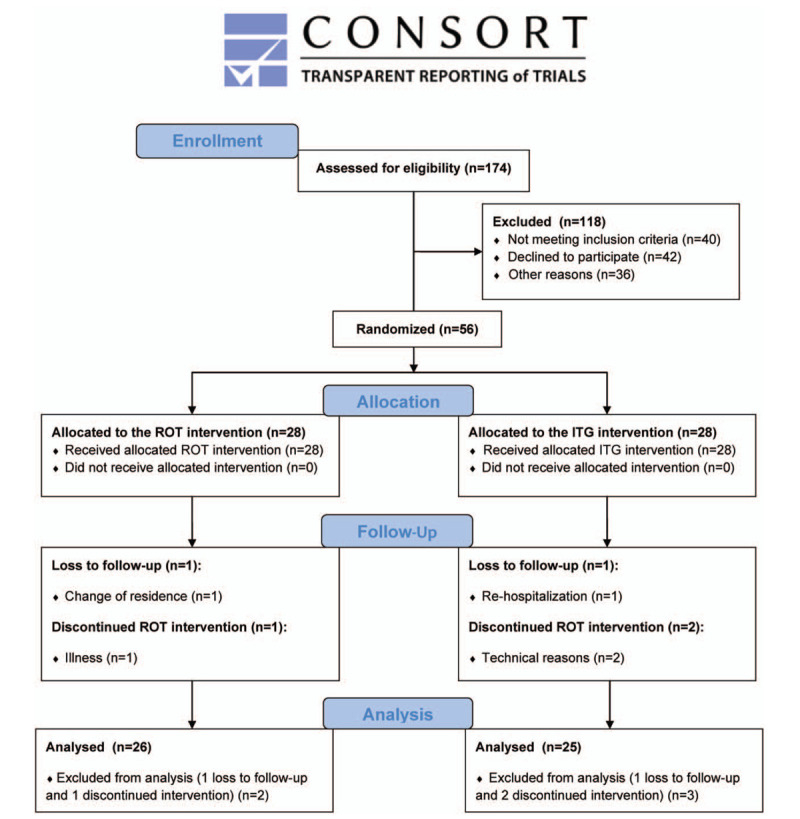
Eligible 56 cardiac rehabilitation patients were randomized into a 12-week regular outpatient training group (ROT) and interventional home-based telerehabilitation group (ITG). For both groups, the intensity of the training was prescribed to be performed at 70% to 80% of heart rate reserve for 60 minutes, 3 times a week. The ITG patients started their training with a wrist heart rate monitor in their home environment. These patients received feedback once a week, reflecting data uploaded on the internet application. The ROT patients performed their exercise under the direct supervision of a physical specialist in a regular outpatient clinic. Physical fitness and health-related quality of life were assessed at baseline and after 12 weeks. Training adherence in both groups was determined and compared.
Fifty-one patients comleted the intervention (91%); no serious adverse events were recorded. Physical fitness expressed as peak oxygen uptake showed significant improvement (P < .001) in ROT group from 23.4 ± 3.3 to 25.9 ± 4.1 mL/kg/min and (P < .01) in ITG group from 23.7 ± 4.1 to 26.5 ± 5.7 mL/kg/min without significant between-group differences after 12 weeks of intervention. The training adherence between groups was similar.
Our study shows that telerehabilitation via wrist heart rate monitor could become an alternative kind of cardiac rehabilitation which deserves attention and further analyzing.
心脏病远程康复有潜力成为常规门诊心脏康复的替代方案。我们的研究聚焦于腕部心率监测器作为一种远程康复设备,明确检测到的局限性,并比较家庭式和常规门诊康复方法在体能、生活质量和训练依从性方面的结果。研究设计为随机对照试验。
56名符合条件的心脏康复患者被随机分为12周的常规门诊训练组(ROT)和干预性家庭远程康复组(ITG)。两组的训练强度均规定为以心率储备的70%至80%进行60分钟,每周3次。ITG组患者在家庭环境中使用腕部心率监测器开始训练。这些患者每周收到一次反馈,反馈内容反映上传至互联网应用程序的数据。ROT组患者在常规门诊诊所的物理治疗专家直接监督下进行锻炼。在基线和12周后评估体能和与健康相关的生活质量。确定并比较两组的训练依从性。
51名患者完成了干预(91%);未记录到严重不良事件。以峰值摄氧量表示的体能在ROT组中从23.4±3.3显著提高到25.9±4.1 mL/kg/min(P<0.001),在ITG组中从23.7±4.1显著提高到26.5±5.7 mL/kg/min(P<0.01),干预12周后组间无显著差异。两组间的训练依从性相似。
我们的研究表明,通过腕部心率监测器进行的远程康复可成为一种值得关注和进一步分析的心脏康复替代方式。