Baling Marleen, Stuart-Fox Devi, Brunton Dianne H, Dale James
Unitec Institute of Technology Auckland New Zealand.
School of Natural and Computational Sciences Massey University (Albany Campus) Auckland New Zealand.
Ecol Evol. 2020 Feb 22;10(5):2310-2319. doi: 10.1002/ece3.6024. eCollection 2020 Mar.
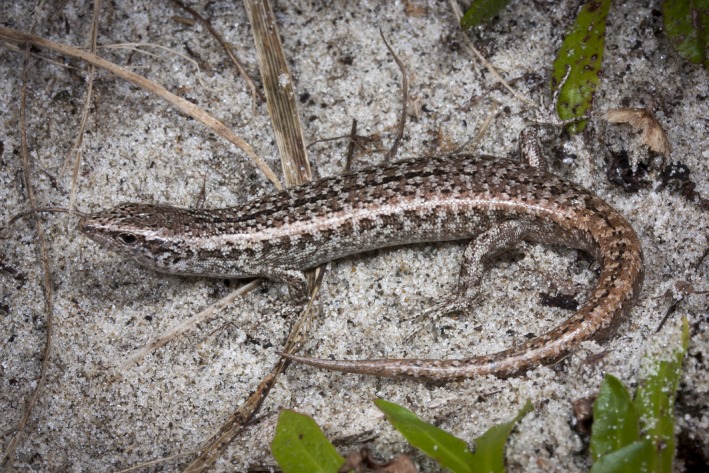
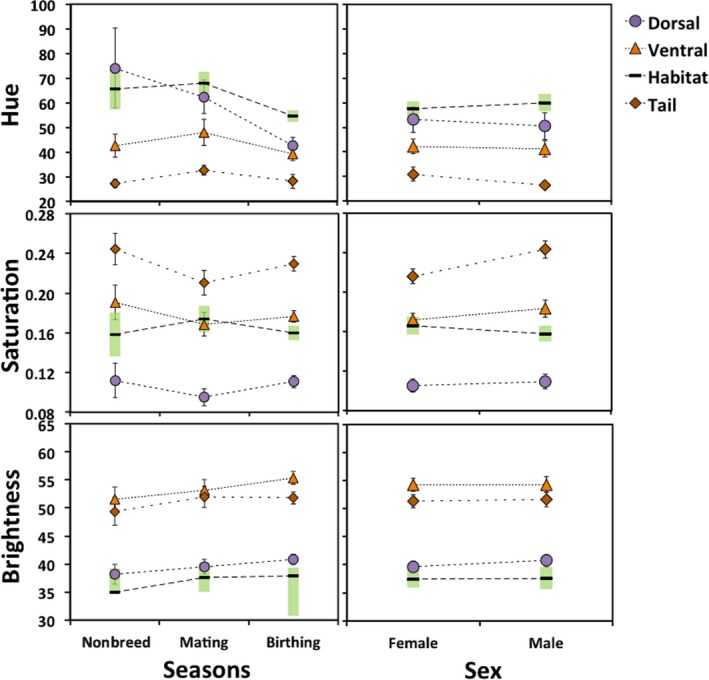
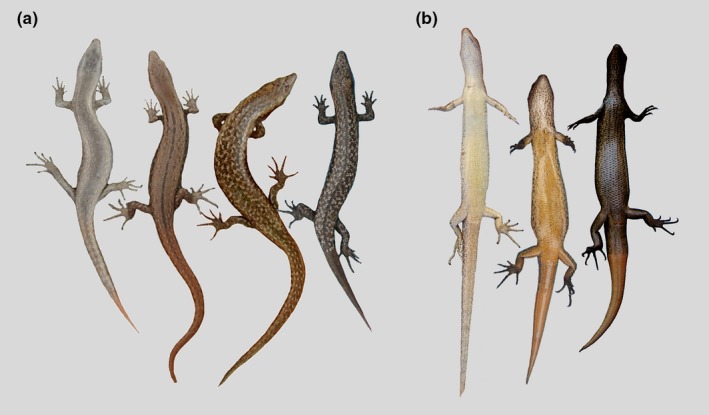
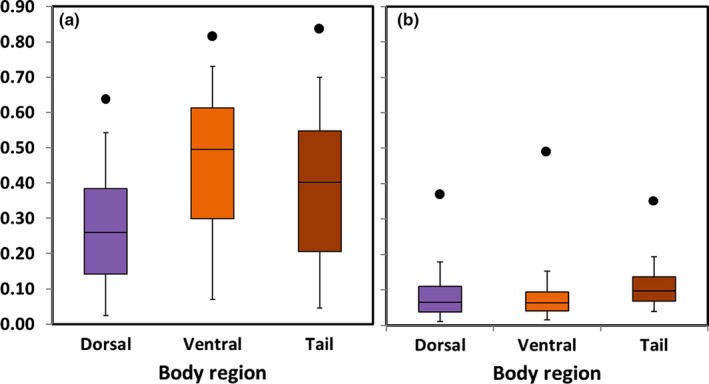
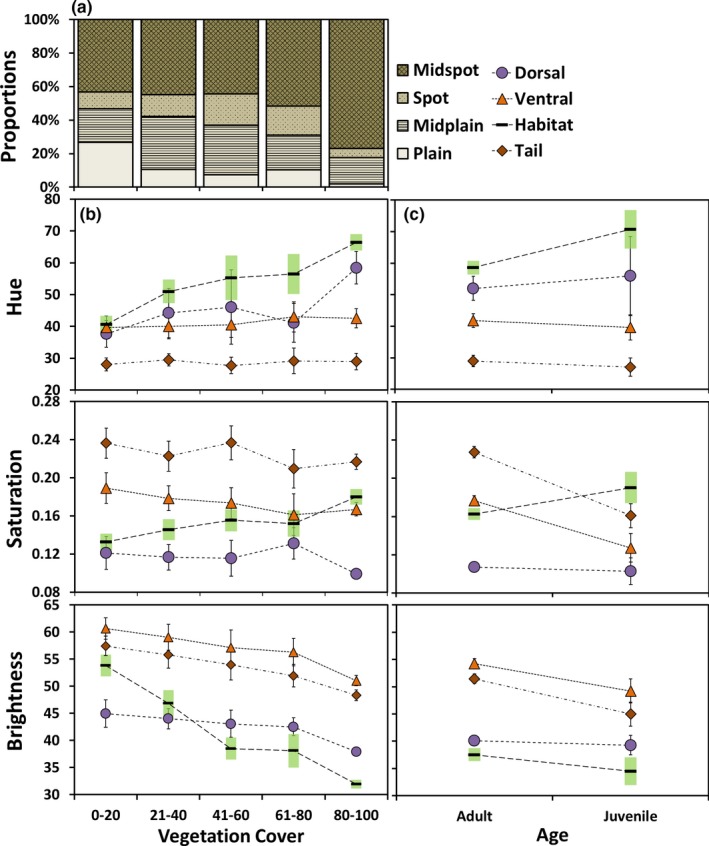
In heterogeneous habitats, camouflage via background matching can be challenging because visual characteristics can vary dramatically across small spatial scales. Additionally, temporal variation in signaling functions of coloration can affect crypsis, especially when animals use coloration seasonally for intraspecific signaling (e.g., mate selection). We currently have a poor understanding of how wild prey optimize background matching within continuously heterogeneous habitats, and whether this is affected by requirements of intraspecific signaling across biological seasons. Here, we quantified color patterns of a wild population of shore skink (), a variably colored lizard endemic to New Zealand, to (a) investigate whether background matching varies across a vegetation gradient; (b) assess potential signaling functions of color; and (c) to determine whether there is a trade-off between requirements for crypsis and intraspecific signaling in coloration across seasons. Although all pattern types occurred throughout the vegetation gradient, we found evidence for background matching in skinks across the vegetation gradient, where dorsal brightness and pattern complexity corresponded with the proportion of vegetation cover. There was also a significant disparity between ventral color (saturation) of juveniles and adults, and also between sexes, suggestive of sex recognition. However, there was little indication that color was condition-dependent in adults. Despite some evidence for a potential role in signaling, crypsis did not greatly differ across seasons. Our study suggests that selection favors a mix of generalist and specialist background matching strategies across continuously heterogeneous habitats.
在异质栖息地中,通过与背景匹配来实现伪装可能具有挑战性,因为视觉特征在小空间尺度上可能会有显著变化。此外,颜色信号功能的时间变化会影响保护色,特别是当动物季节性地利用颜色进行种内信号传递时(例如配偶选择)。目前,我们对野生猎物如何在持续异质的栖息地中优化与背景的匹配,以及这是否受到生物季节中种内信号传递需求的影响了解甚少。在这里,我们对新西兰特有的一种颜色多变的蜥蜴——海岸石龙子的野生种群的颜色模式进行了量化,以(a)研究与背景的匹配是否随植被梯度而变化;(b)评估颜色的潜在信号功能;以及(c)确定在整个季节中,保护色需求与种内信号传递在颜色方面是否存在权衡。尽管所有图案类型都出现在整个植被梯度中,但我们发现有证据表明石龙子在整个植被梯度中都存在与背景的匹配,其背部亮度和图案复杂度与植被覆盖比例相对应。幼体和成体的腹部颜色(饱和度)之间以及两性之间也存在显著差异,这表明存在性别识别。然而,几乎没有迹象表明颜色在成体中依赖于身体状况。尽管有一些证据表明颜色在信号传递中可能发挥作用,但保护色在不同季节之间并没有太大差异。我们的研究表明,在持续异质的栖息地中,选择有利于通才型和专才型背景匹配策略的混合。