
壳聚糖在棉织物和涤棉混纺织物中的应用
The Chitosan Implementation into Cotton and Polyester/Cotton Blend Fabrics.
作者信息
Flinčec Grgac Sandra, Tarbuk Anita, Dekanić Tihana, Sujka Witold, Draczyński Zbigniew
机构信息
Department of Textile Chemistry and Ecology, University of Zagreb Faculty of Textile Technology, Prilaz baruna Filipovića 28a, HR-10000 Zagreb, Croatia.
Tricomed SA production company, ul. Świętojańska 5/9, 93-493 Lódź, Poland.
出版信息
Materials (Basel). 2020 Apr 1;13(7):1616. doi: 10.3390/ma13071616.
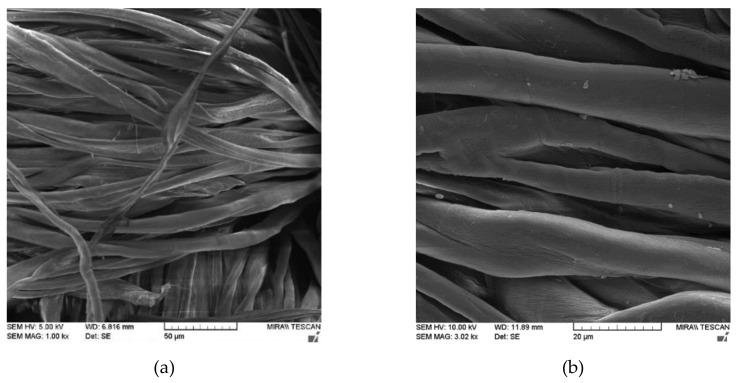
Chitosan is an environmentally friendly agent that is used to achieve the antimicrobial properties of textiles. Nowadays, the binding of chitosan to the textiles has been thoroughly researched due to the increasing demands on the stability of achieved properties during the textile care processes. Most crosslinking agents for chitosan are not safe for humans or environment, such as glutaric aldehyde (GA) and formaldehyde derivatives. Eco-friendly polycarboxyilic acids (PCAs) are usually used in after-treatment. In this work, chitosan powder was dissolved in citric acid with sodium hydrophosphite (SHP) as a catalyst. Standard cotton (CO) and polyester/cotton (PES/CO) fabrics were pretreated in 20% NaOH, similar to mercerization, in order to open the structure of the cotton fibers and hydrolyze polyester fibers, continued by finishing in the gelatin chitosan bath. Afterwards, the hot rinsing process, followed by drying and curing, closed the achieved structure. The main objective was to achieve durable antimicrobial properties to multiple maintenance cycles CO and PES/CO fabric in order to apply it in a hospital environment. The characterization of fabrics was performed after treatment, first and fifth washing cycles according ISO 6330:2012 by field emission scanning electron microscopy (FE-SEM), Fourier transform infrared spectroscopy (FTIR-ATR), electrokinetic analysis (EKA), by the determination of tensile properties and mechanical damage (wear), and the antimicrobial activity. The application of 20% NaOH led to the swelling and mercerization of cotton cellulose, and hydrolysis of polyester, resulting in better mechanical properties. It has been confirmed that the chitosan particles were well implemented into the cotton fiber and onto to the polyester component of PES/CO blend. The presence of chitosan was confirmed after five washing cycles, but in lower quantity. However, achieved antimicrobial activity is persistent.
壳聚糖是一种环保型试剂,用于实现纺织品的抗菌性能。如今,由于对纺织品护理过程中所获性能稳定性的要求不断提高,壳聚糖与纺织品的结合已得到深入研究。大多数用于壳聚糖的交联剂对人类或环境不安全,如戊二醛(GA)和甲醛衍生物。环保型多元羧酸(PCA)通常用于后处理。在本研究中,壳聚糖粉末溶解于柠檬酸中,并以次磷酸钠(SHP)作为催化剂。标准棉(CO)和聚酯/棉(PES/CO)织物在20%氢氧化钠中进行预处理,类似于丝光处理,以打开棉纤维结构并水解聚酯纤维,随后在明胶壳聚糖浴中进行整理。之后,经过热漂洗过程,接着干燥和固化,封闭所形成的结构。主要目的是使CO和PES/CO织物在多次维护循环中获得持久的抗菌性能,以便应用于医院环境。根据ISO 6330:2012,在处理后、第一次和第五次洗涤循环后,通过场发射扫描电子显微镜(FE-SEM)、傅里叶变换红外光谱(FTIR-ATR)、电动分析(EKA)、测定拉伸性能和机械损伤(磨损)以及抗菌活性对织物进行表征。20%氢氧化钠的应用导致棉纤维素膨胀和丝光化以及聚酯水解,从而产生更好的机械性能。已证实壳聚糖颗粒很好地嵌入到棉纤维中以及PES/CO混纺织物的聚酯组分上。经过五次洗涤循环后仍证实有壳聚糖存在,但数量较少。然而,所获得的抗菌活性是持久的。



 Zotero 插件