• 文献检索
  • 文档翻译
  • 深度研究
  • 学术资讯
  • Suppr Zotero 插件Zotero 插件
  • 邀请有礼
  • 套餐&价格
  • 历史记录
应用&插件
Suppr Zotero 插件Zotero 插件浏览器插件Mac 客户端Windows 客户端微信小程序
定价
高级版会员购买积分包购买API积分包
服务
文献检索文档翻译深度研究API 文档MCP 服务
关于我们
关于 Suppr公司介绍联系我们用户协议隐私条款
关注我们

Suppr 超能文献

核心技术专利:CN118964589B侵权必究
粤ICP备2023148730 号-1Suppr @ 2026

文献检索

告别复杂PubMed语法,用中文像聊天一样搜索,搜遍4000万医学文献。AI智能推荐,让科研检索更轻松。

立即免费搜索

文件翻译

保留排版,准确专业,支持PDF/Word/PPT等文件格式,支持 12+语言互译。

免费翻译文档

深度研究

AI帮你快速写综述,25分钟生成高质量综述,智能提取关键信息,辅助科研写作。

立即免费体验

粗糙度表面拓扑诱导细菌细胞膜损伤的相关体外和液相细胞透射电镜观察。

Correlative ex situ and Liquid-Cell TEM Observation of Bacterial Cell Membrane Damage Induced by Rough Surface Topology.

机构信息

Department of Bioengineering, University of Illinois at Chicago, Chicago, IL 60607, USA.

Department of Mechanical and Industrial Engineering, University of Illinois at Chicago, Chicago, IL 60607, USA.

出版信息

Int J Nanomedicine. 2020 Mar 20;15:1929-1938. doi: 10.2147/IJN.S232230. eCollection 2020.

DOI:10.2147/IJN.S232230
PMID:32256069
原文链接:https://pmc.ncbi.nlm.nih.gov/articles/PMC7093104/
Abstract

BACKGROUND

Nanoscale surface roughness has been suggested to have antibacterial and antifouling properties. Several existing models have attempted to explain the antibacterial mechanism of nanoscale rough surfaces without direct observation. Here, conventional and liquid-cell TEM are implemented to observe nanoscale bacteria/surface roughness interaction. The visualization of such interactions enables the inference of possible antibacterial mechanisms.

METHODS AND RESULTS

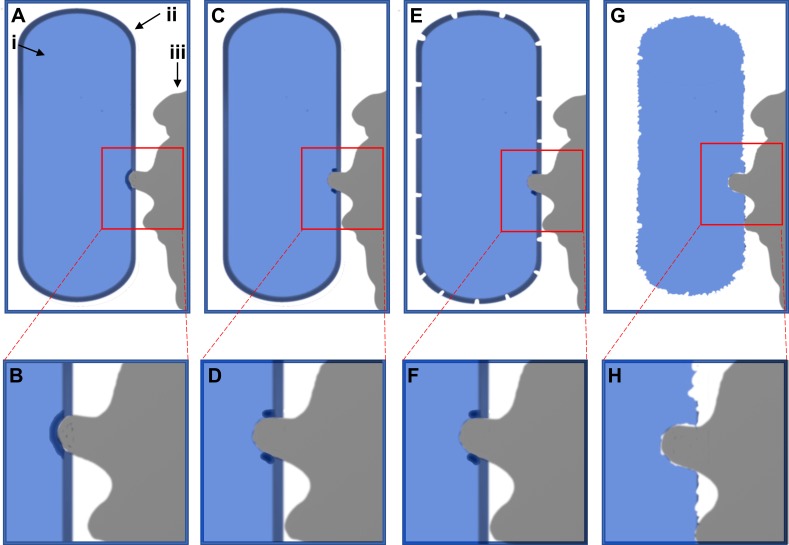
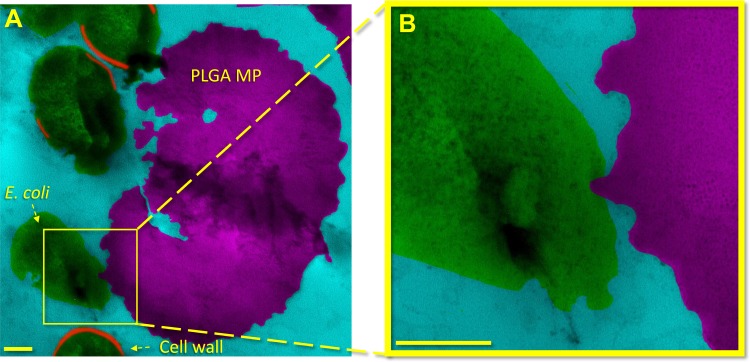
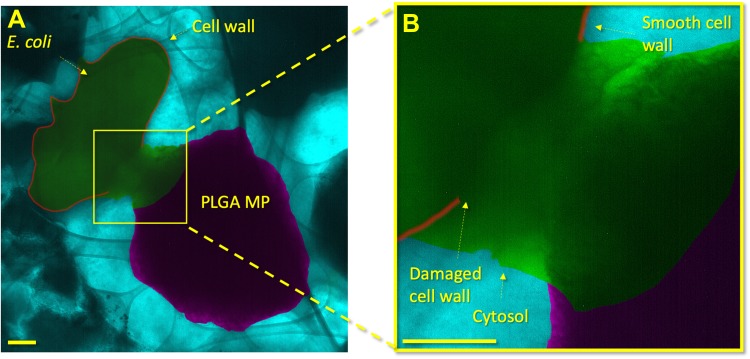
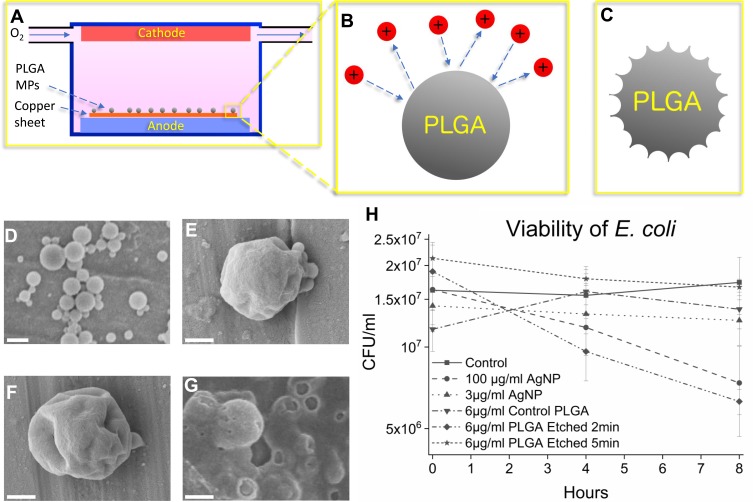
Nanotextures are synthesized on biocompatible polymer microparticles (MPs) via plasma etching. Both conventional and liquid-phase transmission electron microscopy observations suggest that these MPs may cause cell lysis via bacterial binding to a single protrusion of the nanotexture. The bacterium/protrusion interaction locally compromises the cell wall, thus causing bacterial death. This study suggests that local mechanical damage and leakage of the cytosol kill the bacteria first, with subsequent degradation of the cell envelope.

CONCLUSION

Nanoscale surface roughness may act via a penetrative bactericidal mechanism. This insight suggests that future research may focus on optimizing bacterial binding to individual nanoscale projections in addition to stretching bacteria between nanopillars. Further, antibacterial nanotextures may find use in novel applications employing particles in addition to nanotextures on fibers or films.

摘要

背景

纳米级表面粗糙度具有抗菌和抗污性能。现有的几种模型试图在没有直接观察的情况下解释纳米粗糙表面的抗菌机制。在这里,采用传统和液相 TEM 来观察纳米级细菌/表面粗糙度的相互作用。这种相互作用的可视化可以推断出可能的抗菌机制。

方法和结果

通过等离子体刻蚀在生物相容性聚合物微球(MPs)上合成纳米纹理。传统和液相透射电子显微镜观察都表明,这些 MPs 可能通过细菌与纳米纹理的单个突起结合导致细胞裂解。细菌/突起的相互作用使细胞壁局部受损,从而导致细菌死亡。本研究表明,局部机械损伤和细胞质泄漏首先杀死细菌,随后破坏细胞包膜。

结论

纳米级表面粗糙度可能通过一种穿透性的杀菌机制起作用。这一观点表明,未来的研究可能不仅要集中在拉伸纳米柱之间的细菌,还要优化细菌与单个纳米级突起的结合,以优化抗菌纳米纹理。此外,抗菌纳米纹理除了在纤维或薄膜上的纳米纹理外,还可以在采用颗粒的新型应用中找到用途。
https://cdn.ncbi.nlm.nih.gov/pmc/blobs/3ae9/7093104/8846266addd6/IJN-15-1929-g0004.jpg
https://cdn.ncbi.nlm.nih.gov/pmc/blobs/3ae9/7093104/b575da49541b/IJN-15-1929-g0001.jpg
https://cdn.ncbi.nlm.nih.gov/pmc/blobs/3ae9/7093104/d9cc54e385a0/IJN-15-1929-g0002.jpg
https://cdn.ncbi.nlm.nih.gov/pmc/blobs/3ae9/7093104/fa5a3189cda1/IJN-15-1929-g0003.jpg
https://cdn.ncbi.nlm.nih.gov/pmc/blobs/3ae9/7093104/8846266addd6/IJN-15-1929-g0004.jpg
https://cdn.ncbi.nlm.nih.gov/pmc/blobs/3ae9/7093104/b575da49541b/IJN-15-1929-g0001.jpg
https://cdn.ncbi.nlm.nih.gov/pmc/blobs/3ae9/7093104/d9cc54e385a0/IJN-15-1929-g0002.jpg
https://cdn.ncbi.nlm.nih.gov/pmc/blobs/3ae9/7093104/fa5a3189cda1/IJN-15-1929-g0003.jpg
https://cdn.ncbi.nlm.nih.gov/pmc/blobs/3ae9/7093104/8846266addd6/IJN-15-1929-g0004.jpg

相似文献

1
Correlative ex situ and Liquid-Cell TEM Observation of Bacterial Cell Membrane Damage Induced by Rough Surface Topology.粗糙度表面拓扑诱导细菌细胞膜损伤的相关体外和液相细胞透射电镜观察。
Int J Nanomedicine. 2020 Mar 20;15:1929-1938. doi: 10.2147/IJN.S232230. eCollection 2020.
2
TEM Studies on Antibacterial Mechanisms of Black Phosphorous Nanosheets.TEM 研究黑磷纳米片的抗菌机制。
Int J Nanomedicine. 2020 May 1;15:3071-3085. doi: 10.2147/IJN.S237816. eCollection 2020.
3
Nano spray dried antibacterial coatings for dental implants.纳米喷雾干燥抗菌涂层的牙科植入物。
Eur J Pharm Biopharm. 2019 Jun;139:59-67. doi: 10.1016/j.ejpb.2019.03.003. Epub 2019 Mar 2.
4
Interaction of Al(2)O(3) nanoparticles with Escherichia coli and their cell envelope biomolecules.氧化铝纳米颗粒与大肠杆菌及其细胞膜生物分子的相互作用。
J Appl Microbiol. 2014 Apr;116(4):772-83. doi: 10.1111/jam.12423. Epub 2014 Jan 7.
5
Improving antibacterial ability of Ti-Cu thin films with co-sputtering method.采用共溅射法提高 Ti-Cu 薄膜的抗菌能力。
Sci Rep. 2023 Oct 3;13(1):16593. doi: 10.1038/s41598-023-43875-4.
6
Structure-Based Design of Dual Bactericidal and Bacteria-Releasing Nanosurfaces.基于结构的双杀菌与细菌释放纳米表面设计
ACS Appl Mater Interfaces. 2023 Jan 18;15(2):3420-3432. doi: 10.1021/acsami.2c18121. Epub 2023 Jan 4.
7
Poly(lactic--glycolic) Acid-Lipid Hybrid Microparticles Enhance the Intracellular Uptake and Antibacterial Activity of Rifampicin.聚(乳酸-乙醇酸)酸-脂质混合微球增强利福平的细胞内摄取和抗菌活性。
ACS Appl Mater Interfaces. 2020 Feb 19;12(7):8030-8039. doi: 10.1021/acsami.9b22991. Epub 2020 Feb 11.
8
Synthesis, construction, and evaluation of self-assembled nano-bacitracin A as an efficient antibacterial agent in vitro and in vivo.自组装纳米杆菌肽A作为一种高效抗菌剂的体外和体内合成、构建及评价
Int J Nanomedicine. 2017 Jun 30;12:4691-4708. doi: 10.2147/IJN.S136998. eCollection 2017.
9
Superior antibacterial activity of sulfur-doped g-CN nanosheets dispersed by Tetrastigma hemsleyanum Diels & Gilg's polysaccharides-3 solution.层状聚多巴胺纳米片的制备及其在水体中抗生素的吸附性能研究
Int J Biol Macromol. 2021 Jan 31;168:453-463. doi: 10.1016/j.ijbiomac.2020.11.155. Epub 2020 Dec 1.
10
Multifunctional biocompatible and biodegradable folic acid conjugated poly(ε-caprolactone)-polypeptide copolymer vesicles with excellent antibacterial activities.具有优异抗菌活性的多功能生物相容性和可生物降解的叶酸共轭聚(ε-己内酯)-多肽共聚物囊泡。
Bioconjug Chem. 2015 Apr 15;26(4):725-34. doi: 10.1021/acs.bioconjchem.5b00061. Epub 2015 Mar 10.

引用本文的文献

1
Imaging of Hydrated and Living Cells in Transmission Electron Microscope: Summary, Challenges, and Perspectives.透射电子显微镜下对水合及活细胞的成像:综述、挑战与展望
ACS Nano. 2025 Apr 8;19(13):12710-12733. doi: 10.1021/acsnano.5c00871. Epub 2025 Mar 29.
2
Marine Algae Extract () for the Green Synthesis of CoONPs: Antioxidant, Antibacterial, Anticancer, and Hemolytic Activities.用于氧化钴纳米粒子绿色合成的海藻提取物:抗氧化、抗菌、抗癌和溶血活性
Bioinorg Chem Appl. 2022 Oct 20;2022:3977935. doi: 10.1155/2022/3977935. eCollection 2022.
3
Long-Term Antimicrobial Performance of Textiles Coated with ZnO and TiO Nanoparticles in a Tropical Climate.

本文引用的文献

1
Antibacterial, Antibiofilm, Antiquorum Sensing, Antimotility, and Antioxidant Activities of Green Fabricated Ag, Cu, TiO, ZnO, and FeO NPs via Lichen Aqueous Extract against Multi-Drug-Resistant Bacteria.通过地衣水提取物绿色制备的银、铜、二氧化钛、氧化锌和氧化铁纳米粒子对多重耐药细菌的抗菌、抗生物膜、抗群体感应、抗运动性和抗氧化活性
ACS Biomater Sci Eng. 2019 Sep 9;5(9):4228-4243. doi: 10.1021/acsbiomaterials.9b00274. Epub 2019 Aug 19.
2
An overview on antimicrobial and wound healing properties of ZnO nanobiofilms, hydrogels, and bionanocomposites based on cellulose, chitosan, and alginate polymers.基于纤维素、壳聚糖和海藻酸盐聚合物的 ZnO 纳米生物膜、水凝胶和生物纳米复合材料的抗菌和伤口愈合性能概述。
Carbohydr Polym. 2020 Jan 1;227:115349. doi: 10.1016/j.carbpol.2019.115349. Epub 2019 Sep 21.
3
在热带气候下涂覆有氧化锌和二氧化钛纳米颗粒的纺织品的长期抗菌性能
J Funct Biomater. 2022 Nov 9;13(4):233. doi: 10.3390/jfb13040233.
4
TEM Studies on Antibacterial Mechanisms of Black Phosphorous Nanosheets.TEM 研究黑磷纳米片的抗菌机制。
Int J Nanomedicine. 2020 May 1;15:3071-3085. doi: 10.2147/IJN.S237816. eCollection 2020.
Exploration of the antibiotic potentiating activity of indolglyoxylpolyamines.吲哚甘氨聚多胺类抗生素增效活性的探索。
Eur J Med Chem. 2019 Dec 1;183:111708. doi: 10.1016/j.ejmech.2019.111708. Epub 2019 Sep 17.
4
Recent progress in nanoformulations of silver nanoparticles with cellulose, chitosan, and alginic acid biopolymers for antibacterial applications.近年来,以纤维素、壳聚糖和海藻酸等生物聚合物为载体的纳米银制剂在抗菌方面取得了进展。
Appl Microbiol Biotechnol. 2019 Nov;103(21-22):8669-8676. doi: 10.1007/s00253-019-10126-4. Epub 2019 Sep 14.
5
An overview of the antimicrobial resistance mechanisms of bacteria.细菌抗菌耐药机制概述。
AIMS Microbiol. 2018 Jun 26;4(3):482-501. doi: 10.3934/microbiol.2018.3.482. eCollection 2018.
6
Recent advances in antibacterial applications of metal nanoparticles (MNPs) and metal nanocomposites (MNCs) against multidrug-resistant (MDR) bacteria.金属纳米粒子(MNPs)和金属纳米复合材料(MNCs)在抗多重耐药(MDR)细菌方面的抗菌应用的最新进展。
Expert Rev Anti Infect Ther. 2019 Jun;17(6):419-428. doi: 10.1080/14787210.2019.1614914. Epub 2019 May 17.
7
Bacterial-nanostructure interactions: The role of cell elasticity and adhesion forces.细菌-纳米结构相互作用:细胞弹性和粘附力的作用。
J Colloid Interface Sci. 2019 Jun 15;546:192-210. doi: 10.1016/j.jcis.2019.03.050. Epub 2019 Mar 15.
8
In Situ Study of Molecular Structure of Water and Ice Entrapped in Graphene Nanovessels.石墨烯纳米通道中捕获的水和冰的分子结构的原位研究。
ACS Nano. 2019 Apr 23;13(4):4677-4685. doi: 10.1021/acsnano.9b00914. Epub 2019 Apr 2.
9
Investigation of the magnetosome biomineralization in magnetotactic bacteria using graphene liquid cell - transmission electron microscopy.利用石墨烯液相细胞-透射电子显微镜研究趋磁细菌的磁小体生物矿化。
Nanoscale. 2019 Jan 3;11(2):698-705. doi: 10.1039/c8nr08647h.
10
High Aspect Ratio Nanostructures Kill Bacteria via Storage and Release of Mechanical Energy.高纵横比纳米结构通过储存和释放机械能来杀死细菌。
ACS Nano. 2018 Jul 24;12(7):6657-6667. doi: 10.1021/acsnano.8b01665. Epub 2018 Jun 11.