School of Public Health, Fudan University, Fudan Institute of Health communication, Shanghai, China.
PLoS One. 2020 Apr 16;15(4):e0231924. doi: 10.1371/journal.pone.0231924. eCollection 2020.
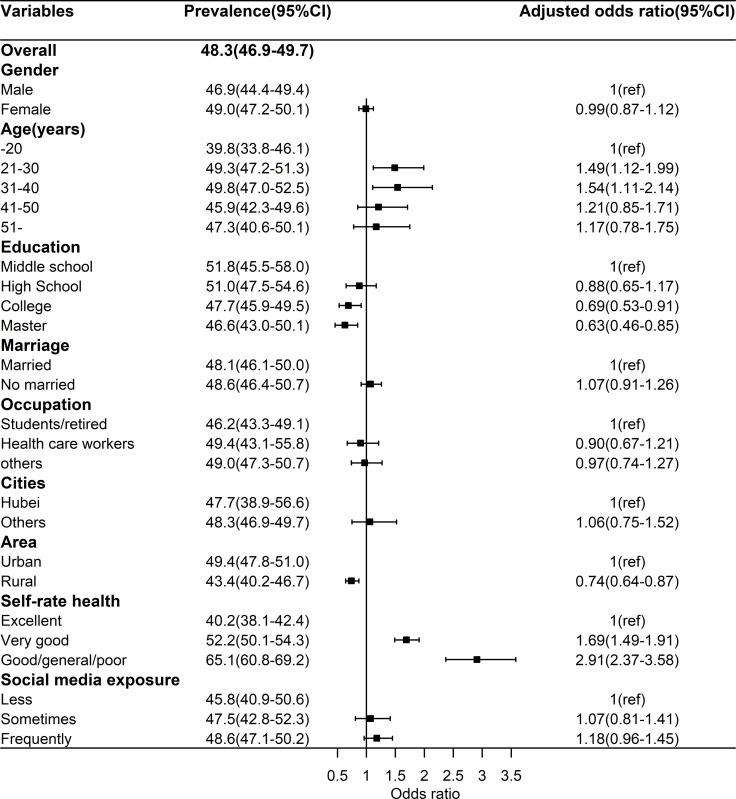
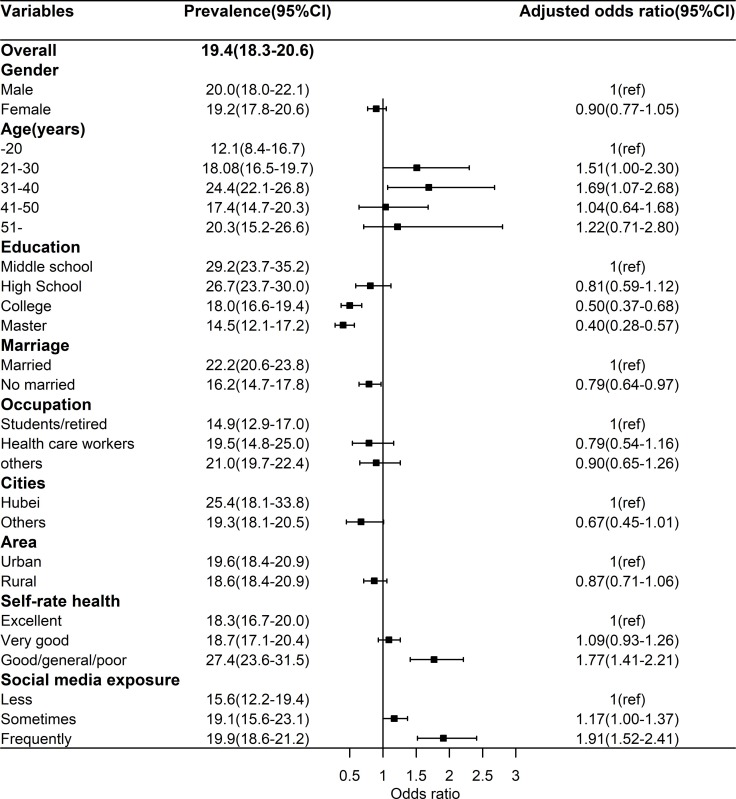
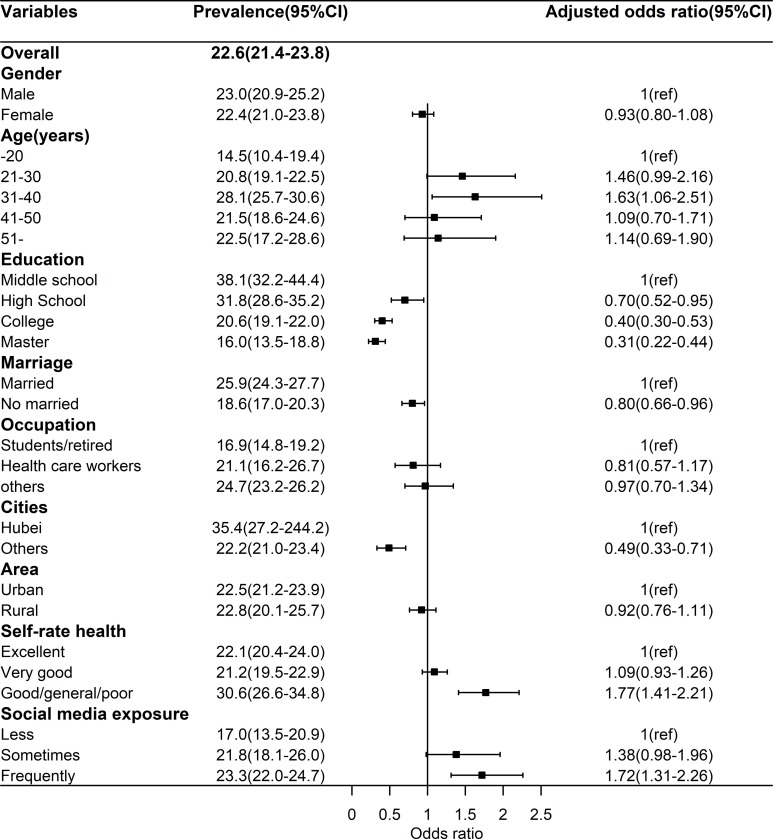
Huge citizens expose to social media during a novel coronavirus disease (COVID-19) outbroke in Wuhan, China. We assess the prevalence of mental health problems and examine their association with social media exposure. A cross-sectional study among Chinese citizens aged≥18 years old was conducted during Jan 31 to Feb 2, 2020. Online survey was used to do rapid assessment. Total of 4872 participants from 31 provinces and autonomous regions were involved in the current study. Besides demographics and social media exposure (SME), depression was assessed by The Chinese version of WHO-Five Well-Being Index (WHO-5) and anxiety was assessed by Chinese version of generalized anxiety disorder scale (GAD-7). multivariable logistic regressions were used to identify associations between social media exposure with mental health problems after controlling for covariates. The prevalence of depression, anxiety and combination of depression and anxiety (CDA) was 48.3% (95%CI: 46.9%-49.7%), 22.6% (95%CI: 21.4%-23.8%) and 19.4% (95%CI: 18.3%-20.6%) during COVID-19 outbroke in Wuhan, China. More than 80% (95%CI:80.9%-83.1%) of participants reported frequently exposed to social media. After controlling for covariates, frequently SME was positively associated with high odds of anxiety (OR = 1.72, 95%CI: 1.31-2.26) and CDA (OR = 1.91, 95%CI: 1.52-2.41) compared with less SME. Our findings show there are high prevalence of mental health problems, which positively associated with frequently SME during the COVID-19 outbreak. These findings implicated the government need pay more attention to mental health problems, especially depression and anxiety among general population and combating with "infodemic" while combating during public health emergency.
在新型冠状病毒病(COVID-19)在中国武汉爆发期间,大量市民暴露在社交媒体上。我们评估了心理健康问题的流行情况,并研究了它们与社交媒体暴露的关系。2020 年 1 月 31 日至 2 月 2 日,对中国≥18 岁的公民进行了一项横断面研究。使用在线调查进行快速评估。本研究共纳入来自 31 个省、自治区的 4872 名参与者。除了人口统计学和社交媒体暴露(SME)外,还使用世界卫生组织五维健康量表中文版(WHO-5)评估抑郁,使用广泛性焦虑症量表中文版(GAD-7)评估焦虑。多变量逻辑回归用于在控制协变量后识别社交媒体暴露与心理健康问题之间的关联。在中国武汉 COVID-19 爆发期间,抑郁、焦虑和抑郁焦虑共病(CDA)的患病率分别为 48.3%(95%CI:46.9%-49.7%)、22.6%(95%CI:21.4%-23.8%)和 19.4%(95%CI:18.3%-20.6%)。超过 80%(95%CI:80.9%-83.1%)的参与者报告经常接触社交媒体。在控制协变量后,与 SME 较少相比,频繁 SME 与焦虑(OR=1.72,95%CI:1.31-2.26)和 CDA(OR=1.91,95%CI:1.52-2.41)的高患病风险相关。我们的研究结果表明,心理健康问题的患病率很高,与 COVID-19 爆发期间频繁的 SME 呈正相关。这些结果表明,政府需要更加关注普通民众的心理健康问题,尤其是抑郁和焦虑,并在应对公共卫生紧急情况时应对“信息疫情”。