College of Ecology and Environment, Center for Eco-Environmental Restoration Engineering of Hainan Province, Key Laboratory of Agro-Forestry Environmental Processes and Ecological Regulation of Hainan Province, Hainan University, Haikou, Hainan, China.
Research Center for Eco-Environmental Sciences, Chinese Academy of Sciences, Beijing, China.
PLoS One. 2020 May 20;15(5):e0232051. doi: 10.1371/journal.pone.0232051. eCollection 2020.
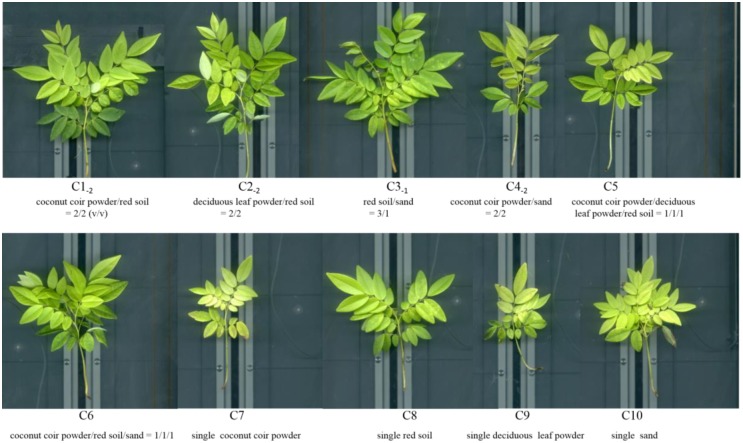
Dalbergia odorifera T. Chen seedlings do not grow well in the typical red soils of tropical regions. Eighteen culture substances filled with different substrate combinations and proportions of red soil, coconut coir powder, deciduous leaf powder, and sand were used as to determine their effects on the growth, root system development, dry matter accumulation and allocation, leaf relative electrolyte leakage, chlorophyll content, root superoxide dismutase activity, root malondialdehyde content, and total soluble sugar content of D. odorifera. Results demonstrated that different substrate combinations and proportions had different effects on the performance of D. odorifera. All mixed substrates were better than any single substrate. The suitable substrate combinations and proportions of sand, coconut coir powder, and deciduous leaf powder mixed with red soil improved the growth, root architecture, and physiological characteristics of D. odorifera seedling. For example, groups C1-2 (coconut coir/red soil = 2/2, v/v, the same below) and C3-2 (red soil/sand = 2/2) exerted the best effects on plant growth and biomass accumulation. Groups C1-2, C2-2 (deciduous leaf powder/red soil = 2/2), and C3-2 remarkably enhanced root system development. Group C6 (coconut coir/red soil/sand = 1/1/1) substantially promoted root nodule development. Group C3-1 (red soil/sand = 3/1) exhibited the best effects on physiological characteristics. On the basis of the comprehensive evaluation of Euclid's multidimensional space mathematical model, we found that the suitable substrate combinations followed the order of C1-2 > C3-1 > C2-2. This research provides scientific guidance for the proper seedling culture of D. odorifera and the rational utilization of solid wastes such as coconut coir and deciduous leaves of Ficus elastica.
降香黄檀幼苗在热带地区典型的红壤中生长不良。本研究采用 18 种含有不同基质组合和红壤、椰糠粉、落叶粉和沙比例的培养物质,以确定它们对降香黄檀生长、根系发育、干物质积累和分配、叶片相对电解质渗漏率、叶绿素含量、根系超氧化物歧化酶活性、根系丙二醛含量和总可溶性糖含量的影响。结果表明,不同的基质组合和比例对降香黄檀的表现有不同的影响。所有混合基质都优于任何单一基质。沙、椰糠粉和落叶粉与红壤混合的适宜基质组合和比例改善了降香黄檀幼苗的生长、根系结构和生理特性。例如,C1-2(椰糠/红土=2/2,下同)和 C3-2 组对植物生长和生物量积累的效果最好。C1-2、C2-2(落叶粉/红土=2/2)和 C3-2 组显著增强了根系发育。C6 组(椰糠/红土/沙=1/1/1)显著促进了根瘤的发育。C3-1 组(红土/沙=3/1)对生理特性的影响最好。基于欧几里得多维空间数学模型的综合评价,我们发现适宜的基质组合顺序为 C1-2>C3-1>C2-2。本研究为降香黄檀的适当育苗和椰糠、榕树叶等固体废物的合理利用提供了科学指导。