
颗粒酶B正电子发射断层扫描成像用于免疫介导的肿瘤杀伤,作为理解免疫治疗反应的一种工具。
Granzyme B PET imaging of immune-mediated tumor killing as a tool for understanding immunotherapy response.
作者信息
LaSalle Thomas, Austin Emily E, Rigney Grant, Wehrenberg-Klee Eric, Nesti Sarah, Larimer Benjamin, Mahmood Umar
机构信息
Radiology, Massachusetts General Hospital, Boston, Massachusetts, USA.
Radiology, Massachusetts General Hospital, Boston, Massachusetts, USA
出版信息
J Immunother Cancer. 2020 May;8(1). doi: 10.1136/jitc-2019-000291.
BACKGROUND
Cancer immunotherapy research is expanding to include a more robust understanding of the mechanisms of treatment response and resistance. Identification of drivers of pro-tumor and anti-tumor immunity during treatment offers new strategies for effective alternative or combination immunotherapies. Currently, tissue or blood samples are collected and analyzed, then dichotomized based on clinical end points that may occur months or years after tissue is collected. While overall survival is ultimately the desired clinical outcome, this dichotomization fails to incorporate the nuances that may occur during an anti-tumor response. By failing to directly measure immune activation at the time of sampling, tumors may be misclassified and potentially obscure important biological information. Non-invasive techniques, such as positron emission tomography (PET), allow for global and quantitative measurements of cancer specific processes and are widely used clinically to help manage disease.
METHODS
We have previously developed a novel PET agent that can non-invasively quantify granzyme B release in tumors and have demonstrated its ability to predict response to checkpoint inhibitor therapy in multiple murine models of cancer. Here, we used the quantitative measurement of granzyme B release as a direct and time-matched marker of immune cell activation in order to determine immune cell types and cytokines that correlate with effective checkpoint inhibitor therapy in both tumors and tumor-draining lymph nodes.
RESULTS
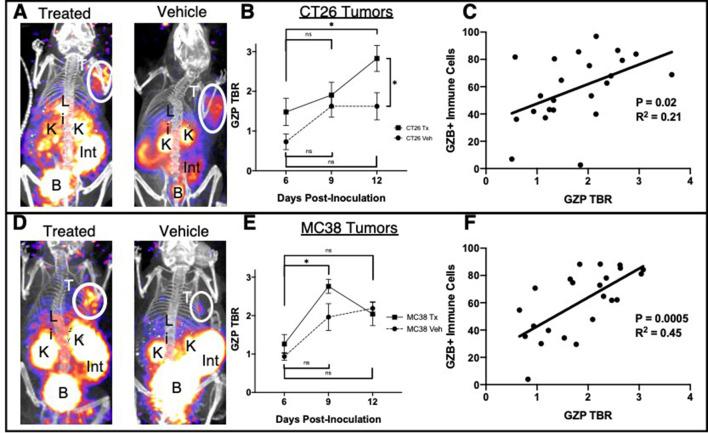
Through PET imaging, we were able to successfully distinguish distinct microenvironments, based on tumor type, which influenced immune cell subpopulations and cytokine release. Although each tumor was marked by functionally distinct pathways of immune cell activation and inflammation, they also shared commonalities that ultimately resulted in granzyme B release and tumor killing.
CONCLUSIONS
These results suggest that discrete tumor immune microenvironments can be identified in both responsive and non-responsive tumors and offers strategic targets for intervention to overcome checkpoint inhibitor resistance.
背景
癌症免疫治疗研究正在不断扩展,以更深入地了解治疗反应和耐药机制。识别治疗过程中促肿瘤和抗肿瘤免疫的驱动因素为有效的替代或联合免疫疗法提供了新策略。目前,收集组织或血液样本并进行分析,然后根据可能在收集组织数月或数年之后出现的临床终点进行二分法分类。虽然总生存期最终是期望的临床结果,但这种二分法未能纳入抗肿瘤反应过程中可能出现的细微差别。由于未能在采样时直接测量免疫激活情况,肿瘤可能会被错误分类,并可能掩盖重要的生物学信息。正电子发射断层扫描(PET)等非侵入性技术能够对癌症特异性过程进行整体和定量测量,在临床上被广泛用于辅助疾病管理。
方法
我们之前开发了一种新型PET试剂,它可以非侵入性地定量肿瘤中颗粒酶B的释放,并已在多种癌症小鼠模型中证明其预测对检查点抑制剂治疗反应的能力。在此,我们将颗粒酶B释放的定量测量作为免疫细胞激活的直接且与时间匹配的标志物,以确定与肿瘤和引流肿瘤的淋巴结中有效检查点抑制剂治疗相关的免疫细胞类型和细胞因子。
结果
通过PET成像,我们能够根据肿瘤类型成功区分不同的微环境,这些微环境会影响免疫细胞亚群和细胞因子的释放。虽然每种肿瘤都以免疫细胞激活和炎症的功能不同途径为特征,但它们也有共同之处,最终导致颗粒酶B释放和肿瘤杀伤。
结论
这些结果表明,在反应性和非反应性肿瘤中均可识别离散的肿瘤免疫微环境,并为克服检查点抑制剂耐药性的干预提供了战略靶点。



 Zotero 插件