Zhang Ning, Zhang Zong-Kang, Yu Yuanyuan, Zhuo Zhenjian, Zhang Ge, Zhang Bao-Ting
School of Chinese Medicine, Faculty of Medicine, The Chinese University of Hong Kong, Hong Kong, China.
Law Sau Fai Institute for Advancing Translational Medicine in Bone and Joint Diseases, School of Chinese Medicine, Hong Kong Baptist University, Hong Kong, China.
Front Cell Dev Biol. 2020 May 14;8:325. doi: 10.3389/fcell.2020.00325. eCollection 2020.
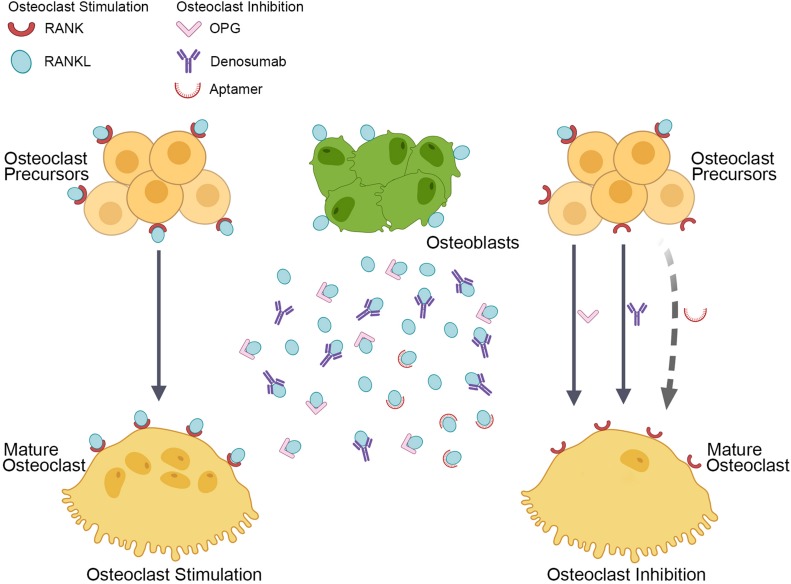
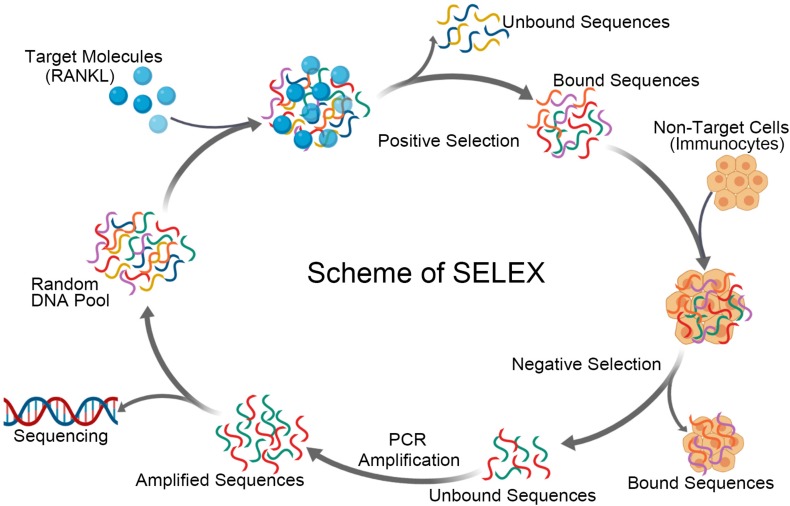
Osteoporosis is age-related deterioration in bone mass and micro-architecture. Denosumab is a novel human monoclonal antibody for osteoporosis. It is a receptor activator of nuclear factor-κB ligand (RANKL) inhibitor, which binds to and inhibits osteoblast-produced RANKL, in turn reduces the binding between RANKL and osteoclast receptor RANK, therefore decreases osteoclast-mediated bone resorption and turnover. However, adverse events have also been reported after denosumab treatment, including skin eczema, flatulence, cellulitis and osteonecrosis of the jaw (ONJ). Extensive researches on the mechanism of adverse reactions caused by denosumab have been conducted and may provide new insights into developing new RANKL inhibitors that achieve better specificity and safety. Aptamers are single-stranded oligonucleotides that can bind to target molecules with high specificity and affinity. They are screened from large single-stranded synthetic oligonucleotides and enriched by a technology named SELEX (systematic evolution of ligands by exponential enrichment). With extra advantages such as high stability, low immunogenicity and easy production over antibodies, aptamers are hypothesized to be promising candidates for therapeutic drugs targeting RANKL to counteract osteoporosis. In this review, we focus on the pros and cons of denosumab treatment in osteoporosis and the implication for novel aptamer treatment.
骨质疏松症是与年龄相关的骨量和微结构退化。地诺单抗是一种用于治疗骨质疏松症的新型人源单克隆抗体。它是一种核因子κB受体活化因子配体(RANKL)抑制剂,可与成骨细胞产生的RANKL结合并抑制其活性,进而减少RANKL与破骨细胞受体RANK之间的结合,从而降低破骨细胞介导的骨吸收和骨转换。然而,地诺单抗治疗后也有不良事件的报道,包括皮肤湿疹、肠胃胀气、蜂窝织炎和颌骨骨坏死(ONJ)。针对地诺单抗引起不良反应的机制已进行了广泛研究,这可能为开发具有更好特异性和安全性的新型RANKL抑制剂提供新的见解。适体是能够以高特异性和亲和力与靶分子结合的单链寡核苷酸。它们从大量单链合成寡核苷酸中筛选出来,并通过一种名为SELEX(指数富集配体系统进化)的技术进行富集。由于适体具有比抗体更高的稳定性、更低的免疫原性和易于生产等额外优势,因此被认为是靶向RANKL治疗骨质疏松症的有前景的候选治疗药物。在这篇综述中,我们重点讨论地诺单抗治疗骨质疏松症的利弊以及新型适体治疗的意义。