Yadav Ashok, Kumar Singh Vinod, Kumar Bhoi Akash, Marques Gonçalo, Garcia-Zapirain Begonya, de la Torre Díez Isabel
Department of ECE, Krishna Engineering College, Ghaziabad 201007, India.
Department of Electrical Engineering, S.R. Group of Institutions, Jhansi 284002, U.P., India.
Micromachines (Basel). 2020 May 30;11(6):558. doi: 10.3390/mi11060558.
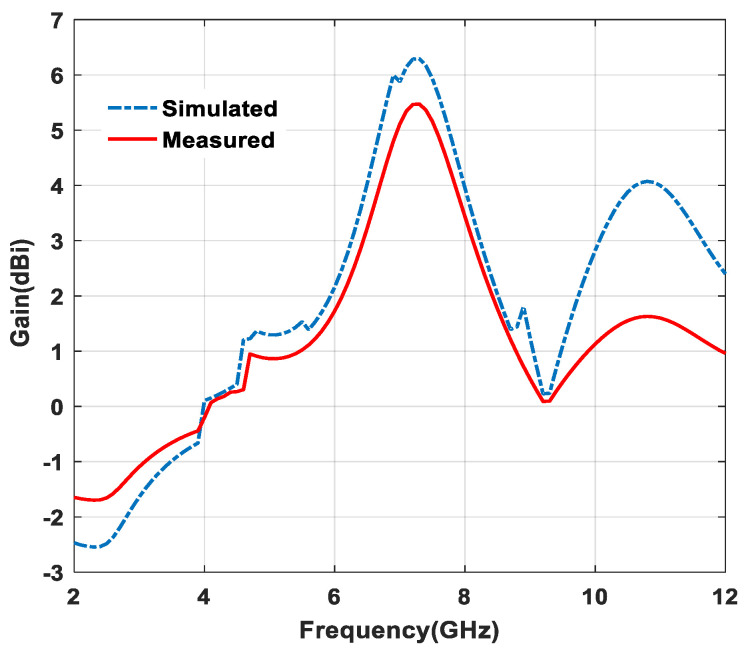
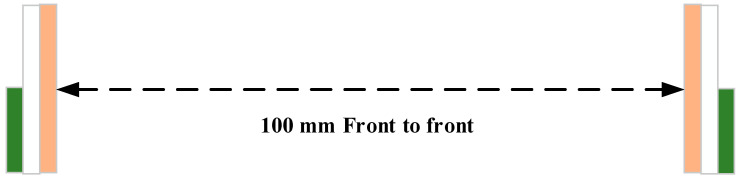
A compact textile ultra-wideband (UWB) antenna with an electrical dimension of 0.24λ × 0.24λ × 0.009λ with microstrip line feed at lower edge and a frequency of operation of 2.96 GHz is proposed for UWB application. The analytical investigation using circuit theory concepts and the cavity model of the antenna is presented to validate the design. The main contribution of this paper is to propose a wearable antenna with wide impedance bandwidth of 118.68 % (2.96-11.6 GHz) applicable for UWB range of 3.1 to 10.6 GHz. The results present a maximum gain of 5.47 dBi at 7.3 GHz frequency. Moreover, this antenna exhibits Omni and quasi-Omni radiation patterns at various frequencies (4 GHz, 7 GHz and 10 GHz) for short-distance communication. The cutting notch and slot on the patch, and its effect on the antenna impedance to increase performance through current distribution is also presented. The time-domain characteristic of the proposed antenna is also discussed for the analysis of the pulse distortion phenomena. A constant group delay less than 1 ns is obtained over the entire operating impedance bandwidth (2.96-11.6 GHz) of the textile antenna in both situations, i.e., side by side and front to front. Linear phase consideration is also presented for both situations, as well as configurations of reception and transmission. An assessment of the effects of bending and humidity has been demonstrated by placing the antenna on the human body. The specific absorption rate (SAR) value was tested to show the radiation effect on the human body, and it was found that its impact on the human body SAR value is 1.68 W/kg, which indicates the safer limit to avoid radiation effects. Therefore, the proposed method is promising for telemedicine and mobile health systems.
本文提出了一种紧凑型纺织超宽带(UWB)天线,其电尺寸为0.24λ×0.24λ×0.009λ,在下边缘采用微带线馈电,工作频率为2.96 GHz,适用于超宽带应用。文中利用电路理论概念和天线的腔体模型进行了分析研究,以验证该设计。本文的主要贡献在于提出了一种可穿戴天线,其阻抗带宽为118.68%(2.96 - 11.6 GHz),适用于3.1至10.6 GHz的超宽带范围。结果表明,在7.3 GHz频率下,该天线的最大增益为5.47 dBi。此外,该天线在不同频率(4 GHz、7 GHz和10 GHz)下呈现全向和准全向辐射方向图,适用于短距离通信。文中还介绍了贴片上的切割槽口和缝隙及其对天线阻抗的影响,通过电流分布来提高性能。为了分析脉冲失真现象,还讨论了所提天线的时域特性。在两种情况下,即并排和面对面放置时,在纺织天线的整个工作阻抗带宽(2.96 - 11.6 GHz)内均获得了小于1 ns的恒定群延迟。还给出了两种情况下的线性相位考虑以及收发配置。通过将天线放置在人体上,展示了对弯曲和湿度影响的评估。测试了比吸收率(SAR)值以显示对人体的辐射效应,发现其对人体SAR值的影响为1.68 W/kg,这表明避免辐射效应的安全限值。因此,所提方法在远程医疗和移动健康系统中具有广阔前景。