Department of Infectious Diseases, Public Health Service of Amsterdam, Amsterdam, The Netherlands.
Research Laboratory on Viral Hepatitis and Health Communication, University of Yaoundé I, Yaoundé, Cameroon.
Trop Med Int Health. 2020 Sep;25(9):1098-1109. doi: 10.1111/tmi.13450. Epub 2020 Jul 5.
Highly effective direct-acting antivirals (DAAs) for Hepatitis C treatment are largely inaccessible in sub-Saharan Africa. Data on treatment feasibility and outcomes in clinical settings are limited. We assessed the feasibility of achieving a high (≥90%) cure rate with DAAs in six gastroenterology clinics in Cameroon.
Patients with chronic Hepatitis C virus (HCV) infection were treated for 12 or 24 weeks with ledipasvir/sofosbuvir, ledipasvir/sofosbuvir/ribavirin or sofosbuvir/ribavirin, depending on the stage of liver disease and HCV genotype. The cure rate was defined as the proportion of patients with a sustained virological response 12 weeks after treatment completion (SVR12) among all treatment completers.
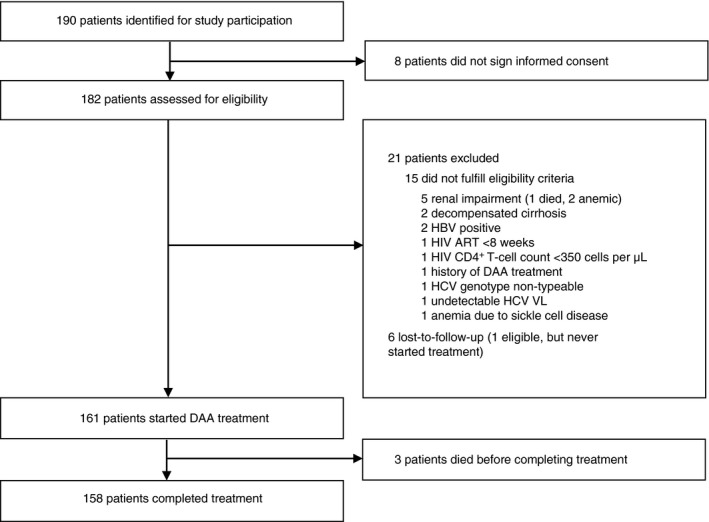
We identified 190 HCV RNA positive patients between September-2017 and August-2018, 161 (84.7%) of whom started treatment. 105 (65.2%) were female, median age was 61.3 years [IQR = 55.9-66.9] and 11 (6.8%) were HIV-positive. Median plasma HCV RNA was 6.0 log IU/mL [IQR = 5.6-6.4]. HCV genotypes identified were 1 (34.8%), 2 (13.7%), 4 (50.9%), 1 and 4 (0.6%); 46 (28.6%) strains of 160 single-genotype infections were non-subtypeable. Of 158 treatment completers, 152 (96.2%, 95%CI = 91.9-98.6%) achieved SVR12. Six patients did not achieve SVR12: five carried HCV with NS5A resistance mutations and one with NS5B resistance mutations. Three patients died before and two after treatment completion. The most common adverse events were asthenia (12.0%), headache (11.4%) and dizziness (18.9%).
High cure rates of Hepatitis C with DAAs are achievable in clinical settings of Cameroon. However, the accessibility and provision of HCV screening, diagnosis, treatment, monitoring and care should be addressed for large-scale implementation.
高效直接作用抗病毒药物(DAA)在撒哈拉以南非洲地区基本无法获得。关于临床环境中治疗可行性和结果的数据有限。我们评估了在喀麦隆的六家胃肠病诊所使用 DAA 实现高(≥90%)治愈率的可行性。
患有慢性丙型肝炎病毒(HCV)感染的患者根据肝病阶段和 HCV 基因型接受 12 或 24 周的 ledipasvir/索非布韦、ledipasvir/索非布韦/利巴韦林或索非布韦/利巴韦林治疗。治愈率定义为所有治疗完成者中治疗完成后 12 周持续病毒学应答(SVR12)的患者比例。
我们在 2017 年 9 月至 2018 年 8 月期间发现了 190 例 HCV RNA 阳性患者,其中 161 例(84.7%)开始治疗。105 例(65.2%)为女性,中位年龄为 61.3 岁[IQR=55.9-66.9],11 例(6.8%)为 HIV 阳性。中位血浆 HCV RNA 为 6.0 log IU/mL[IQR=5.6-6.4]。鉴定的 HCV 基因型为 1(34.8%)、2(13.7%)、4(50.9%)、1 和 4(0.6%);在 160 例单基因型感染中,46 株(28.6%)无法分型。在 158 例治疗完成者中,152 例(96.2%,95%CI=91.9-98.6%)达到 SVR12。6 例未达到 SVR12:5 例携带 HCV 具有 NS5A 耐药突变,1 例携带 NS5B 耐药突变。3 例患者在治疗前死亡,2 例在治疗后死亡。最常见的不良事件是乏力(12.0%)、头痛(11.4%)和头晕(18.9%)。
在喀麦隆的临床环境中,使用 DAA 治疗丙型肝炎可实现高治愈率。然而,应解决 HCV 筛查、诊断、治疗、监测和护理的可及性和提供问题,以实现大规模实施。