Jeger Michael, Bragard Claude, Caffier David, Candresse Thierry, Chatzivassiliou Elisavet, Dehnen-Schmutz Katharina, Gilioli Gianni, Grégoire Jean-Claude, Jaques Miret Josep Anton, MacLeod Alan, Navajas Navarro Maria, Niere Björn, Parnell Stephen, Potting Roel, Rafoss Trond, Rossi Vittorio, Urek Gregor, Van Bruggen Ariena, Van der Werf Wopke, West Jonathan, Winter Stephan, Tegli Stefania, Hollo Gabor, Caffier David
EFSA J. 2018 May 31;16(5):e05299. doi: 10.2903/j.efsa.2018.5299. eCollection 2018 May.
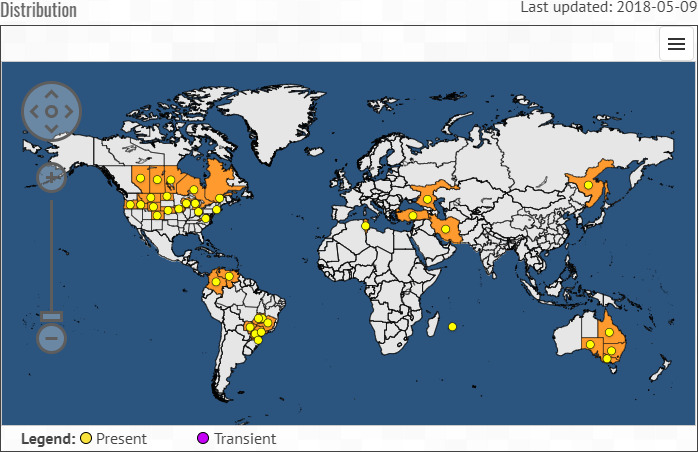
Following a request from the European Commission, the EFSA Panel on Plant Health performed a pest categorisation of the seed-borne bacterium pv. . The pest is regulated in Council Directive 2000/29/EC (Annex IIB) as a harmful organism whose introduction into, and spread within, the protected zones (PZ) of Greece, Portugal and Spain shall be banned if present on seeds of and of . The bacterium is widely distributed outside the EU and causes a systemic vascular disease (bacterial wilt of bean) as well as bacterial tan spot disease on soybean. The pest was sporadically recorded in several EU Member States in the past, but is currently not known to occur in the EU. The identity of the bacterium is well established and identification methods are available. The major host is common bean (), but other crops and weeds are, or may be, hosts or play a role as reservoirs, with uncertainties. Seed transmission remains uncertain for minor and alternative host species. The main pathway for entry is seed. The role of other pathways (e.g. irrigation water and infected residues) is uncertain. Should the bacterium enter the EU (including the PZ), it may establish, spread and have an impact on its host crops. The use of healthy seeds is the most effective control measure. pv. fits all the criteria assessed by EFSA to be regarded as a Union quarantine pest.
应欧盟委员会的要求,欧洲食品安全局植物健康小组对种子传播的细菌pv. 进行了有害生物分类。该有害生物在理事会指令2000/29/EC(附件IIB)中受到监管,被列为有害生物,如果在和的种子上发现,禁止将其引入希腊、葡萄牙和西班牙的保护区(PZ)并在其中传播。该细菌在欧盟以外广泛分布,会导致系统性维管束疾病(菜豆细菌性枯萎病)以及大豆细菌性褐斑病。该有害生物过去曾在几个欧盟成员国偶尔被记录到,但目前已知在欧盟没有发生。该细菌的身份已明确确定,且有可用的鉴定方法。主要寄主是普通菜豆(),但其他作物和杂草是或可能是寄主,或作为储存库发挥作用,但存在不确定性。对于次要寄主和替代寄主物种,种子传播仍不确定。进入的主要途径是种子。其他途径(如灌溉水和受感染的残留物)的作用尚不确定。如果该细菌进入欧盟(包括保护区),它可能会定殖、传播并对其寄主作物产生影响。使用健康种子是最有效的控制措施。pv. 符合欧洲食品安全局评估的所有标准,被视为欧盟检疫性有害生物。