Zhang Mengping, Huang He, Li Xueying, Huang Ying, Chen Chunyan, Fang Xiaojie, Wang Zhao, Guo Chengcheng, Lam Sioteng, Fu Xiaohong, Hong Huangming, Tian Ying, Lu Taixiang, Lin Tongyu
State Key Laboratory of Oncology in South China, Collaborative Innovation Center for Cancer Medicine, Department of Medical Oncology, Sun Yat-sen University Cancer Center, Guangzhou, China.
Department of Oncology, The First Affiliated Hospital of Sun Yat-sen University, Guangzhou, China.
Front Oncol. 2020 Jun 19;10:1011. doi: 10.3389/fonc.2020.01011. eCollection 2020.
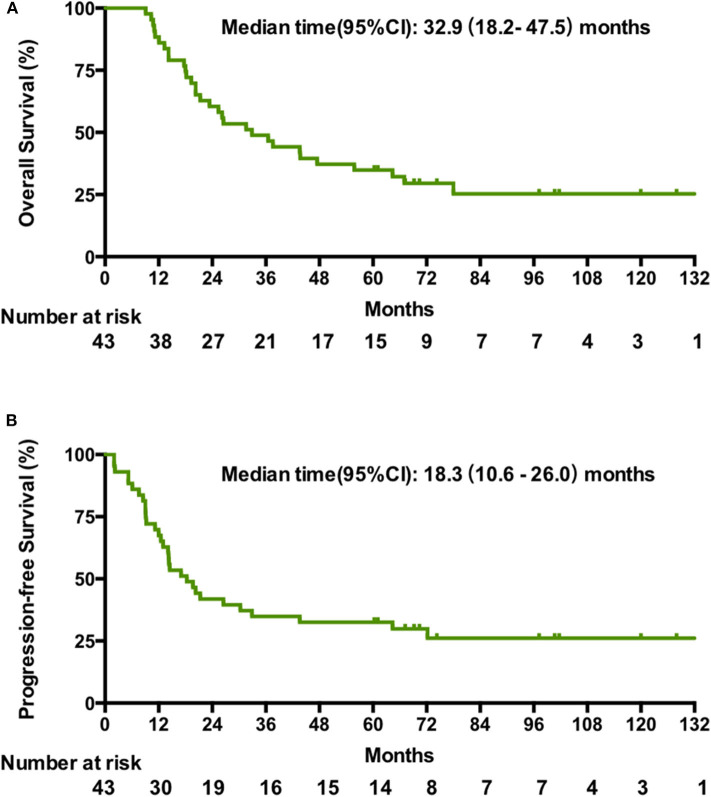
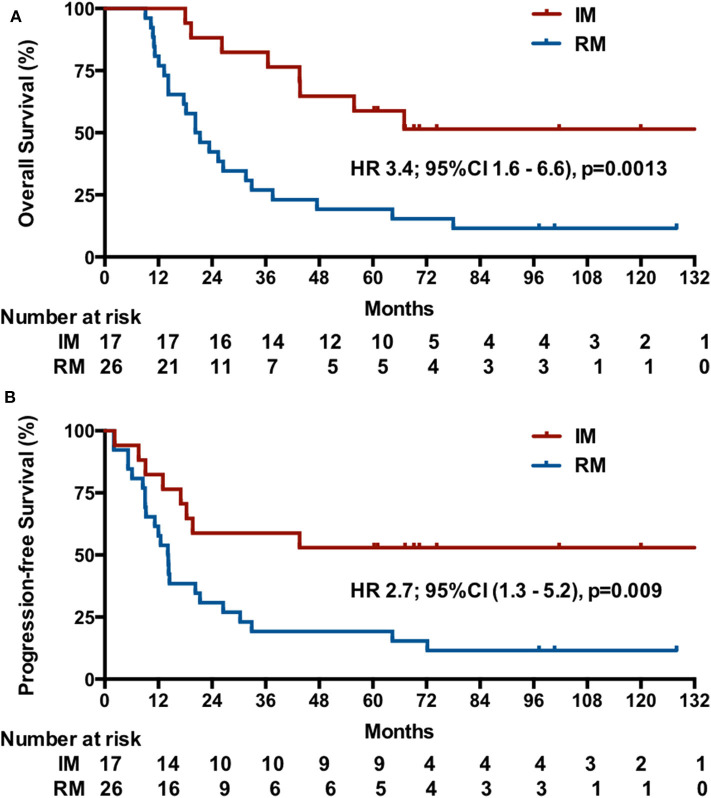
Metastatic nasopharyngeal carcinoma (mNPC) remains incurable. This prospective study aimed to investigate whether adding cetuximab to cisplatin-based induction therapy could improve efficacy and survival for chemotherapy-naïve mNPC patients. Eligible chemotherapy-naïve mNPC patients were enrolled, including those initially diagnosed with mNPC (IM) and those with first-relapse metastases after radiotherapy (RM). Patients all received induction chemotherapy (IC) including docetaxel and cisplatin plus cetuximab. Those who obtained objective remission after IC would continue to receive radiotherapy concurrent with cetuximab and cisplatin, and further capecitabine as maintenance. Contemporaneous patients who received conventional therapy served as controls. Forty-three patients were enrolled, including 17 IM and 26 RM patients. Thirty-nine (90.7%) patients had WHO III subtype. The overall response and complete response (CR) rates were, respectively, 79.1 and 34.9% after induction therapy and 76.7 and 46.5% after chemoradiotherapy. The 5-year overall survival (OS) and progression-free survival (PFS) rates reached 34.9 and 30%, respectively. Subgroup analysis showed that compared with RM patients, IM patients had a higher 5-year OS (58.8 vs. 19.2%) and PFS (52.9 vs. 19.2%). The IM group had a higher CR rate of induction treatment than the RM group (52.9 vs. 23.1%). No treatment-related death was observed. Twelve patients (27.9%) remained alive with disease-free survival times from 60+ to 135+ months. Control patients showed a substantially lower survival rate (5-year OS, 10.9%) and few long-term survivors. This regimen resulted in significantly improved efficacy and survival, which indicates a potentially curative role for chemotherapy-naïve mNPC, especially in newly diagnosed patients. A phase III clinical trial (NCT02633176) is ongoing for confirmation.
转移性鼻咽癌(mNPC)仍然无法治愈。这项前瞻性研究旨在调查在基于顺铂的诱导治疗中加入西妥昔单抗是否能提高初治mNPC患者的疗效和生存率。符合条件的初治mNPC患者被纳入研究,包括那些最初被诊断为mNPC的患者(IM)和放疗后首次复发转移的患者(RM)。患者均接受诱导化疗(IC),包括多西他赛、顺铂加西妥昔单抗。诱导化疗后获得客观缓解的患者将继续接受与西妥昔单抗和顺铂同步的放疗,并进一步使用卡培他滨作为维持治疗。接受传统治疗的同期患者作为对照。共纳入43例患者,包括17例IM患者和26例RM患者。39例(90.7%)患者为WHO III型。诱导治疗后的总缓解率和完全缓解(CR)率分别为79.1%和34.9%,放化疗后的总缓解率和完全缓解率分别为76.7%和46.5%。5年总生存率(OS)和无进展生存率(PFS)分别达到34.9%和30%。亚组分析显示,与RM患者相比,IM患者的5年总生存率(58.8%对19.2%)和无进展生存率(52.9%对19.2%)更高。IM组诱导治疗的CR率高于RM组(52.9%对23.1%)。未观察到与治疗相关的死亡。12例患者(27.9%)仍存活,无病生存时间为60+至135+个月。对照患者的生存率显著较低(5年总生存率为10.9%),长期存活者很少。该方案显著提高了疗效和生存率,这表明初治mNPC患者尤其是新诊断患者可能具有治愈作用。一项III期临床试验(NCT02633176)正在进行以进行确认。