Anderson Melissa N, Weber Rawlins Michelle L, Schmidt Julianne D
Concussion Research Laboratory, Department of Kinesiology, University of Georgia, Athens, Georgia.
Department of Interdisciplinary Health Sciences, A.T. Still University, Mesa, Arizona, United States.
J Clin Transl Res. 2020 Apr 28;5(4):204-214. eCollection 2020 May 26.
Athletes who delay seeking care for a suspected concussion can experience longer recovery outcomes. Concussion care-seeking intentions may be influenced by several understudied factors; coping, perceptions of limitations, perceptions of interference, and locus of control.
The aim of the study was to describe and compare coping, perceptions of limitations, perceptions of interference, and locus of control and determine whether these variables influence symptom and concussion care-seeking intentions in collegiate student-athletes.
Collegiate student-athletes (n=204; female=54.9%) reported demographic information (i.e., sex, division, and contact level), symptom and concussion care-seeking intentions, coping (approach, social, and avoidance), perceptions of limitations, perceptions of interference, and locus of control ratings (internal, powerful others, and chance). Non-parametric statistics was conducted to compare all outcomes between groups (α=0.05). Multiple linear regressions were used to predict symptom and concussion care-seeking intentions based on each of the variables. Spearman rank-order correlations supplemented the regression models.
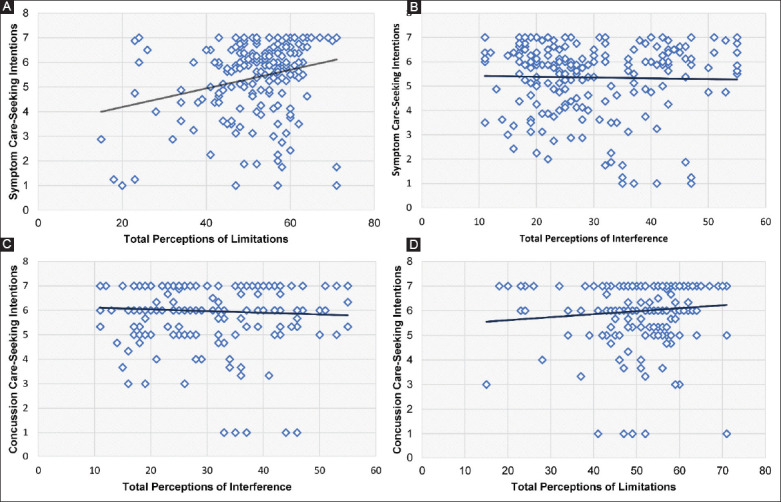
Females had significantly higher symptom care-seeking intentions (=0.04) and greater powerful other ratings (=0.04) than males. Non-contact student-athletes had significantly higher symptom care-seeking intentions (<0.00) compared to collision sport athletes. Coping, perceptions of limitations, perceptions of interference, and locus of control did not significantly predict symptom or concussion care-seeking intentions. There was a weak positive association between perceptions of limitations and symptom care-seeking intentions (r(198)=0.23, <0.01) and concussion care-seeking intentions (r(198)=0.15, <0.05).
We may not need to focus extensively on coping, perceptions of limitations, perceptions of interference, and locus of control ratings when creating concussion education since none of these variables significantly predicted care-seeking intentions.
Care-seeking intentions for concussion do not appear to be influenced largely by these variables.
疑似脑震荡后延迟寻求治疗的运动员可能会有更长的恢复时间。脑震荡寻求治疗的意愿可能受到几个研究较少的因素影响;应对方式、对限制的认知、对干扰的认知以及控制点。
本研究的目的是描述和比较应对方式、对限制的认知、对干扰的认知以及控制点,并确定这些变量是否会影响大学生运动员的症状及脑震荡寻求治疗的意愿。
大学生运动员(n = 204;女性占54.9%)报告了人口统计学信息(即性别、级别和接触程度)、症状及脑震荡寻求治疗的意愿、应对方式(积极应对、社交应对和回避应对)、对限制的认知、对干扰的认知以及控制点评分(内控、他人影响和机遇)。采用非参数统计方法比较各组间的所有结果(α = 0.05)。使用多元线性回归基于每个变量预测症状及脑震荡寻求治疗的意愿。Spearman等级相关补充回归模型。
女性的症状寻求治疗意愿(P = 0.04)和他人影响评分(P = 0.04)显著高于男性。与碰撞类运动项目的运动员相比,非接触类运动项目的运动员症状寻求治疗意愿显著更高(P < 0.00)。应对方式、对限制的认知、对干扰的认知以及控制点并不能显著预测症状或脑震荡寻求治疗的意愿。对限制的认知与症状寻求治疗意愿之间存在微弱的正相关(r(198) = 0.23,P < 0.01)以及与脑震荡寻求治疗意愿之间存在微弱的正相关(r(198) = 0.15,P < 0.05)。
在开展脑震荡教育时,我们可能无需过多关注应对方式、对限制的认知、对干扰的认知以及控制点评分,因为这些变量均未显著预测寻求治疗的意愿。
脑震荡的寻求治疗意愿似乎在很大程度上不受这些变量的影响。