Laboratoire d'Hématologie, Hôpital de la Timone, Assistance Publique - Hôpitaux de Marseille, Marseille, France.
Laboratoire SYNLAB Provence, Marseille, France.
Int J Lab Hematol. 2020 Dec;42(6):697-704. doi: 10.1111/ijlh.13278. Epub 2020 Jul 8.
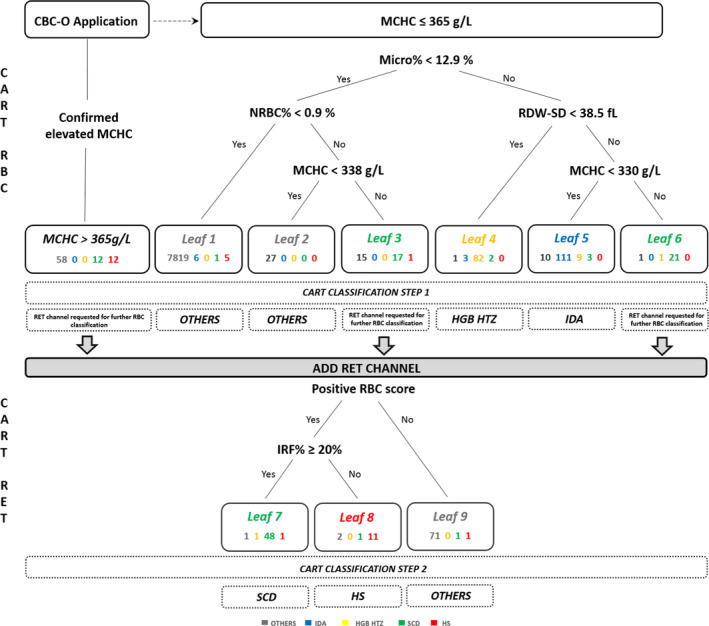
In daily practice in haematology laboratories, red blood cell (RBC) abnormalities are frequent and their management is a real challenge. The aim of this study is to establish a "decision tree" using RBC and reticulocyte parameters from the SYSMEX XN-10 analyser to distinguish between patients with a hereditary RBC disease from iron deficiency anaemia and other patients.
We analysed results of complete RBC counts in a cohort composed of 8217 adults divided into 5 different groups: iron deficiency anaemia (n = 120), heterozygous haemoglobinopathy (n = 92), sickle cell disease syndrome (n = 56), hereditary spherocytosis (n = 18) and other patients (n = 7931). A Classification And Regression Tree (CART) analysis was used to obtain a two-step decision tree in order to predict these previous groups.
Five parameters and the calculated RBC score were selected by the CART method: mean corpuscular haemoglobin concentration, percentage of microcytes, distribution width of the RBC histogram, percentage of nucleated red blood cells, immature reticulocytes fraction and finally RBC Score. When applying the tree and recommended flowchart, 158/166 of the RBC hereditary disease patients and 114/120 iron deficiency anaemia patients are detected. Overall, the correct classification rate reached 99.4%. Sensitivity and specificity for RBC disease detection were 95.2% and 99.9%, respectively. These results were confirmed in an independent validation cohort.
Based on the XN-10 RBC and reticulocyte parameters, we propose a two-step decision tree delivering a good prediction and classification of hereditary RBC diseases. These results can be used to optimize additional reticulocyte analysis and microscopy review.
在血液学实验室的日常实践中,常出现红细胞(RBC)异常,其管理是一个真正的挑战。本研究的目的是使用 SYSMEX XN-10 分析仪的 RBC 和网织红细胞参数建立一个“决策树”,以区分遗传性 RBC 疾病患者与缺铁性贫血和其他患者。
我们分析了由 8217 名成年人组成的队列的完整 RBC 计数结果,这些成年人分为 5 个不同组:缺铁性贫血(n=120)、杂合血红蛋白病(n=92)、镰状细胞病综合征(n=56)、遗传性球形红细胞增多症(n=18)和其他患者(n=7931)。使用分类和回归树(CART)分析获得两步决策树,以预测这些先前的组。
CART 方法选择了五个参数和计算的 RBC 评分:平均红细胞血红蛋白浓度、微细胞百分比、RBC 直方图分布宽度、有核红细胞百分比、未成熟网织红细胞分数和最终的 RBC 评分。当应用该树和推荐的流程图时,检测到 158/166 例 RBC 遗传性疾病患者和 114/120 例缺铁性贫血患者。总体而言,正确分类率达到 99.4%。RBC 疾病检测的灵敏度和特异性分别为 95.2%和 99.9%。这些结果在独立验证队列中得到了证实。
基于 XN-10 的 RBC 和网织红细胞参数,我们提出了一个两步决策树,可以很好地预测和分类遗传性 RBC 疾病。这些结果可用于优化额外的网织红细胞分析和显微镜复查。