MMWR Morb Mortal Wkly Rep. 2020 Jul 10;69(27):853-858. doi: 10.15585/mmwr.mm6927a1.
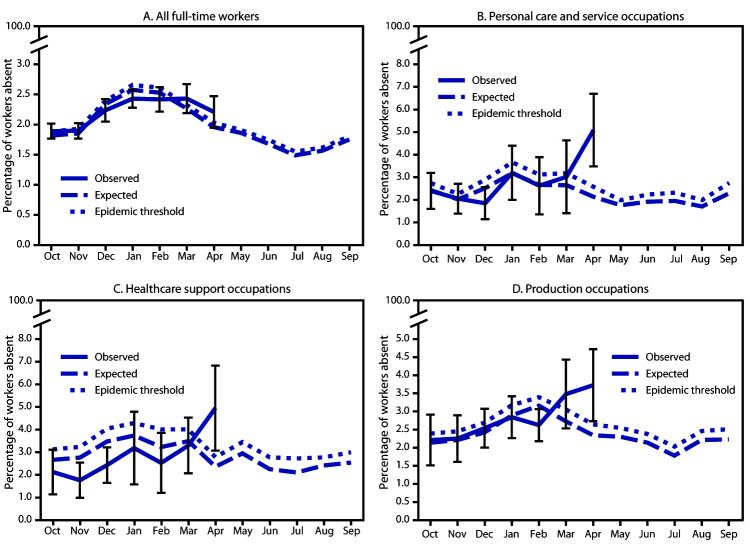
During a pandemic, syndromic methods for monitoring illness outside of health care settings, such as tracking absenteeism trends in schools and workplaces, can be useful adjuncts to conventional disease reporting (1,2). Each month, CDC's National Institute for Occupational Safety and Health (NIOSH) monitors the prevalence of health-related workplace absenteeism among currently employed full-time workers in the United States, overall and by demographic and occupational subgroups, using data from the Current Population Survey (CPS).* This report describes trends in absenteeism during October 2019-April 2020, including March and April 2020, the period of rapidly accelerating transmission of SARS-CoV-2, the virus that causes coronavirus disease 2019 (COVID-19). Overall, the prevalence of health-related workplace absenteeism in March and April 2020 were similar to their 5-year baselines. However, compared with occupation-specific baselines, absenteeism among workers in several occupational groups that define or contain essential critical infrastructure workforce categories was significantly higher than expected in April. Significant increases in absenteeism were observed in personal care and service (includes child care workers and personal care aides); healthcare support; and production** (includes meat, poultry, and fish processing workers). Although health-related workplace absenteeism remained relatively unchanged or decreased in other groups, the increase in absenteeism among workers in occupational groups less able to avoid exposure to SARS-CoV-2 (3) highlights the potential impact of COVID-19 on the essential critical infrastructure workforce because of the risks and concerns of occupational transmission of SARS-CoV-2. More widespread and complete collection of occupational data in COVID-19 surveillance is required to fully understand workers' occupational risks and inform intervention strategies. Employers should follow available recommendations to protect workers' health.
在大流行期间,在医疗保健环境之外监测疾病的综合征方法,例如跟踪学校和工作场所的缺勤趋势,可以作为传统疾病报告的有用辅助手段(1,2)。美国疾病预防控制中心(CDC)国家职业安全与健康研究所(NIOSH)每月使用当前人口调查(CPS)的数据监测美国目前在职的全职工人中与健康相关的工作场所缺勤率,总体以及按人口统计学和职业亚组进行监测*。本报告描述了 2019 年 10 月至 2020 年 4 月期间的缺勤趋势,包括 2020 年 3 月和 4 月,这是 SARS-CoV-2 传播迅速加速的时期,SARS-CoV-2 是导致 2019 年冠状病毒病(COVID-19)的病毒。总体而言,2020 年 3 月和 4 月与健康相关的工作场所缺勤率与 5 年基线相似。然而,与特定职业的基线相比,在几个职业群体中,定义或包含基本关键基础设施劳动力类别的工人的缺勤率明显高于预期。在个人护理和服务(包括儿童保育工作者和个人护理助手);医疗保健支持;和生产**(包括肉类,家禽和鱼类加工工人)中观察到缺勤率显著增加。尽管其他群体的与健康相关的工作场所缺勤率保持相对不变或减少,但由于 SARS-CoV-2 的职业传播的风险和担忧,无法避免接触 SARS-CoV-2 的职业群体中工人的缺勤率增加(3)突出了 COVID-19 对基本关键基础设施劳动力的潜在影响。为了全面了解工人的职业风险并为干预策略提供信息,需要在 COVID-19 监测中更广泛和更完整地收集职业数据。雇主应遵循现有的建议,以保护工人的健康。