Lin Jiayang, Zhang Peizhen, Huang Yan, Wei Xueyun, Guo Dan, Liu Jianfang, Liu Deying, Deng Yajuan, Xu Bingyan, Huang Chensihan, Yang Xiaoyu, Lu Yan, Jia Lijing, Zhang Huijie
Department of Endocrinology and Metabolism, Nanfang Hospital, Southern Medical University, Guangzhou, China.
Department of Endocrinology and Metabolism, Zhongshan Hospital, Fudan University, Shanghai, China.
Endocr Connect. 2020 Aug;9(8):783-792. doi: 10.1530/EC-20-0240.
Glycoprotein non-metastatic protein B (Gpnmb) has been identified as a new cytokine secreted by hepatocyte that plays an important role in balancing lipid homeostasis and development of obesity and metabolic disorders. However, information is not available regarding the association between circulating Gpnmb and hyperthyroid in humans.
We measured serum Gpnmb in 180 hyperthyroid patients and 82 healthy subjects that were recruited from the clinic. Of them, 46 hyperthyroid patients received thionamide treatment for 3 months.
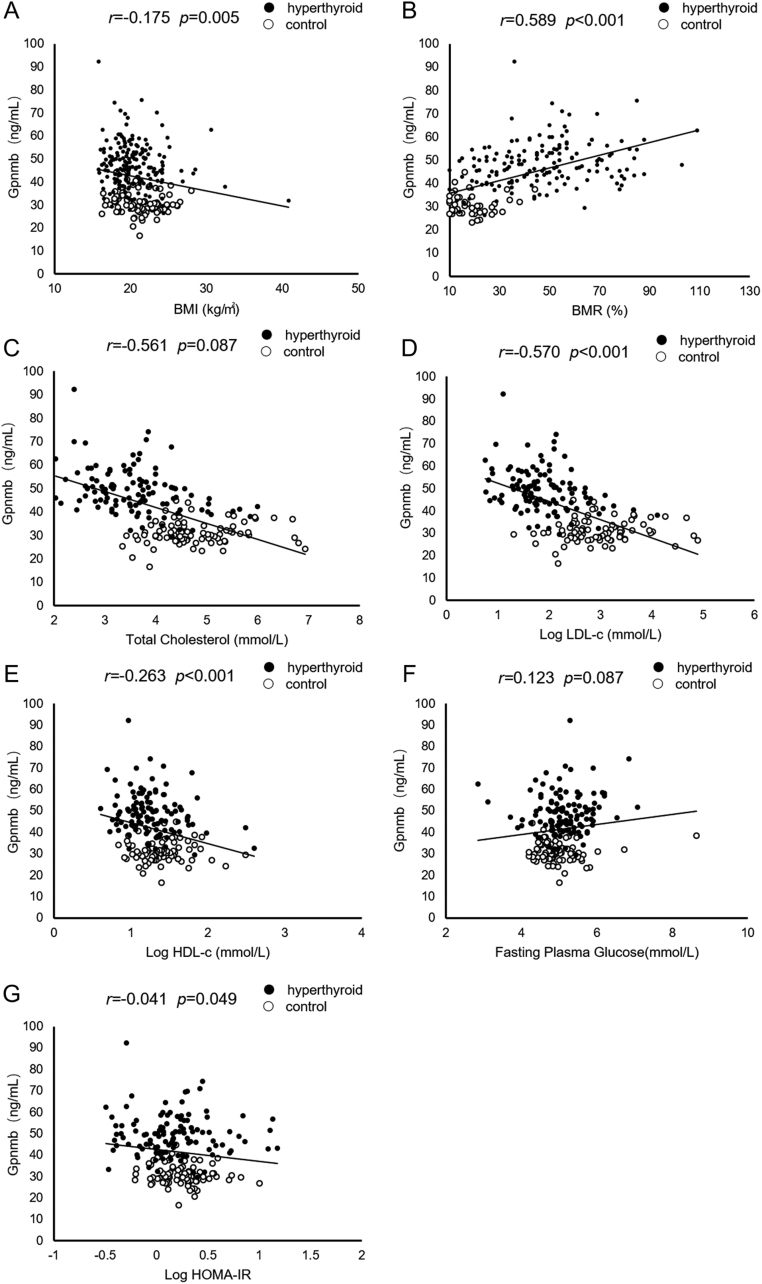
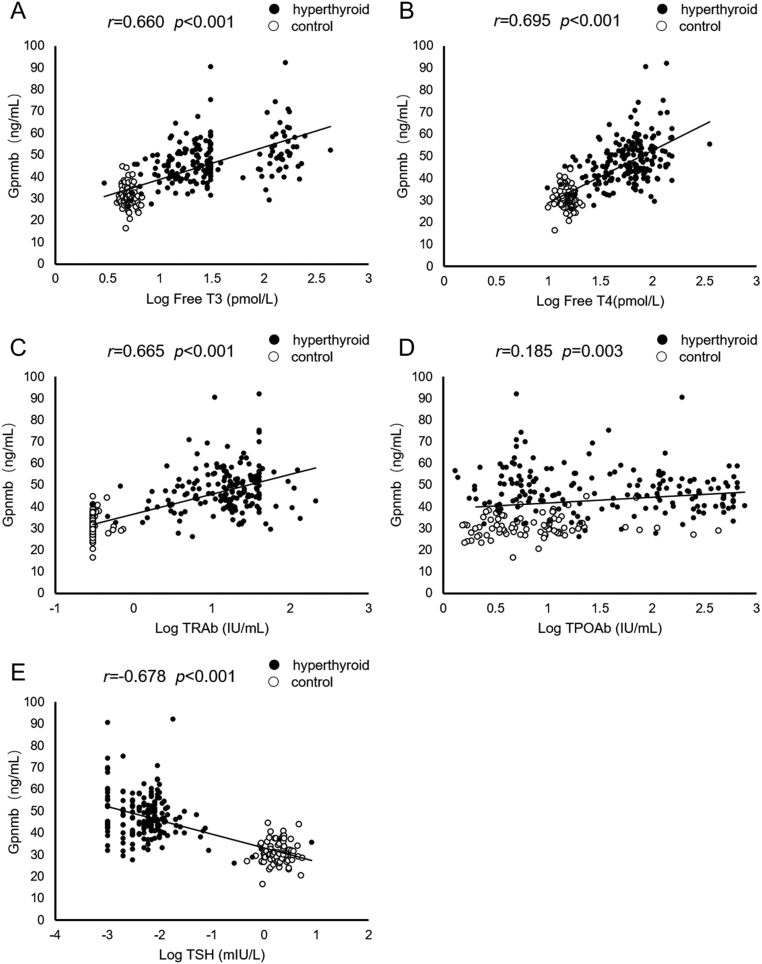
Hyperthyroid subjects had higher levels of circulating Gpnmb than healthy controls (47.8 ± 10.1 ng/mL vs 31.0 ± 4.9 ng/mL, P < 0.001). Subjects with higher levels of serum free triiodothyronine (T3) and free thyroxine (T4) had higher levels of circulating Gpnmb. After thionamide treatment, levels of circulating Gpnmb in hyperthyroid subjects remarkably declined with significant improvement of thyroid function (P < 0.001). Furthermore, the change of circulating Gpnmb levels was significantly associated with basal metabolic rate (BMR) and thyroid hormones, including free T3 and free T4, adjusting for age, gender, smoking and BMI before thionamide treatment. In multivariable logistic regression analyses, circulating Gpnmb was significantly associated with risks of hyperthyroidism (OR (95% CI): 1.44 (1.20-1.74), P < 0.001), adjusted for age, gender, BMI, fasting glucose, HOMA-IR, LDL-cholesterol, ALT and AST.
These findings indicate that circulating Gpnmb concentrations are independently associated with hyperthyroid, suggesting that circulating Gpnmb may be a predictor of risk for hyperthyroidism and can be used for therapeutic monitoring.
糖蛋白非转移性蛋白B(Gpnmb)已被鉴定为一种由肝细胞分泌的新细胞因子,在平衡脂质稳态以及肥胖和代谢紊乱的发展中发挥重要作用。然而,关于循环Gpnmb与人类甲状腺功能亢进之间的关联尚无相关信息。
我们测量了从诊所招募的180例甲状腺功能亢进患者和82例健康受试者的血清Gpnmb。其中,46例甲状腺功能亢进患者接受了硫酰胺类药物治疗3个月。
甲状腺功能亢进受试者的循环Gpnmb水平高于健康对照组(47.8±10.1 ng/mL对31.0±4.9 ng/mL,P<0.001)。血清游离三碘甲状腺原氨酸(T3)和游离甲状腺素(T4)水平较高的受试者循环Gpnmb水平也较高。硫酰胺类药物治疗后,甲状腺功能亢进受试者的循环Gpnmb水平显著下降,甲状腺功能明显改善(P<0.001)。此外,在调整硫酰胺类药物治疗前的年龄、性别、吸烟和体重指数后,循环Gpnmb水平的变化与基础代谢率(BMR)以及甲状腺激素,包括游离T3和游离T4显著相关。在多变量逻辑回归分析中,调整年龄、性别、体重指数、空腹血糖、稳态模型评估的胰岛素抵抗(HOMA-IR)、低密度脂蛋白胆固醇、谷丙转氨酶(ALT)和谷草转氨酶(AST)后,循环Gpnmb与甲状腺功能亢进风险显著相关(比值比(95%置信区间):1.44(1.20-1.74),P<0.001)。
这些发现表明,循环Gpnmb浓度与甲状腺功能亢进独立相关,提示循环Gpnmb可能是甲状腺功能亢进风险的预测指标,可用于治疗监测。