
分子动力学作为研究晶粒尺寸和应变速率对316L纳米晶不锈钢塑性变形影响的一种手段。
Molecular Dynamics as a Means to Investigate Grain Size and Strain Rate Effect on Plastic Deformation of 316 L Nanocrystalline Stainless-Steel.
作者信息
Husain Abdelrahim, La Peiqing, Hongzheng Yue, Jie Sheng
机构信息
State Key Laboratory of Advanced Processing and Recycling of Nonferrous Metals, Lanzhou University of Technology, Lanzhou 730050, China.
Department of physics, Faculty of science and technology, University of Shendi, Shendi P.O. Box 407, Sudan.
出版信息
Materials (Basel). 2020 Jul 20;13(14):3223. doi: 10.3390/ma13143223.
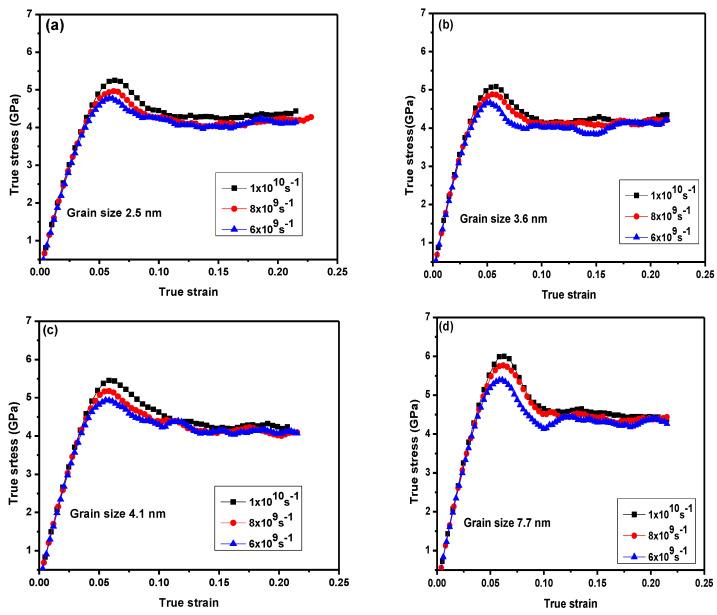
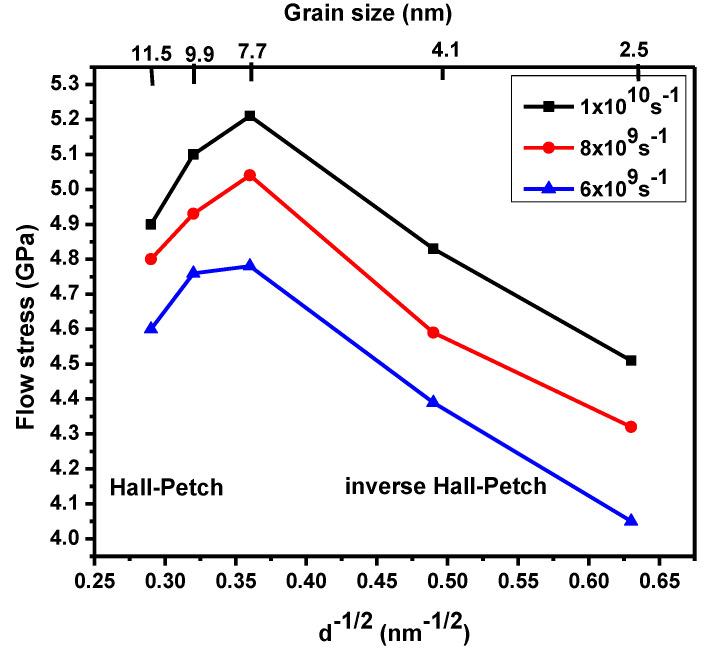
In the present study, molecular dynamics simulations were employed to investigate the effect of strain rate on the plastic deformation mechanism of nanocrystalline 316 L stainless-steel, wherein there was an average grain of 2.5-11.5 nm at room temperature. The results showed that the critical grain size was 7.7 nm. Below critical grain size, grain boundary activation was dominant (i.e., grain boundary sliding and grain rotation). Above critical grain size, dislocation activities were dominant. There was a slight effect that occurred during the plastic deformation mechanism transition from dislocation-based plasticity to grain boundaries, as a result of the stress rate on larger grain sizes. There was also a greater sensitive on the strain rate for smaller grain sizes than the larger grain sizes. We chose samples of 316 L nanocrystalline stainless-steel with mean grain sizes of 2.5, 4.1, and 9.9 nm. The values of strain rate sensitivity were 0.19, 0.22, and 0.14, respectively. These values indicated that small grain sizes in the plastic deformation mechanism, such as grain boundary sliding and grain boundary rotation, were sensitive to strain rates bigger than those of the larger grain sizes. We found that the stacking fault was formed by partial dislocation in all samples. These stacking faults were obstacles to partial dislocation emission in more sensitive stress rates. Additionally, the results showed that mechanical properties such as yield stress and flow stress increased by increasing the strain rate.
在本研究中,采用分子动力学模拟来研究应变速率对纳米晶316L不锈钢塑性变形机制的影响,其中室温下平均晶粒尺寸为2.5 - 11.5nm。结果表明,临界晶粒尺寸为7.7nm。低于临界晶粒尺寸时,晶界激活占主导(即晶界滑动和晶粒旋转)。高于临界晶粒尺寸时,位错活动占主导。由于较大晶粒尺寸上的应力速率,在塑性变形机制从基于位错的塑性向晶界转变过程中发生了轻微影响。较小晶粒尺寸对应变速率也比较大晶粒尺寸更敏感。我们选择了平均晶粒尺寸为2.5nm、4.1nm和9.9nm的316L纳米晶不锈钢样品。应变速率敏感性值分别为0.19、0.22和0.14。这些值表明,在塑性变形机制中,如晶界滑动和晶界旋转等小晶粒尺寸对应变速率比大晶粒尺寸更敏感。我们发现所有样品中均由部分位错形成了堆垛层错。这些堆垛层错在更敏感的应力速率下是部分位错发射的障碍。此外,结果表明,屈服应力和流动应力等力学性能随应变速率的增加而提高。




 Zotero 插件