Seer, Inc., Redwood City, CA, 94065, USA.
Broad Institute of MIT and Harvard, Cambridge, MA, 02142, USA.
Nat Commun. 2020 Jul 22;11(1):3662. doi: 10.1038/s41467-020-17033-7.
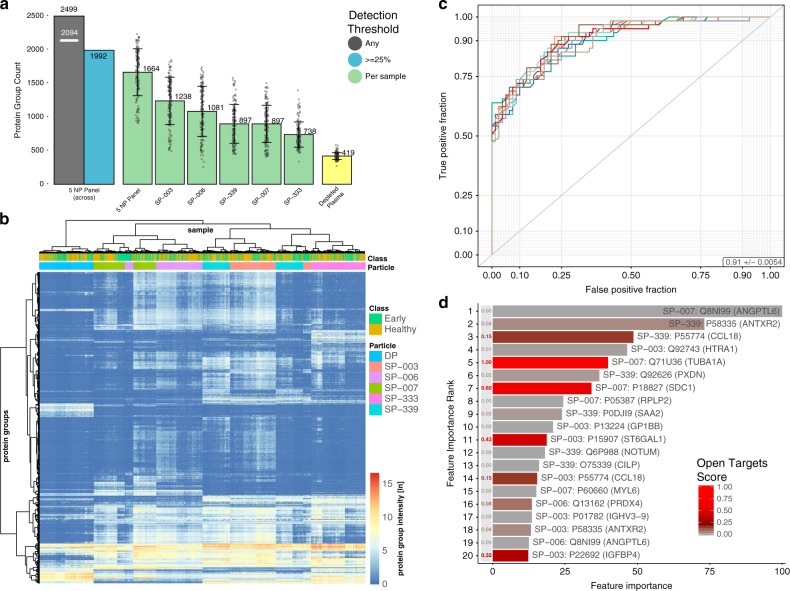
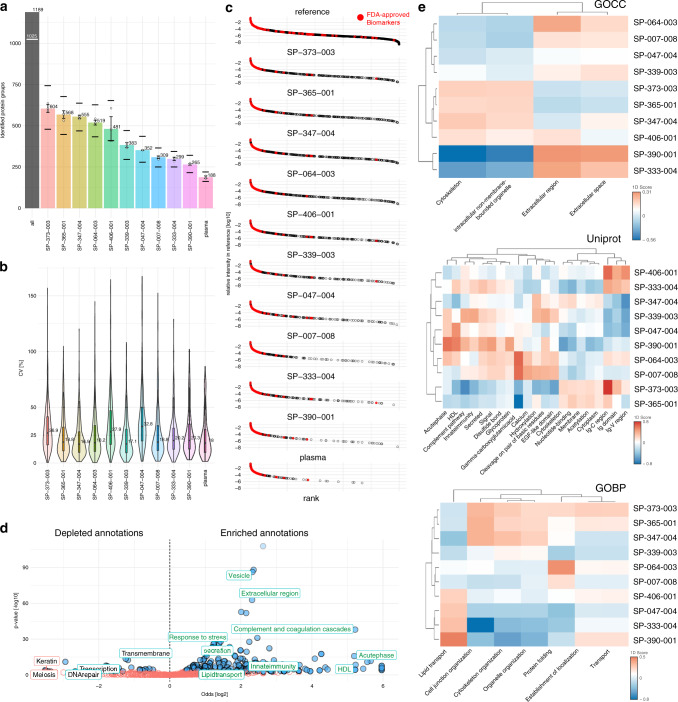
Large-scale, unbiased proteomics studies are constrained by the complexity of the plasma proteome. Here we report a highly parallel protein quantitation platform integrating nanoparticle (NP) protein coronas with liquid chromatography-mass spectrometry for efficient proteomic profiling. A protein corona is a protein layer adsorbed onto NPs upon contact with biofluids. Varying the physicochemical properties of engineered NPs translates to distinct protein corona patterns enabling differential and reproducible interrogation of biological samples, including deep sampling of the plasma proteome. Spike experiments confirm a linear signal response. The median coefficient of variation was 22%. We screened 43 NPs and selected a panel of 5, which detect more than 2,000 proteins from 141 plasma samples using a 96-well automated workflow in a pilot non-small cell lung cancer classification study. Our streamlined workflow combines depth of coverage and throughput with precise quantification based on unique interactions between proteins and NPs engineered for deep and scalable quantitative proteomic studies.
大规模、无偏的蛋白质组学研究受到血浆蛋白质组复杂性的限制。在这里,我们报告了一个高度并行的蛋白质定量平台,该平台将纳米颗粒(NP)蛋白质冠与液相色谱-质谱联用,用于有效的蛋白质组学分析。蛋白质冠是纳米颗粒与生物流体接触时吸附在其上的蛋白质层。改变工程化 NP 的物理化学性质会导致不同的蛋白质冠模式,从而实现对生物样本的差异化和可重复的检测,包括对血浆蛋白质组的深度采样。加标实验证实了线性信号响应。中值变异系数为 22%。我们筛选了 43 种 NP,并选择了 5 种 NP 组成的面板,使用 96 孔自动化工作流程,对 141 个血浆样本进行了试点非小细胞肺癌分类研究,检测到 2000 多种蛋白质。我们的简化工作流程将深度覆盖和高通量与基于蛋白质与 NP 之间的独特相互作用的精确定量相结合,NP 是为深度和可扩展的定量蛋白质组学研究而设计的。