Vermehren Charlotte, Søgaard Nielsen Regitze, Jørgensen Steffen, Drastrup Anne Mette, Westergaard Niels
Department of Clinical Pharmacology, Bispebjerg Hospital, University of Copenhagen, Bispebjerg Bakke 23, 2400 Copenhagen, Denmark.
Department of Pharmacy, Section for Social and Clinical Pharmacy, Faculty of Health and Medical Sciences, University of Copenhagen, Universitetsparken 2, 2100 Copenhagen, Denmark.
J Pers Med. 2020 Jul 31;10(3):78. doi: 10.3390/jpm10030078.
Polypharmacy is most prevalent among the elderly population and in particular among nursing home residents. The frequency of the use of drugs with pharmacogenomics (PGx)-based dosing guidelines for CYP2D6, CYP2C9, CYP2C19 and SLCO1B1 were measured among nursing home residents in the Capital Region of Denmark as well as drug-drug interactions. The aim was to evaluate the potential of applying PGx-test as a supportive tool in medication reviews.
Drug use among nursing home residents during 2017-2018 in the Capital Region of Copenhagen, for drugs with PGx-based dosing guidelines available through the PharmGKB website, were measured. Drug-drug interactions were scored in severity by using drug interaction checkers.
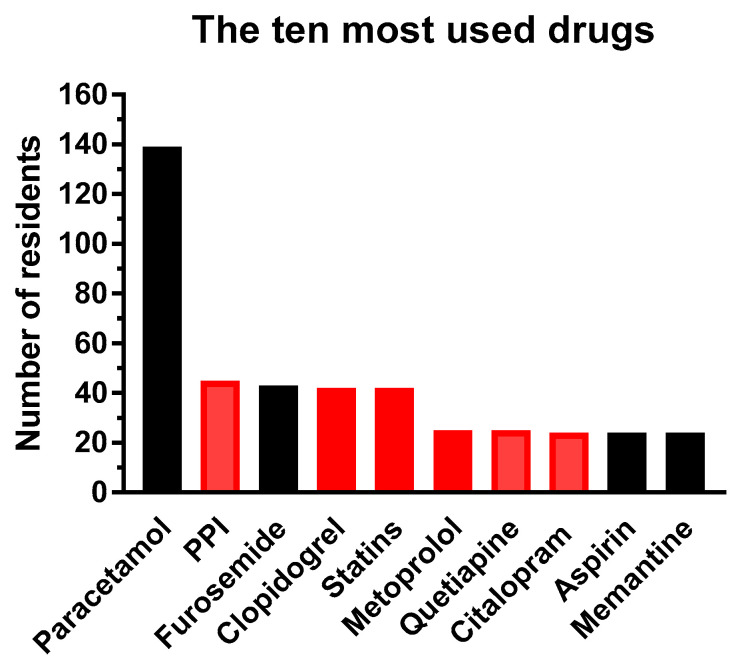
The number of residents using drugs with PGx-based actionable dosing guidelines (AG) were 119 out of 141 residents (84.3%). Of these 119 residents, 87 residents used drugs with AG for CYP2C19, 47 residents for CYP2D6, and 42 residents for SLCO1B1. In addition, 30 residents used two drugs with an AG for CYP2C19, and for CYP2D6, it was only seven residents. The most used drugs with AG were clopidogrel (42), pantoprazole (32), simvastatin (30), metoprolol (25), and citalopram (24). The most frequent drug interactions found with warnings were combinations of proton pump inhibitors and clopidogrel underscoring the potential for phenoconversion.
this study clearly showed that the majority of the nursing home residents were exposed to drugs or drug combinations for which there exist PGx-based AG. This indeed supports the notion of accessing and accounting for not only drug-gene but also drug-drug-gene interactions as a supplement to medication review.
多重用药在老年人群中最为普遍,尤其是在养老院居民中。在丹麦首都地区的养老院居民中,测量了使用基于药物基因组学(PGx)的CYP2D6、CYP2C9、CYP2C19和SLCO1B1给药指南的药物使用频率以及药物相互作用情况。目的是评估应用PGx检测作为药物审查辅助工具的潜力。
对2017 - 2018年哥本哈根首都地区养老院居民中可通过PharmGKB网站获取基于PGx给药指南的药物使用情况进行了测量。使用药物相互作用检查器对药物相互作用的严重程度进行评分。
在141名居民中,有119名居民(84.3%)使用了基于PGx的可操作给药指南(AG)的药物。在这119名居民中,87名居民使用了针对CYP2C19的AG药物,47名居民使用了针对CYP2D6的AG药物,42名居民使用了针对SLCO1B1的AG药物。此外,30名居民使用了两种针对CYP2C19的AG药物,而针对CYP2D6,只有7名居民。使用AG最多的药物是氯吡格雷(42例)、泮托拉唑(32例)、辛伐他汀(30例)、美托洛尔(25例)和西酞普兰(24例)。发现的最常见有警示的药物相互作用是质子泵抑制剂和氯吡格雷的组合,突出了表型转化的可能性。
本研究清楚地表明,大多数养老院居民接触到了存在基于PGx的AG的药物或药物组合。这确实支持了不仅要考虑药物 - 基因相互作用,还要考虑药物 - 药物 - 基因相互作用,作为药物审查补充的观点。