Department of Preventive Services, School of Public Health, Kyoto University, Kyoto, 606-8501, Japan.
Department of Primary care and Emergency Medicine, Graduate School of Medicine, Kyoto University, Kyoto, Japan.
Scand J Trauma Resusc Emerg Med. 2020 Aug 5;28(1):75. doi: 10.1186/s13049-020-00765-2.
There is limited information on the predictive accuracy of commonly used predictors, such as lactate, pH or serum potassium for the survival among out-of-hospital cardiac arrest (OHCA) patients with hypothermia. This study aimed to identify the predictive accuracy of these biomarkers for survival among OHCA patients with hypothermia.
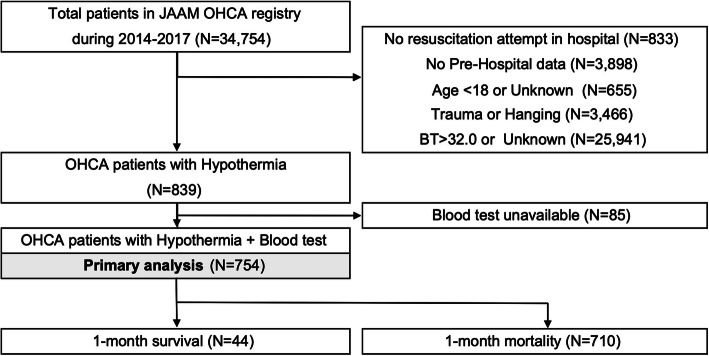
In this retrospective analysis, we analyzed the data from a multicenter, prospective nationwide registry among OHCA patients transported to emergency departments in Japan (the JAAM-OHCA Registry). We included all adult (≥18 years) OHCA patients with hypothermia (≤32.0 °C) who were registered from June 2014 to December 2017 and whose blood test results on hospital arrival were recorded. We calculated the predictive accuracy of pH, lactate, and potassium for 1-month survival.
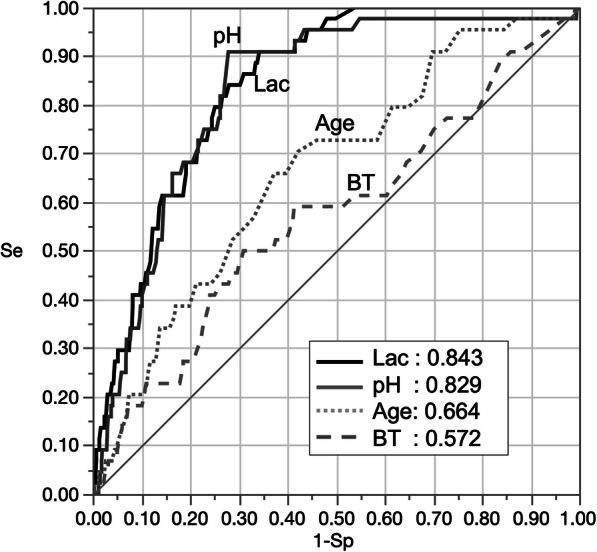
Of the 34,754 patients in the JAAM-OHCA database, we included 754 patients from 66 hospitals. The 1-month survival was 5.8% (44/754). The areas under the curve of the predictors and 95% confidence interval were as follows: pH 0.829 [0.767-0.877] and lactate 0.843 [0.793-0.882]. On setting the cutoff points of 6.9 in pH and 120 mg/dL (13.3 mmol/L) in lactate, the predictors had a high sensitivity (lactate: 0.91; pH 0.91) and a low negative likelihood ratio (lactate: 0.14; pH 0.13), which are suitable to exclude survival to 1 month. Furthermore, in additional analysis that included only the patients with potassium values available, a cutoff point of 7.0 (mmol/L) for serum potassium had high sensitivity (0.96) and a low negative likelihood ratio (0.09).
This study indicated the predictive accuracy of serum lactate, pH, and potassium for 1-month survival among adult OHCA patients with hypothermia. These biomarkers may help define a more appropriate resuscitation strategy.
目前关于常用预测因子(如乳酸、pH 值或血清钾)对低温性院外心脏骤停(OHCA)患者生存率的预测准确性的信息有限。本研究旨在确定这些生物标志物对低温性 OHCA 患者生存率的预测准确性。
在这项回顾性分析中,我们分析了来自日本多中心、前瞻性全国 OHCA 患者登记处(JAAM-OHCA 登记处)的数据。我们纳入了所有在 2014 年 6 月至 2017 年 12 月期间登记的成年(≥18 岁)低温(≤32.0°C)OHCA 患者,且其入院时的血液检测结果有记录。我们计算了 pH 值、乳酸和钾对 1 个月生存率的预测准确性。
在 JAAM-OHCA 数据库的 34754 例患者中,我们纳入了来自 66 家医院的 754 例患者。1 个月生存率为 5.8%(44/754)。预测因子的曲线下面积和 95%置信区间如下:pH 值 0.829 [0.767-0.877]和乳酸值 0.843 [0.793-0.882]。将 pH 值的截定点设为 6.9 和乳酸值的 120mg/dL(13.3mmol/L)时,预测因子具有较高的敏感性(乳酸:0.91;pH 值:0.91)和较低的负似然比(乳酸:0.14;pH 值:0.13),适合排除 1 个月的生存率。此外,在仅纳入有血清钾值的患者的额外分析中,血清钾值的截定点为 7.0(mmol/L)时具有较高的敏感性(0.96)和较低的负似然比(0.09)。
本研究表明,血清乳酸、pH 值和钾对低温性成人 OHCA 患者 1 个月生存率具有预测准确性。这些生物标志物可能有助于确定更合适的复苏策略。