Li Feng, Dai Bo, Ni Xiquan
Department of Nephrology, Heze Mudan People's Hospital, Heze, Shandong China.
Department of Nephrology, Liaocheng People's Hospital, Liaocheng, Shandong China.
Diabetol Metab Syndr. 2020 Aug 6;12:68. doi: 10.1186/s13098-020-00574-8. eCollection 2020.
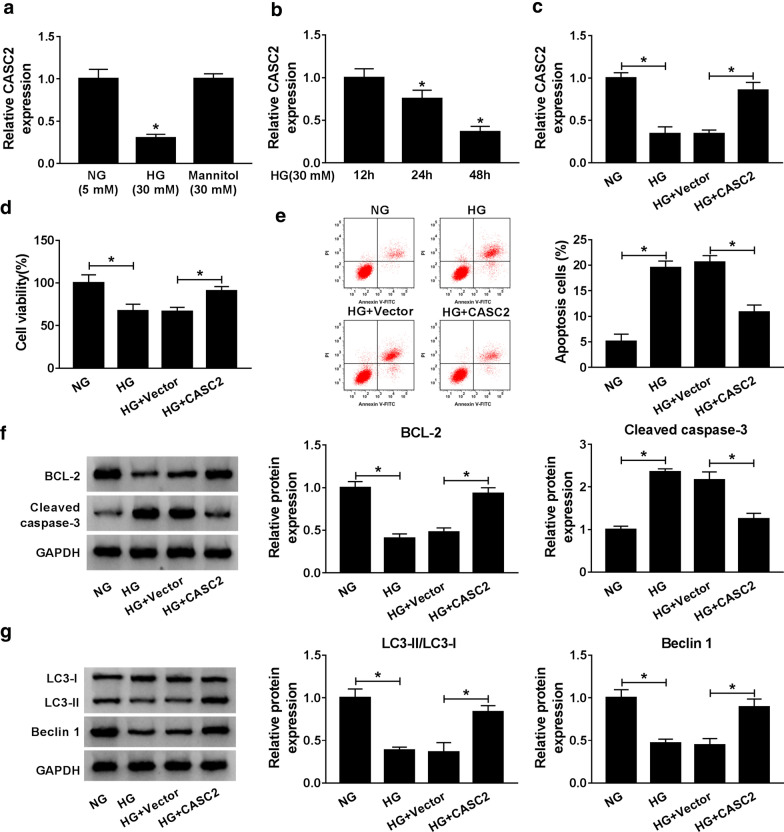
High glucose (HG) induced podocytes injury plays an important role in diabetes nephropathy (DN) development. Long noncoding RNA cancer susceptibility candidate 2 (CASC2) was found to be decreased in serum of DN patients. We aimed to explore the function and possible mechanism of CASC2 in HG induced podocytes injury.
Under normal glucose (NG), HG and mannitol stimulated podocyte conditions, the levels of CASC2, microRNA-9-5p (miR-9-5p) and peroxisome proliferator-activated receptor gamma (PPARγ) were examined by quantitative real-time polymerase chain reaction (qRT-PCR). Podocyte injury was evaluated by measuring cell viability and apoptosis of CIHP-1 cells were checked by cell counting kit-8 (CCK-8) assay and flow cytometry, respectively. Western blot was used to detect all protein levels. Dual-luciferase reporter, RNA immunoprecipitation (RIP) and RNA pull-down assays were performed to confirm the relationship between CASC2 and miR-9-5p.
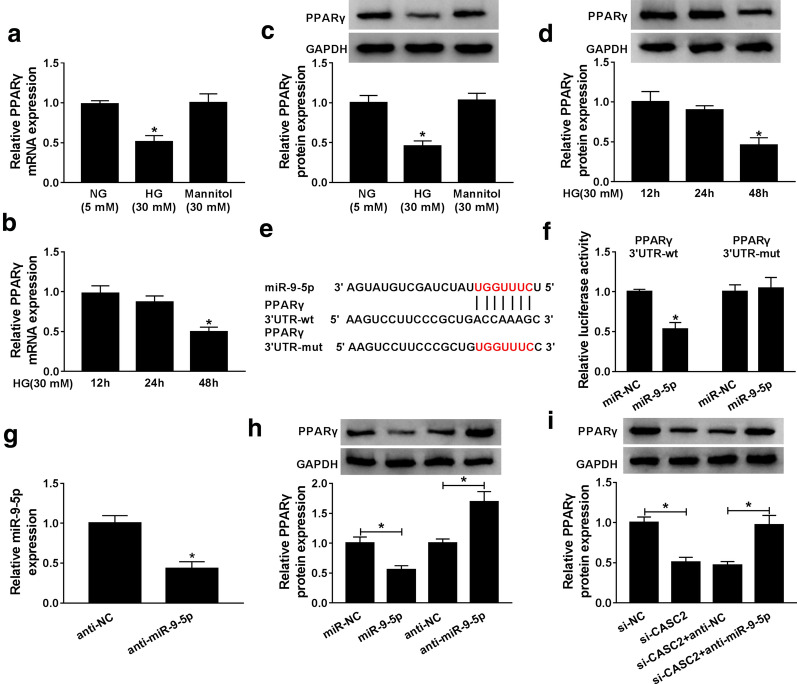
HG stimulation inhibited the expression levels of CASC2 and PPARγ, but promoted the expression of miR-9-5p. HG could restrain cell viability, autophagy and facilitate apoptosis in CIHP-1 cells, while CASC2 overexpression could reverse HG-induced podocytes injury. Furthermore, CASC2 could be used as a ceRNA to adsorb miR-9-5p, and miR-9-5p mimic overturned the effects of CASC2 on cell viability, autophagy and apoptosis in HG-stimulated podocytes. Additionally, PPARγ was a target gene of miR-9-5p, and CASC2 could weaken the HG-induced podocytes injury by up-regulating PPARγ.
CASC2 increased cell viability, autophagy and inhibited cell apoptosis by regulating miR-9-5p/PPARγ axis, thus reducing the HG-induced podocytes injury.
高糖(HG)诱导的足细胞损伤在糖尿病肾病(DN)的发展中起重要作用。研究发现,长链非编码RNA癌症易感性候选基因2(CASC2)在DN患者血清中表达降低。我们旨在探讨CASC2在HG诱导的足细胞损伤中的作用及可能机制。
在正常葡萄糖(NG)、HG和甘露醇刺激足细胞的条件下,采用定量实时聚合酶链反应(qRT-PCR)检测CASC2、微小RNA-9-5p(miR-9-5p)和过氧化物酶体增殖物激活受体γ(PPARγ)的水平。分别通过细胞计数试剂盒-8(CCK-8)法和流式细胞术检测细胞活力和CIHP-1细胞凋亡情况,以评估足细胞损伤。采用蛋白质印迹法检测所有蛋白质水平。进行双荧光素酶报告基因、RNA免疫沉淀(RIP)和RNA下拉实验,以证实CASC2与miR-9-5p之间的关系。
HG刺激抑制了CASC2和PPARγ的表达水平,但促进了miR-9-5p的表达。HG可抑制CIHP-1细胞的细胞活力和自噬,并促进其凋亡,而CASC2过表达可逆转HG诱导的足细胞损伤。此外,CASC2可作为竞争性内源RNA(ceRNA)吸附miR-9-5p,miR-9-5p模拟物可逆转CASC2对HG刺激的足细胞的细胞活力、自噬和凋亡的影响。此外,PPARγ是miR-9-5p的靶基因,CASC2可通过上调PPARγ减轻HG诱导的足细胞损伤。
CASC2通过调节miR-9-5p/PPARγ轴增加细胞活力、自噬并抑制细胞凋亡,从而减轻HG诱导的足细胞损伤。